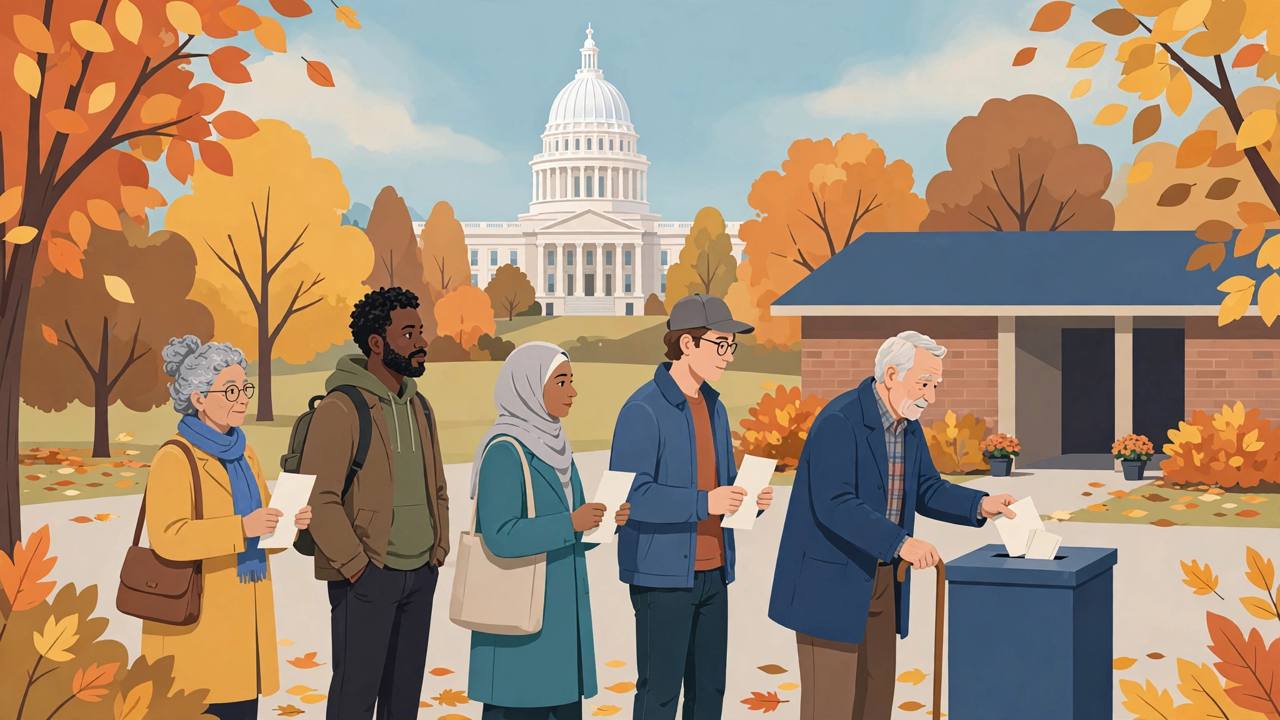
When Virginia voters finish casting their ballots on Tuesday, November 3, they will decide far more than who represents them in Congress. Three separate amendments to the Constitution of Virginia are on the ballot — one protecting reproductive health decisions including abortion, one removing the constitution's ban on same-sex marriage, and one making voting-rights restoration automatic for people released from prison — and Governor Abigail Spanberger spent the final days of the campaign on the road urging voters to approve all three, including a stop on Thursday, October 30, at the Jubilee Family Development Center in Lynchburg.
Source: NewsAdvance reporting via WiseVoter, Oct. 31, 2026
Turnout is already high before a single Election Day vote is cast. More than 1.3 million Virginians had voted early by late October, roughly 350,000 more than the early-voting total from the 2022 congressional midterms, and Saturday, October 31, is the final day of in-person early voting. Supporters of the amendments say the measures may themselves be driving part of that turnout: each one writes into the state constitution a right that currently rests on statutes, court rulings or the personal discretion of a governor.
Source: Virginia Mercury / VPM reporting via Warren County, Oct. 30, 2026
Question 1 — reproductive freedom
The first amendment would ensure the right to make one's own decisions about reproductive health care, including access to abortion, contraception and fertility treatments. Under the amendment's terms, the state could still place restrictions on abortion access during the third trimester of pregnancy — except when the patient's life or physical or mental health is at risk, or when the fetus is not viable. Supporters, including health-equity advocates such as Birth in Color who campaigned alongside the governor in Lynchburg, argue the amendment closes gaps in reproductive care for underserved communities by putting the protection beyond the reach of a future legislature.
Question 2 — marriage equality
The second amendment repeals the provision in Virginia's constitution that defines marriage as only a union between one man and one woman, and requires equal treatment under the law of a lawful marriage between two adult persons regardless of sex, gender or race. Same-sex marriage has been legal across the United States since the U.S. Supreme Court's 2015 ruling, but the old text remains in Virginia's constitution; supporters say removing it matters because a state constitution should not carry a ban that a future court fight could revive.
Question 3 — voting rights, restored automatically
The third amendment is the one with the longest paper trail. Its ballot text asks voters to amend the constitution to declare a fundamental right to vote, to provide that a person convicted of a felony loses the vote only during incarceration and is automatically invested with the right to vote upon release, and to replace the current disqualification for people 'adjudicated to be mentally incompetent' with a narrower one covering only people a court finds lack the capacity to understand the act of voting — with rights returning once that capacity is restored. Today, restoration runs through the governor's office: a person who has finished a sentence must petition, and each governor decides. Spanberger has argued Virginia is among the worst states in the country at restoring rights to people who have completed their sentences, and the amendment's sponsor, Delegate Elizabeth Bennett-Parker, has called the petition system a relic of the 1902 constitution. A version of the legislation was carried in past years by Republican Delegate Mike Cherry as well, and it passed the General Assembly in two successive sessions, as Virginia law requires, before reaching voters.
Source: Ballotpedia summary via PoliAlert, Oct. 2026
The human stakes are already visible in this election. More than 200,000 Virginians regained their voting rights after a court ruled earlier this year, in litigation involving the Campaign Legal Center, that they never should have lost them under a Reconstruction-era law; Spanberger restored the rights of about 60,000 more people over the summer. For some of them, November 3 will be a first vote — among them Seychell Williams, who told reporters this will be her first time voting and that she is excited to do it. The campaign for Question 3, led by the Virginia Right to Vote Coalition with the ACLU of Virginia, the League of Women Voters and The Sentencing Project, has raised about $679,000, against about $10,500 raised by committees opposing it, according to Ballotpedia's figures.
In the campaign's final week, the governor's existing restoration process itself became an argument. Republican Delegate Tom Garrett demanded an investigation after a constituent in Goochland County received an official rights-restoration certificate addressed to his dog — a beagle-hound mix that died about five years ago — following a similar Chesapeake case involving a certificate for a person listed with no last name. Those reports, circulated by Republican critics in the last days of October, are claims about administrative errors in the petition-based system; the governor's office response was not detailed in the reporting reviewed. Both sides are using the episode: opponents say it shows sloppy vetting, supporters of Question 3 say a petition system that produces paper errors is exactly why restoration should be automatic by law.
How these amendments got here — and the one that did not survive
Spanberger signed the referendum legislation on February 6, sending four amendments toward the voters. The fourth, on mid-decade redistricting, went to an April special election and was approved — but the Supreme Court of Virginia later nullified that result, ruling 4-3 that because early voting in the November 4, 2025 election was already under way when the legislature first voted on the redistricting amendment, the constitutional sequence had not been followed. The three amendments on Tuesday's ballot are not affected by that ruling: all three received their initial approval during the 2025 regular legislative session. One legal fight does hang over Question 1: opponents including the Association of American Physicians and Surgeons, the Virginia Medical Freedom Alliance and Bluefield council member Meagan Kade sued on April 30, arguing the ballot language is misleading; the other two referendums face no current legal challenge.
Source: Virginia Independent News, 2026
What it means for Virginia's Punjabi and South Asian families
Virginia is home to one of the East Coast's larger Punjabi and South Asian communities, concentrated around Richmond and Northern Virginia, with gurdwaras, trucking and small-business networks woven through both regions. Constitutional amendments do not ask anyone's background — they apply to every voter the same way — but two of Tuesday's questions touch daily life directly: Question 1 governs what health-care decisions families can make with their doctors, and Question 3 decides whether a neighbour, employee or family member with an old felony conviction gets the vote back automatically on release or must petition the governor and wait. Community organisations that run voter-registration drives at gurdwaras and cultural events have treated this ballot as a turnout election: with early voting already 350,000 ballots ahead of 2022, the marginal voters campaigns are chasing this weekend are disproportionately first-time and newly restored voters.
What happens next
Polls close on Tuesday, November 3, and each amendment needs only a simple majority of voters to change the constitution. If Question 3 passes, automatic restoration replaces the petition system for people released from incarceration; if it fails, restoration stays where it has always been — in the governor's office, one application at a time. Results will be certified after Election Day, and the amendments' supporters and opponents alike say the same thing about Tuesday: with control of Congress also on the ballot in a midterm year, the constitutional questions will be decided by whoever actually shows up.