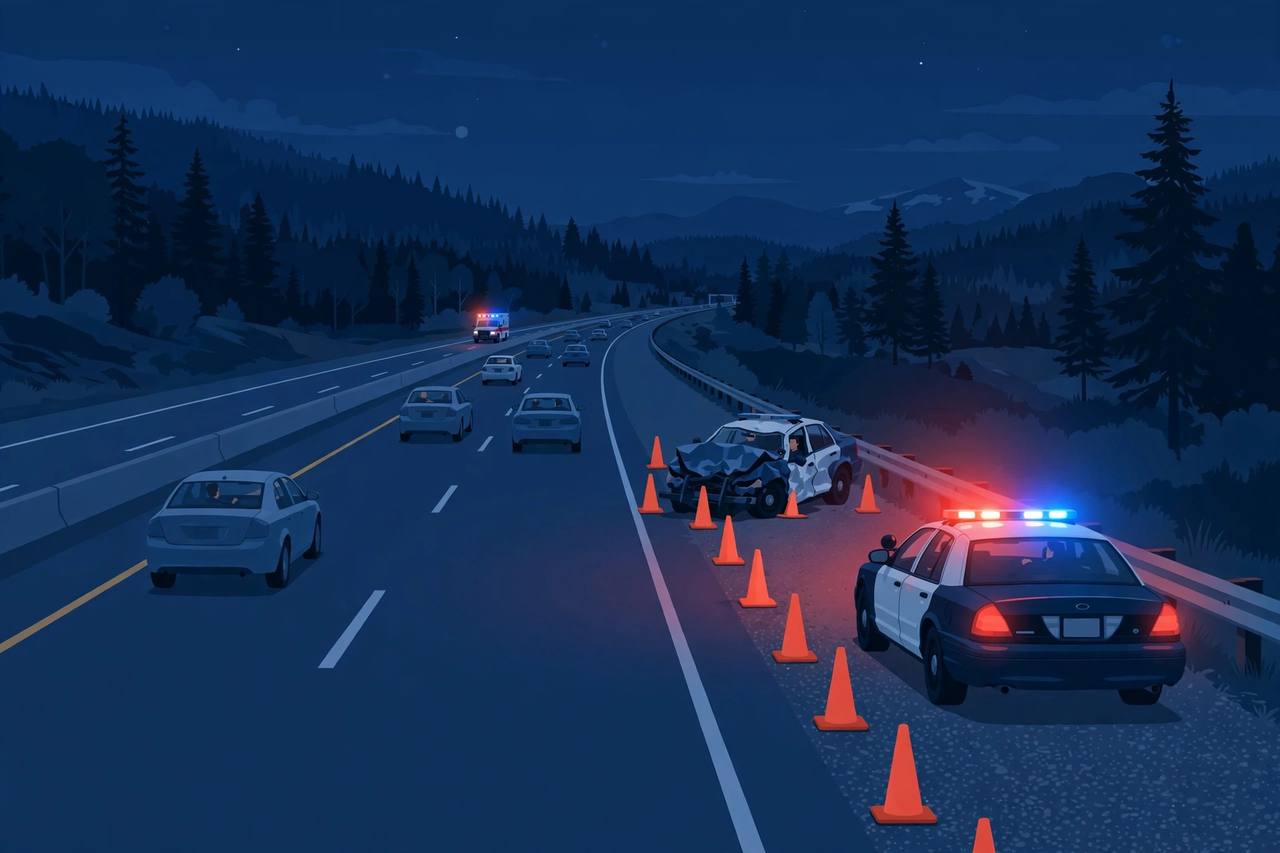
A man suspected of driving under the influence crashed into a Washington State Patrol trooper's patrol car on Interstate 5 near Des Moines on Sunday, November 1, and three people were taken to hospital, according to reporting by The Seattle Times. KOMO News reported that a passenger in the suspect's vehicle was seriously injured, and KIRO 7 reported that the driver was arrested after the crash. The DUI allegation is a suspicion stated by the patrol and the outlets reporting it — the driver has not been convicted of anything, and the accounts published by Monday morning did not name him or detail the charges in full.
Source: The Seattle Times, Nov 1, 2026 (summary via Seattle Courant)
Des Moines is a King County city on the east shore of Puget Sound, between Seattle and Tacoma, and the stretch of I-5 through it is one of the busiest in Washington — the main north-south freeway for the Seattle-Tacoma corridor, the airport traffic for Sea-Tac and the freight moving between the ports, the warehouses of the Kent Valley and the rest of the West Coast. A patrol car struck on that freeway is not a local curiosity: it is the latest entry in a pattern the State Patrol itself quantified three days before this crash.
Source: KOMO News, Nov 1-2, 2026 (summary via Seattle Courant)
What the first reports do — and do not — say
The reports published on Sunday and early Monday agree on the core facts: a suspected DUI driver, a State Patrol car struck on I-5 near Des Moines, the driver arrested, three people hospitalised and a passenger seriously injured. They do not yet say at what hour the crash happened, whether the trooper was inside the patrol car or outside it, which hospital or hospitals the injured were taken to, or what the arrested driver is charged with beyond the suspicion of DUI. Those details normally come from the State Patrol's own collision release, and Awaaz Punjab will update this story when it is published rather than fill the gaps with guesswork.
Source: KOMO News, Nov 1-2, 2026 (summary via Seattle Courant)
Every reference in this story to DUI is to a suspicion reported by KOMO News, The Seattle Times and KIRO 7, attributed to the Washington State Patrol's account of the crash. A DUI arrest in Washington begins a court process; it is not a conviction. The driver had not been publicly named in the reports reviewed on Monday morning.
The pattern behind one crash: 64 patrol cars struck in nine months
On Thursday, October 29 — three days before the Des Moines crash — the Washington State Department of Transportation and the State Patrol published figures that read like a warning label for exactly this kind of night. In the first nine months of 2026, 64 WSP patrol units were struck while troopers were conducting traffic enforcement or collision investigations, and 19 troopers were injured in those collisions. Between vehicle damage and ordinary wear, the patrol must replace on average one patrol unit with a new model every business day of the year. WSDOT's Incident Response Team, whose trucks work the same shoulders, saw a 40% increase in calls for service between 2024 and 2025 — from 43,800 incidents to 61,400.
Source: Washington State Department of Transportation and Washington State Patrol, Oct 29, 2026
The enforcement numbers behind the risk are just as large. Between January and September 2026, WSP contacted 9,200 drivers for DUI, 32,400 drivers for distracted driving and 93,400 drivers for aggressive driving, the agencies said. And the danger is not limited to troopers: according to the National Institute for Occupational Safety and Health, cited by WSDOT, the fatality rate for tow-truck drivers is nearly 15 times higher than that of other jobs. Northwest Region Incident Response supervisor Dennis Smith put the roadside reality bluntly in the same release: “It doesn't become a matter of if you're going to be hit, it's when,” adding that it is not uncommon for one of his drivers to be struck four, five or six times during a career.
Source: Washington State Department of Transportation and Washington State Patrol, Oct 29, 2026
Crash Responder Safety Week starts the next morning
The timing gives this crash a policy frame as well as a police one. Crash Responder Safety Week runs Monday, November 2 to Friday, November 6, with more than 22 states taking part, and WSDOT marked it by offering free Traffic Incident Management training for responders on Monday from 10 a.m. to 2 p.m. and ride-alongs with its Incident Response drivers through the week. The week exists because of the trend in the figures above: the people who stop on freeway shoulders to work crashes — troopers, WSDOT crews, tow operators, firefighters — are being hit at a rate their own agencies call alarming.
Source: Washington State Department of Transportation and Washington State Patrol, Oct 29, 2026
The law every driver on I-5 is supposed to follow: Move Over, Slow Down
Washington's Move Over, Slow Down law is the rule written for the exact scene near Des Moines. Drivers must move over one lane, if possible, and slow down when passing emergency crews on highway shoulders. If moving over is not possible — because of traffic or a single lane — drivers must still slow to at least 10 mph below the posted speed limit when passing. The law covers far more than police and fire vehicles: it also applies to WSDOT Incident Response trucks, highway maintenance vehicles, tow trucks, solid-waste trucks and utility vehicles displaying flashing lights. A driver passing a stopped patrol car at full freeway speed, one lane unchanged, is breaking that law whether or not a crash follows.
Source: Washington State Department of Transportation and Washington State Patrol, Oct 29, 2026
Why it matters for truckers — and what happens next
I-5 through King County is a working corridor for the region's Punjabi trucking and warehouse workforce as much as for commuters: it links the Port of Seattle and Port of Tacoma, the Kent Valley distribution centres and the Canadian border crossing at Blaine, and it is driven at every hour by drivers for whom a stopped patrol car, a tow truck or a WSDOT crew on the shoulder is a daily sight. The professional rule and the legal rule are the same — move over, slow down, and treat every lit shoulder as a workplace, because it is one. What happens next in the Des Moines case is procedural: the State Patrol's investigation and collision release, the arrested driver's first court steps on the suspected DUI, and updates on the condition of the seriously injured passenger and the other two people taken to hospital. None of those details had been published in the reports reviewed on Monday morning, and this story will be updated when the patrol releases them.
Source: The Seattle Times, Nov 1, 2026 (summary via Seattle Courant)