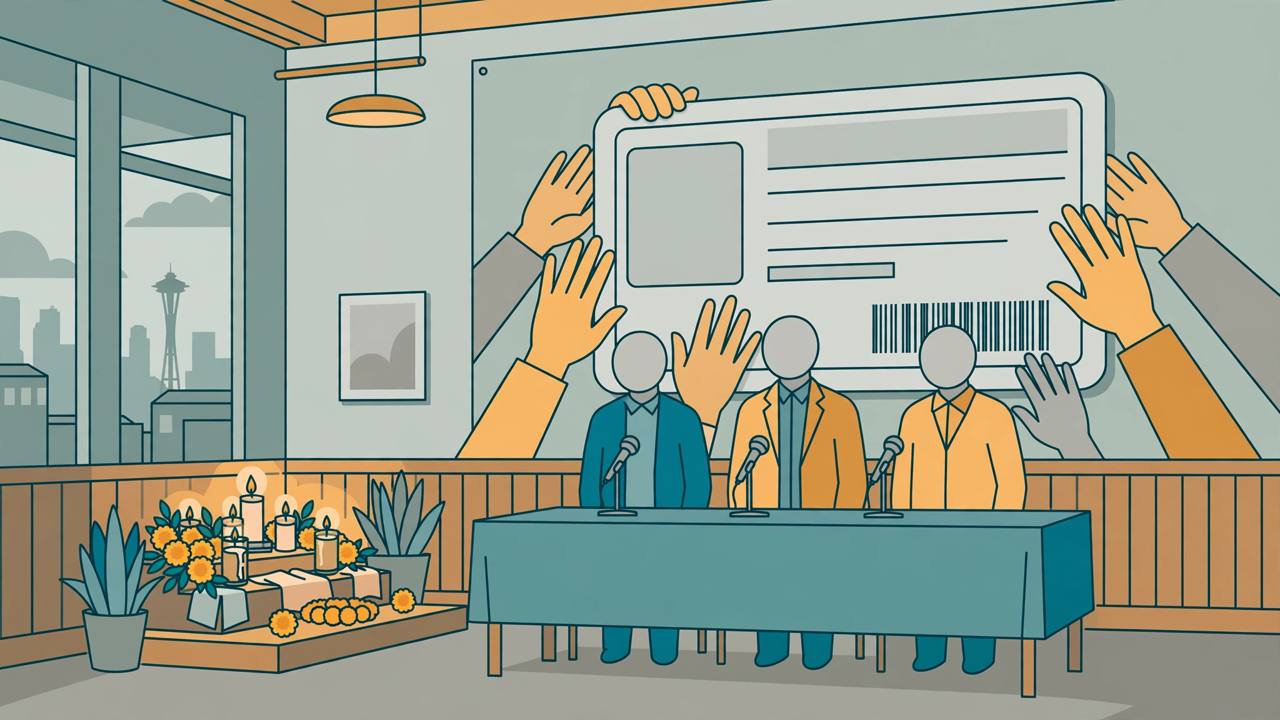
SEATTLE, Washington — “The surge is here,” Roxana Norouzi, executive director of OneAmerica, told a news conference at Casa Latina in Seattle on Tuesday, October 27. “It is happening right now, right here, in our home in Washington State.” Immigrant families, community members and advocates had gathered at the Latino community organisation's hall to make a specific demand of their state government: stop Washington's Department of Licensing (DOL) from sharing drivers' information with federal immigration authorities, and do it while a surge of U.S. Immigration and Customs Enforcement (ICE) activity is moving through the Seattle area — South Seattle and South King County in particular, where residents have shared footage of arrests in Burien and White Center, including an agent seen carrying a rifle, KING 5 reported.
Source: South Seattle Emerald
The human centre of the room was Alondra Miranda Garcia. Her father was detained on October 17 and is being held at the Northwest ICE Processing Center in Tacoma, she said. He has no criminal record and has lived in the United States for more than 20 years. He was on his way to a plumbing job in Burien when he was stopped by two unmarked vehicles and detained by immigration authorities. “In an instant, our family's world was shattered,” Miranda Garcia said, breaking down as she spoke. “Now we are left wondering when we will see him again, and we worry about his well-being. We miss his presence in our home.” After the conference she said the family tries not to miss work because they still have to sustain themselves; they have raised more than $10,000 through a GoFundMe fundraiser and plan bake sales to raise more. Her father, she said, is surviving “as much as he can.”
An altar in the middle of the room
At the centre of the hall stood an altar — candles, skulls, food and papel picado, the colourful cut-paper banners of Día de los Muertos — carrying the names and photographs of immigrants who have been detained or who have died in ICE custody. Community members placed marigolds beside a scroll of names; the Emerald, citing the ACLU, reported that more than 50 people have died in ICE custody during President Donald Trump's second term. Speaker Savong Lam described what the raids leave behind: “When an aggressive hunt sweeps through our neighborhood, no one is left untouched. It traumatizes children who come home to not seeing their parents, destabilizes local workplaces, fractures our schools, and shatters the trust that keeps every community safe.” Among the recently detained, speakers said, were a refugee from Laos, a 19-year-old student about to start her freshman year at the University of Washington, and caregivers who provide round-the-clock care to seniors and people with disabilities.
The demand: cut the data pipeline
The advocates' demands were aimed at Olympia as much as at Washington, D.C.: keep funding and support flowing to immigrant communities who fear deportation; stop the state from sharing data with immigration authorities; and end the use of surveillance technology against their communities. They also gave practical advice to neighbours — stay informed, attend legal clinics, contact an attorney, prepare a family emergency plan, and store documents in a safe place. The Washington State Standard reported the same day that volunteers, among them Chris Megargee at a Home Depot in Shoreline, are helping day labourers — many of them noncitizens — learn their rights if ICE agents come. “We're here to demand change, and there is real change needed,” Norouzi said. “We can't guarantee anyone's safety anymore. … We have to fight back and fight for the future we want, and that's what we're doing every day.”
This conference was the latest chapter of a fight this site has tracked through the autumn. Researchers at the University of Washington's Center for Human Rights documented that federal immigration authorities continued to reach Washington's licensing data through Nlets, a national data-sharing system — queries that bypass the state's own safeguards. Their updated count linked driver-data searches to at least 356 immigration arrests, up from 64 verified cases over about a year as of July — a fivefold jump in three months, as Awaaz Punjab reported earlier in October. The governor's office has said the state blocked nearly 2,000 information requests, largely from Customs and Border Protection, and disabled 16 agency identifiers it determined were being used for civil immigration enforcement. Governor Bob Ferguson has said the state is working to limit federal access for immigration enforcement while preserving access needed for public safety. The researchers' answer is that the gaps remain: “When you cut off one pathway, you squeeze a balloon, and another bubbles out,” said Angelina Godoy, the centre's director — including, the report notes, access routed through data brokers such as LexisNexis. Organiser Guillermo Rivera, who helped compile the report, has put the ask plainly: review how the information is collected and shared, find the gaps or misuse, and “use his authority to protect Washington residents” — now, not next session.
Source: University of Washington Center for Human Rights
The Seattle conference also landed on top of a national escalation. In recent weeks, the Emerald reported, ICE leadership told agents to ramp up daily immigration arrests — to detain 1,000 more people a day, according to CNN's reporting. Norouzi pointed to money as well as orders: in 2025 the Department of Homeland Security, which oversees ICE, received $170.7 billion in funding under H.R. 1, the American Immigration Council has calculated. “[ICE] is way more organized, and they're way more cruel,” she said. “The cruelty, the violence, the lengths that they're willing to go to, and the scale feels very different this time around.” Washington's own history cuts the other way: it was the first state, in 1993, to let noncitizens obtain driver's licences and insurance, and its Keep Washington Working Act restricts state agencies from exchanging information with immigration authorities — the very protections advocates say the data routes are quietly defeating.
A driver's licence is not optional for a trucker or a tradesperson — it is the job. The Washington fight is about whether the information a state collects to licence its drivers can be searched to locate and arrest them. With deputized local officers making a growing share of immigration arrests at traffic stops nationally, what Olympia decides about its data will be felt at every roadside stop in the state — including by Punjabi drivers who cross Washington's highways daily.
What happens next
No new state decision was announced at Casa Latina. The pressure now sits with Governor Ferguson and the Department of Licensing: advocates want a full review of how driver information is collected and shared, every federal access route — direct, through other agencies' accounts, and through data brokers — audited and closed to civil immigration enforcement, and a public accounting to the families affected. The state's stated position so far is the one the governor's office gave the researchers: requests blocked, identifiers disabled, work continuing to limit access while preserving genuine public-safety uses. For families like Miranda Garcia's, the next milestone is not in Olympia at all — it is in Tacoma, where her father remains in detention at the Northwest ICE Processing Center, and where his case, like hundreds of others this autumn, will be decided one hearing at a time.