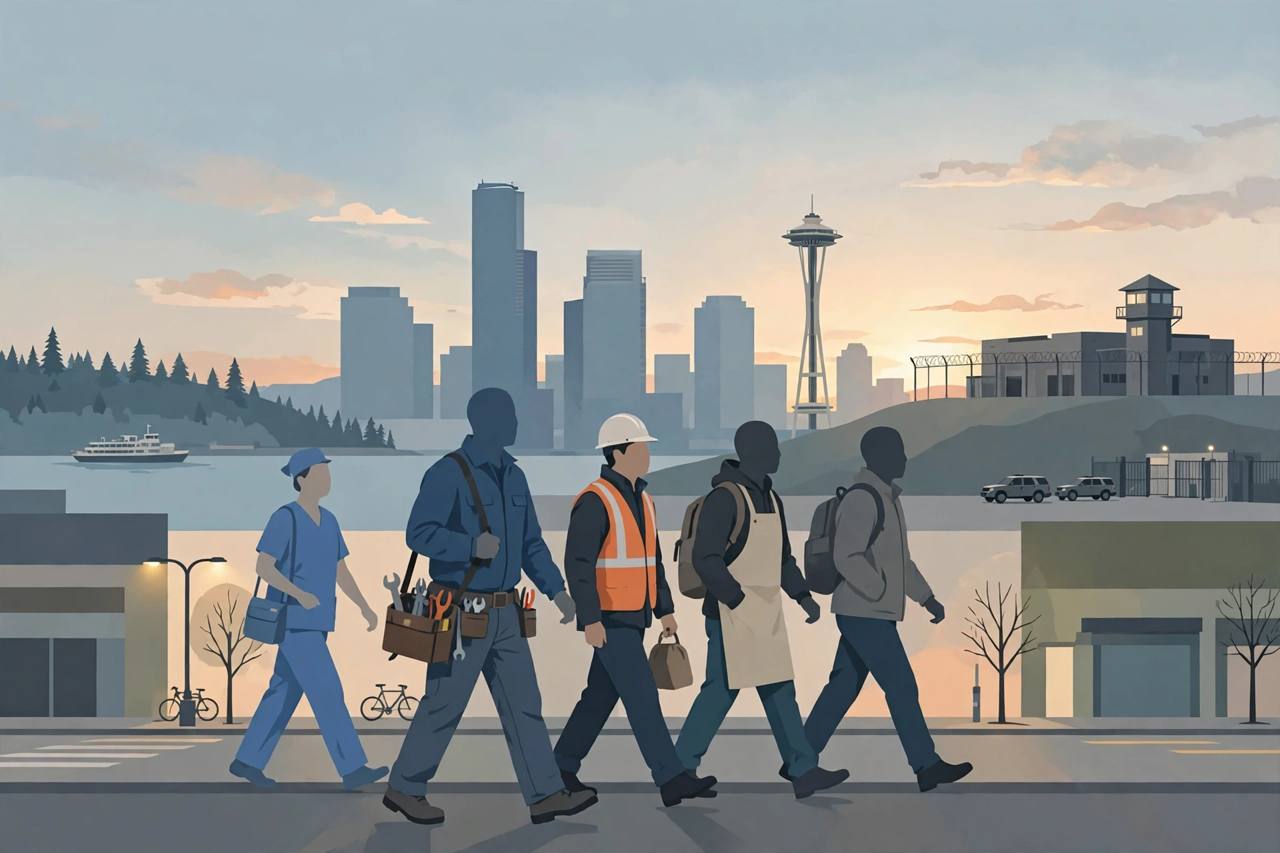
Immigrant, labour and civil-rights groups in Washington state say a federal immigration enforcement surge has now reached workplaces and work journeys across the state — and they brought the workers' stories to a news conference in Seattle to prove it. "The surge is here," Roxana Norouzi, executive director of OneAmerica, said at the October 27 news conference at Casa Latina in Seattle, where more than a half-dozen organisations asked state officials to cut off immigration agents' remaining routes into Washington driver and vehicle records and to fund help for families left behind when a worker is detained.
Source: The Seattle Times, via The Spokesman-Review, Oct. 27, 2026
The cases the advocates described were not border crossings or courthouse arrests. A father from Federal Way was stopped on his way to a plumbing job. Two home caregivers represented by the union SEIU 775 were detained — one of them in the middle of a shift. A volunteer told the news conference that about half a dozen men have been detained since January around a single Home Depot in Shoreline. The pattern the groups allege is enforcement aimed at ordinary working days: the drive to a job, a break at a convenience store, a routine check-in with immigration authorities.
Source: Washington State Standard, via The Columbian, Oct. 27, 2026
Stopped on the way to a plumbing job in Normandy Park
Alondra Miranda Garcia told the news conference that her father, who lives in Federal Way, was stopped in Normandy Park early on October 17 while driving to a plumbing job. He is being held at the Northwest ICE Processing Center in Tacoma. "He's a hardworking, humble man who has spent over 23 years building a life centered around his family," she said, according to the Seattle Times. The South Seattle Emerald reported that she said he has no criminal record — a detail advocates stressed because it matches what the arrest data show for most people picked up on the street.
Source: South Seattle Emerald, Oct. 27, 2026
Two caregivers detained — and a client left without round-the-clock care
Lucy Vazquez-Martinez, field director at SEIU 775, which represents home-care workers, described two detained caregivers. One went to a convenience store in the middle of a shift and was detained there. The other was detained at a check-in with immigration authorities. The human cost landed on a third person who was never arrested at all: a client who needs round-the-clock care went without care for several days and had to be hospitalised, Vazquez-Martinez said. "We need you to act and slow down this mass deportation and detention machine," she told state officials, the Washington State Standard reported.
Source: Washington State Standard, via The Columbian, Oct. 27, 2026
Chris Megargee, a volunteer at a Shoreline Home Depot, told the news conference that ICE has detained about half a dozen men there since January, and that he believes agents ran the licence plates on their cars to find them. That belief is the bridge between the individual stories and the data fight at the centre of this story: how federal agents find Washington workers in the first place.
Source: Washington State Standard, via The Columbian, Oct. 27, 2026
The numbers behind the surge: about 700 arrests a month
ICE arrested roughly 700 people in Washington in each of June and July, according to KUOW's analysis of records obtained from the Department of Homeland Security through Freedom of Information Act requests by the Deportation Data Project, run by the University of California, Berkeley and UCLA. That compares with an average of about 342 arrests a month in the four months before, OPB reported. KUOW found that most people arrested on the street had no criminal record. Advocates say the arrests have kept coming since the summer data end.
Source: KUOW, analysis of Deportation Data Project records
How a licence plate can become an arrest: the DMV-to-DHS pipeline
Many of those arrests start with a licence plate, the advocates and researchers say. The University of Washington Center for Human Rights has verified 356 cases from August 2025 through October 13, 2026, in which immigration arrests followed federal searches of state Department of Licensing data through Nlets, a national network police use to share driver records. Its October report, titled Stopping the DMV-to-DHS Data Pipeline, concludes that Washington's steps to curb that access "have been ineffective." The background matters for every driver in the state: Washington issues driver's licences regardless of immigration status, and the 2019 Keep Washington Working Act bars sharing nonpublic personal information with immigration authorities in civil matters — yet the university's verified cases say the searches, and then the arrests, continued through other accounts and routes.
Source: University of Washington Center for Human Rights, October 2026 report
Governor Bob Ferguson said Washington has blocked ICE accounts from searching Nlets. "There are only a handful of states that have taken this step, and Washington is one of them," he said in a statement. Other federal agencies still have access, however, and the State Patrol says it blocked more than 174,000 federal search attempts from November 2025 through October 12 — while UW researchers say agents switch to other accounts when one is cut off. Ferguson spokesperson Brionna Aho said the office is reviewing whether it can lawfully require judicial warrants for civil immigration requests, and that shutting off access entirely is not an option for public-safety reasons.
Force, fear — and the other side of the record
Asked about force used in arrests, the Department of Homeland Security said its officers "are trained to use the minimum amount of force necessary." The agency did not address any of the Washington cases in that response and offered no records for them. Palmira Figueroa of the King County Immigrant and Refugee Commission said, as an allegation from the advocates' side, that rapid responders have watched agents display pepper spray and guns and that some people have been seriously hurt. "If this is what happens when we're watching, when we're taking video, what is happening when we're not?" she said. Those competing accounts — the department's training assurance and the advocates' eyewitness claims — are both on the record; neither was independently adjudicated in the reporting.
Why this matters to Punjabi and trucking readers in Washington
Washington's Punjabi community is concentrated in the Seattle-Tacoma corridor and in farming and trucking work across the state — jobs that depend, every single day, on a driver's licence, a vehicle registration and a clean run to work. A system in which a licence-plate search can precede an arrest on the way to a job is therefore not an abstract privacy debate for those readers: it touches the plumber stopped in Normandy Park, the caregiver detained mid-shift, and any driver whose licence was issued under Washington's status-blind licensing law. The advocates' specific asks — close the remaining data routes and fund help for families left behind — would decide how much of that exposure remains.
What happens next
The governor's office says its review of a judicial-warrant requirement for civil immigration data requests is still under way, and the university centre says it will keep publishing monthly updates on licensing-data searches, so the next verified numbers will show whether the blocked accounts slowed the pipeline or merely rerouted it. The Federal Way plumber remains, on the family's account, at the Northwest ICE Processing Center in Tacoma, and the detained caregivers' cases move through immigration proceedings. No new state law was announced at the October 27 news conference — what the groups left Seattle with was a public record, a set of demands, and arrest figures the state will now have to answer month by month.