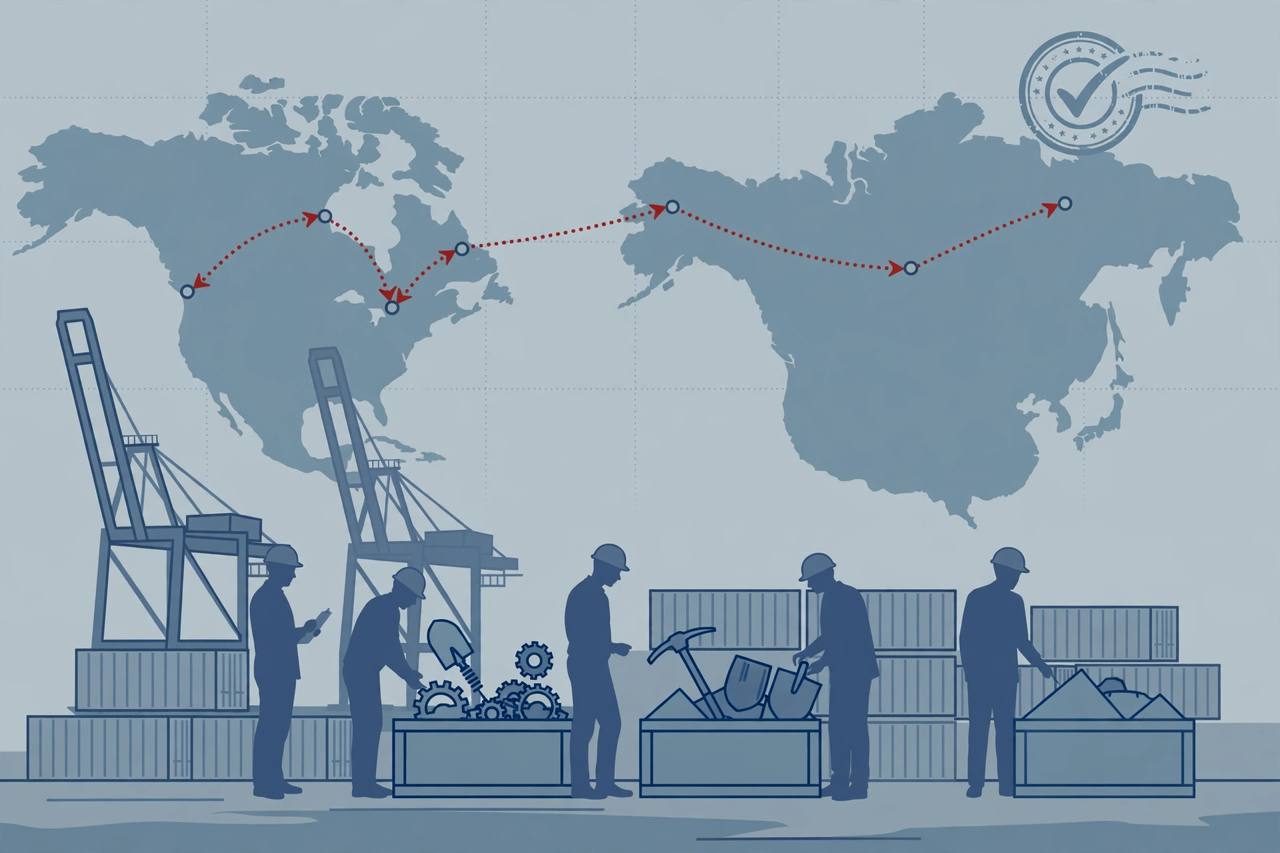
A 53-year-old Seattle man was arrested on the morning of Tuesday, October 27, 2026, on a 12-count federal indictment accusing him of conspiring to ship restricted mining and other equipment to Russia through straw-buyer companies in Turkey, Korea and Kazakhstan, the U.S. Attorney's Office for the Western District of Washington announced. Ilya Pankov, also known as Ilia Pankov, appeared in U.S. District Court in Seattle the same day and pleaded not guilty.
Source: U.S. Department of Justice, Western District of Washington
Independent reporting by Bytes Europe confirmed the same core facts: the 12-count indictment, the not-guilty plea in Seattle, the January 4, 2027 trial date, the four shipments identified in 2023 and 2024, and at least $225,000 allegedly laundered through accounts connected to Pankov's company.
Source: Bytes Europe
Who Pankov is, and the company at the centre of the case
According to the indictment, Pankov is a principal and the registered agent of Pacific Route Inc., a procurement company established in 2008 and incorporated in Washington state that also does business as Pacific Terminals. The company exports construction and mining equipment. Prosecutors allege Pankov used that business as the vehicle for the scheme. These are allegations in an indictment, not findings of guilt, and Pankov is presumed innocent unless proven guilty beyond a reasonable doubt.
What prosecutors say happened, step by step
The indictment alleges that in February and March 2022, after the United States expanded restrictions on goods that could be exported to Russia following Russia's invasion of Ukraine, Pankov conspired with others to keep shipping goods to Russian companies by first sending them to companies in Korea, Turkey or Kazakhstan, which then sent the goods on to Russia. Prosecutors say that routing was chosen specifically to evade U.S. export-control laws and to ship export-controlled mining and other equipment without the required licence and authorisation.
In furtherance of the alleged scheme, Pankov and others are accused of filing false Electronic Export Information and misrepresenting whether a licence was needed for an export. The indictment identifies four shipments in 2023 and 2024 that prosecutors say were illegally exported.
The indictment identifies two communications in 2024 in which Pankov allegedly submitted false statements to U.S. Customs and Border Protection about two shipments that had been seized for sanctions violations. Prosecutors allege he falsely claimed a straw-buyer company in Korea was the end user, when he knew the items were headed to Russian companies by way of Korea.
Prosecutors also allege that at least $225,000 in proceeds from the illegal sales was laundered through bank accounts connected with Pacific Route Inc. Acting U.S. Attorney Charles Neil Floyd said, as quoted by the Justice Department: 'As alleged in the indictment, Mr. Pankov conspired with others to find ways to send restricted items to a variety of companies in Russia, and then lied about it to export regulators. The email exchanges capture in real time the ways they worked to subvert the export control system while they openly discussed using these third-party business in other countries to break the law.'
Acting Homeland Security Investigations Seattle Special Agent in Charge April Miller said the 12 counts are 'wide ranging, but all tied into our core mission of investigating the illegal movement of people, goods, money, contraband, weapons and sensitive technology into, out of and through the United States,' and that HSI will continue to investigate anyone who circumvents U.S. law in those areas.
The charges and the maximum penalties, count by count
The Justice Department lists the exposure this way: conspiracy is punishable by up to five years in prison; unlawful exporting of goods by up to 20 years; smuggling goods from the United States by up to 10 years; making false statements by up to five years; and conspiracy to commit money laundering by up to 20 years. A judge would determine any actual sentence if there is a conviction, taking the facts and federal guidelines into account.
Background: why mining equipment to Russia is restricted
After Russia's full-scale invasion of Ukraine in 2022, the United States sharply expanded export controls on industrial, mining and other equipment that could support Russia's industrial and military base. Exporters must obtain licences for controlled items, file truthful Electronic Export Information, and must not route goods through third countries to conceal the true end user. Cases like this one are part of a continuing federal effort to police exactly that kind of transshipment through intermediary countries.
What happens next
Pankov has pleaded not guilty. His trial is scheduled before U.S. District Judge Tana Lin on January 4, 2027, in Seattle. The case is being investigated by Homeland Security Investigations and prosecuted by Assistant U.S. Attorney Rachel Yemini in collaboration with the Counterintelligence and Export Control Section of the Justice Department's National Security Division. For readers in Washington's large Punjabi and South Asian trading and trucking communities, the practical lesson is direct: export paperwork, end-user statements and third-country routing are criminal-law issues, not paperwork formalities, when the true destination is a sanctioned country.