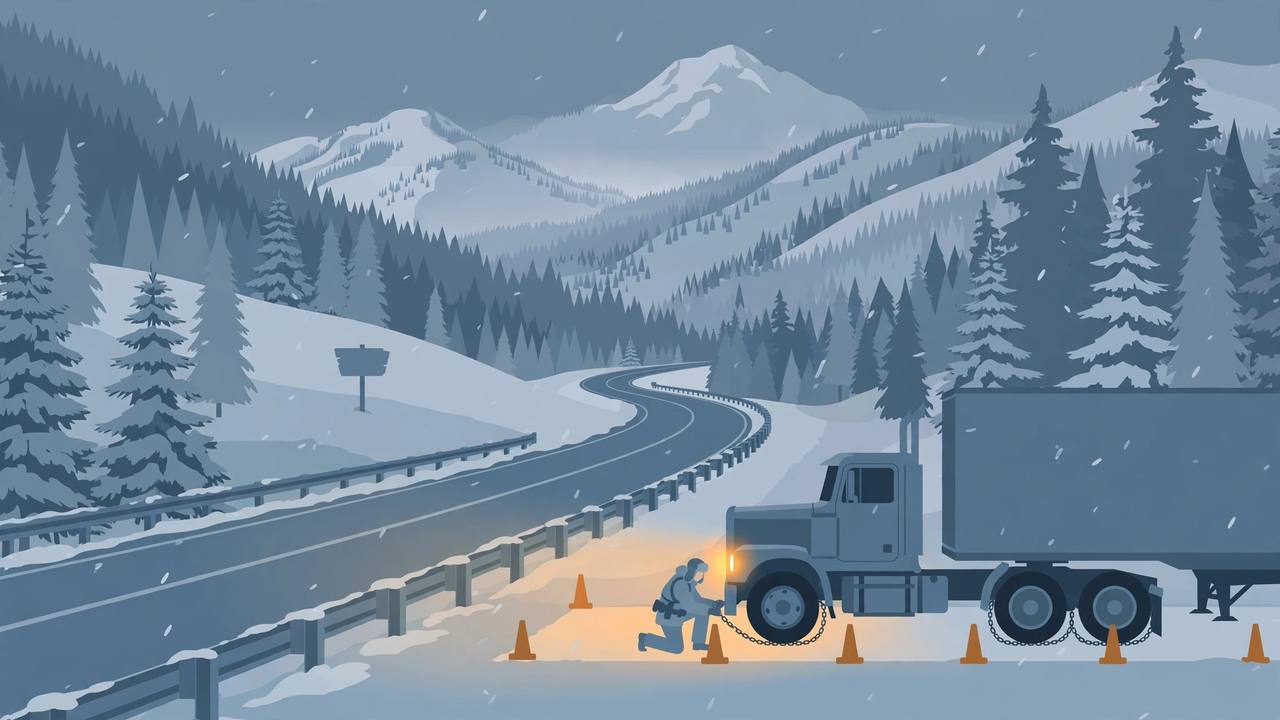
Washington State Patrol troopers will spend Tuesday and Wednesday, November 3 and 4, stopping commercial trucks on Interstate 90 at Snoqualmie Pass to check one thing many drivers forget until the snow flies: whether the rig is actually carrying the tire chains Washington law has required since Sunday, November 1.
Source: Washington State Patrol
The two-day chain enforcement emphasis will run on I-90 over Snoqualmie Pass, the 3,022-foot Cascade crossing between North Bend and Ellensburg that carries Washington's main east–west freight flow between Seattle, Spokane and the inland Northwest. Troopers will “educate and enforce” the state's chain-carry rules for commercial motor vehicles, the patrol said in a release issued Monday, November 2.
Source: CDLLife
“Our main goal is to educate and gain compliance with CMV drivers to carry chains from November 1st to April 1st,” said Trooper Jeremy Weber, the patrol's District 6 public information officer. Once the emphasis ends, the patrol says it will post the results on social media.
The rule that catches drivers out
The requirement is a carry rule, not just a use rule. From November 1 to April 1, every vehicle and vehicle combination over 10,000 pounds gross vehicle weight must carry sufficient tire chains on Washington's designated mountain routes — at all times, regardless of the weather that day or whether any chain advisory is posted. A driver can cross on dry pavement in November sunshine and still be in violation if the chains are not in the truck.
The designated routes cover every major mountain corridor in the state: I-90 from North Bend (milepost 32) to Ellensburg (milepost 101) over Snoqualmie Pass; US 97 over Blewett Pass and Satus Pass; US 2 over Stevens Pass; US 12 over White Pass; SR 410 over Chinook Pass; and SR 20, SR 155, SR 970, SR 14, SR 542 and I-82 between Ellensburg and Selah, under the state rule WAC 204-24-050.
Carrying any single chain is not enough, either. Heavy vehicles entering a chain-control area must carry at least two extra chains in case a chain in use breaks, and approved chains must be built with side chains and hardened cross chains, with at least one cross chain in contact with the road surface at all times. Plastic chains are not allowed.
Why this pass, and why it matters to Punjabi truckers
Snoqualmie is Washington's busiest winter pinch-point — the only interstate crossing of the Cascades in the Seattle corridor — and its weather can turn within a single crossing. For the many Punjabi and South Asian owner-operators who run Seattle–Spokane, Seattle–Yakima and cross-country I-90 loads, the pass is unavoidable, and there is no flat detour when it closes or when troopers turn vehicles around.
Monday morning's WSDOT pass report showed no restrictions in force on Snoqualmie, with a summit temperature of 29°F — a reminder that this week's operation is about the chains in the side box, not about a storm already on the road. When restrictions are posted, troopers can cite drivers who are not carrying chains and turn non-compliant vehicles back at control points.
Carry chains for your configuration, plus two spares. Check side chains and cross chains for broken links. Know the chain-up areas on I-90, and check the WSDOT pass report or dial 511 before you roll.
What happens next
The emphasis runs through Wednesday, November 4, and the State Patrol says the results will be posted on its social media accounts once it is complete. The carry requirement itself stays in force every day until April 1 on all designated routes — and the same troopers will be working the pass again the first time a storm puts “chains required” on the signs.