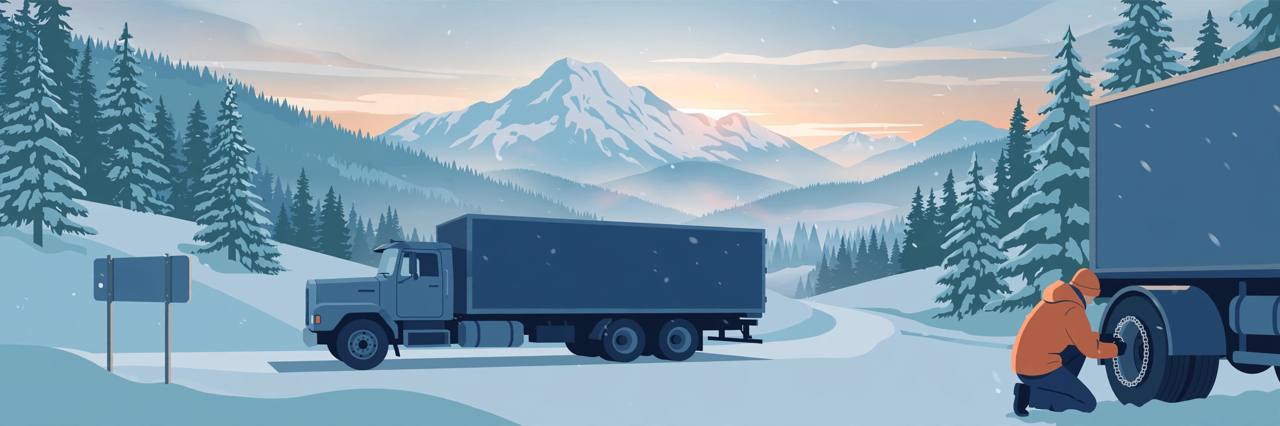
Washington state's winter chain rule for heavy vehicles is in force from today, Sunday, November 1 — and it applies whether the mountain passes are bare and dry or buried in snow. Under the rule published by the Washington State Department of Transportation (WSDOT), every vehicle and vehicle combination over 10,000 pounds gross vehicle weight rating (GVWR) must carry tire chains at all times on 12 designated mountain routes from November 1 through April 1, regardless of road conditions or advisories.
Source: WSDOT — Chain requirements for vehicles over 10,000 pounds
That means a loaded semi crossing Snoqualmie Pass on the Interstate 90 freight corridor between Seattle and Spokane can be turned back at a chain-control area simply for not having chains on board — even on a clear morning with no chain-up sign lit. “You don’t need chains for local deliveries if you stay outside the chain-required areas and don’t cross a mountain pass. WSDOT or WSP may stop vehicles without chains from going into areas where chains are required,” WSDOT says in its guidance for commercial vehicles.
The 12 routes where chains must be carried
The carry requirement covers the state's main Cascade and northern mountain crossings. On the interstates, it applies on I-90 between North Bend (milepost 32) and Ellensburg (milepost 101) — the Snoqualmie Pass stretch — and on I-82 between Ellensburg Exit 3 (milepost 3) and Selah Exit 26 (milepost 26), the corridor that carries traffic down into the Yakima Valley. It also applies on US 2 over Stevens Pass, between Dryden (milepost 108) and Index (milepost 36), and on SR-12 over White Pass, between Packwood (milepost 135) and Naches (milepost 187).
The remaining designated routes are SR-97 between milepost 145 and its junction, SR-97 from the SR-14 junction at the Columbia River (milepost 4) to Toppenish (milepost 59), SR-410 from Enumclaw to Naches, SR-20 between Tonasket (milepost 262) and Kettle Falls (milepost 342), SR-155 between Omak (milepost 79) and Nespelem (milepost 45), SR-970 between mileposts 0 and 10, SR-14 from milepost 18 to the Junction 97 (milepost 102), and the SR-542 Mount Baker Highway between mileposts 22.91 and 57.26. The full list is set out in Washington Administrative Code 204-24-050.
Source: CDLLife — Must-carry chain rules go into effect for trucks in Washington State November 1
What counts as a proper chain
Carrying any chain is not enough. WSDOT requires chains to be two-sided, made with sufficient hardened metal — plastic chains are not allowed — and built so that at least one cross-chain is in contact with the road surface at all times. Every vehicle over 10,000 pounds must also carry at least two extra tire chains, in case conditions worsen or a chain in use breaks or becomes unusable. The Washington State Patrol may approve other devices as chains, but they must perform equivalently to regular chains; cable chains are allowable. From April 2 to October 31, the same vehicles must carry chains on these routes only when it is specifically posted.
Why the timing matters this weekend
The season is not starting on paper only. Snow has already returned to the Cascades: earlier this week, KEYW reported, chains were required overnight on White Pass for vehicles over 10,000 pounds before the restriction was lifted, with snow still falling, while Snoqualmie, Stevens and White passes all carried traction-tire advisories. WSDOT's winter guidance warns that pass requirements can change several times a day as conditions shift, so a truck that leaves the Seattle–Tacoma side legally can meet a stricter requirement at the pass itself — which is exactly why the carry rule runs all season, posted or not.
Source: KEYW — Snow Is Back in the Cascades: Do You Need Chains?
For the Punjabi trucking community the rule lands on home ground. Large numbers of Punjabi-American and Punjabi-Canadian drivers run the I-90, I-82 and I-5 corridors — port loads out of Seattle and Tacoma, produce and freight through the Yakima Valley, and cross-border runs down from British Columbia. A missing set of chains on board can mean a turned-back truck, a missed delivery appointment and a lost day of pay, and an out-of-service stop on a pass in winter weather is a safety risk for every driver behind it. Dispatchers routing a heavy truck over any Cascade crossing between now and April 1 should treat chains on board as part of the load paperwork.
Chains on board for every route listed above, plus at least two extras • Two-sided hardened-metal chains, no plastic • At least one cross-chain touching the road when fitted • Cable chains allowed if they perform like regular chains • Local deliveries that never cross a pass or enter a chain area are exempt • Check the WSDOT pass report before departure — requirements change several times a day
What happens next
The carry season runs through April 1, 2027. Through the winter, WSDOT and the Washington State Patrol will set pass-by-pass requirements as storms arrive — from traction-tire advisories up to chains required on all vehicles — and oversize-load movement by permit is prohibited on passes where those signs are displayed. Studded tires became legal again in Washington on November 1 and remain legal through March 31, but studs do not satisfy a chain requirement. Drivers should check WSDOT's mountain-pass reports before every crossing and be ready to chain up at the designated chain-up areas rather than on the shoulder.