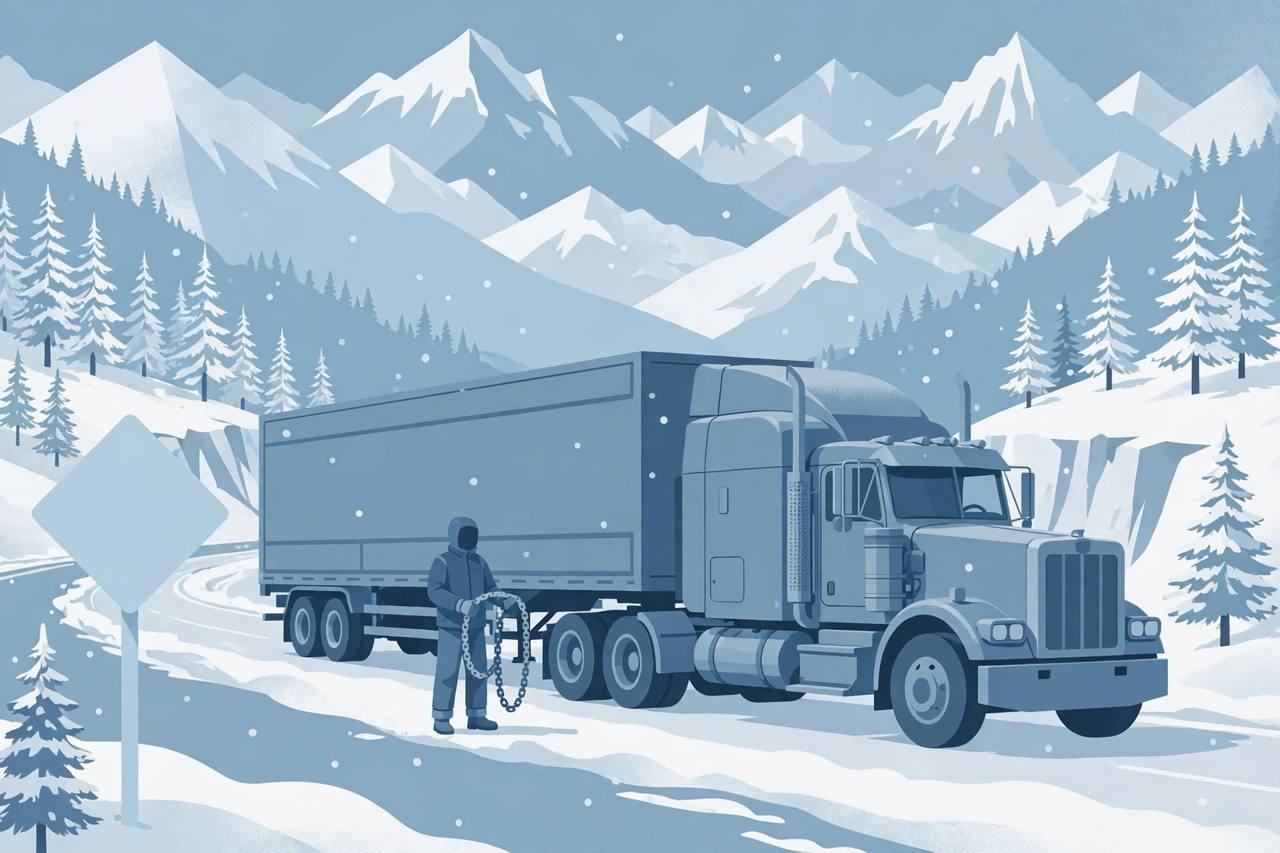
Truck drivers crossing Washington's mountain passes have four days to get ready: from Sunday, November 1, through April 1, every vehicle and vehicle combination over 10,000 pounds gross vehicle weight (GVW) must carry tire chains at all times on the state's designated chain routes — whether or not snow is falling and whether or not any advisory is posted, the Washington State Department of Transportation (WSDOT) says.
Source: WSDOT — Chain requirements for vehicles over 10,000 pounds
The seasonal must-carry rule, reported by trucking outlet CDLLife on Wednesday, October 28, is an annual requirement under Washington law — but it catches out-of-state and Canada-crossing drivers out every year, because carrying chains is compulsory on the listed routes even on a clear, dry day. A driver who reaches a pass without chains can be stopped from continuing by WSDOT or the Washington State Patrol (WSP).
Source: CDLLife
The 12 designated routes, with mileposts
WSDOT lists the carry requirement on: Interstate 90 between North Bend (milepost 32) and Ellensburg (milepost 101); Interstate 82 between Ellensburg Exit 3 (milepost 3) and Selah Exit 26 (milepost 26); State Route 97 between milepost 145 and its junction, and separately between the SR-14 junction at the Columbia River (milepost 4) and Toppenish (milepost 59); SR-2 between Dryden (milepost 108) and Index (milepost 36); SR-12 between Packwood (milepost 135) and Naches (milepost 187); SR-410 from Enumclaw to Naches; SR-20 between Tonasket (milepost 262) and Kettle Falls (milepost 342); SR-155 between Omak (milepost 79) and Nespelem (milepost 45); SR-970 between mileposts 0 and 10; SR-14 between milepost 18 and the Junction 97 (milepost 102); and SR-542, the Mt. Baker Highway, between mileposts 22.91 and 57.26.
In plain terms, the routes cover the Cascade and northern crossings truckers use most: Snoqualmie Pass on I-90, Stevens Pass on SR-2, Blewett Pass on SR-97, White Pass on SR-12 and Sherman Pass on SR-20. I-90 is Washington's main east–west freight artery, linking the Port of Seattle and the Puget Sound warehouses with Spokane and the inland Northwest — a corridor Punjabi owner-operators and fleet drivers from British Columbia, California and Washington itself run every week.
What drivers must carry — and what counts as a chain
Every vehicle over 10,000 pounds must carry at least two extra tire chains, on top of the chains needed for its axle configuration, in case conditions worsen or a chain breaks, WSDOT says. Approved chains must be two-sided, made with sufficient hardened metal — plastic chains are not allowed — and built so that at least one cross-chain is in contact with the road surface at all times. The Washington State Patrol may approve other devices as chains, but they must be equivalent to regular chains in performance; cable chains are allowable.
“You don't need chains for local deliveries if you stay outside the chain-required areas and don't cross a mountain pass. WSDOT or WSP may stop vehicles without chains from going into areas where chains are required,” WSDOT said.
The requirement sits in Washington Administrative Code WAC 204-24-050. It has two layers that drivers often confuse: from November 1 to April 1, chains must simply be carried on the designated routes at all times; outside that window, from April 2 to October 31, chains must be carried only when requirements are specifically posted for a vehicle's axle configuration. When a “chains required” order is posted on a pass, having chains in the side box is not enough — they must be installed as the posted configuration requires.
For the Punjabi trucking community, the practical advice from the rule itself is simple: check the chains are the right size for the drive tires, confirm two spares are on board before any I-90, SR-2, SR-12 or SR-97 run after Sunday, and use WSDOT's pass reports before crossing — a truck turned around at a pass loses the load window, not just an hour.
What happens next
The must-carry season begins Sunday, November 1, 2026 and runs to April 1, 2027. Enforcement is by the Washington State Patrol, and WSDOT posts pass conditions and any install requirements as winter weather arrives. Drivers heading into Washington this weekend should treat the chains as part of the pre-trip inspection, not an afterthought at the chain-up area.