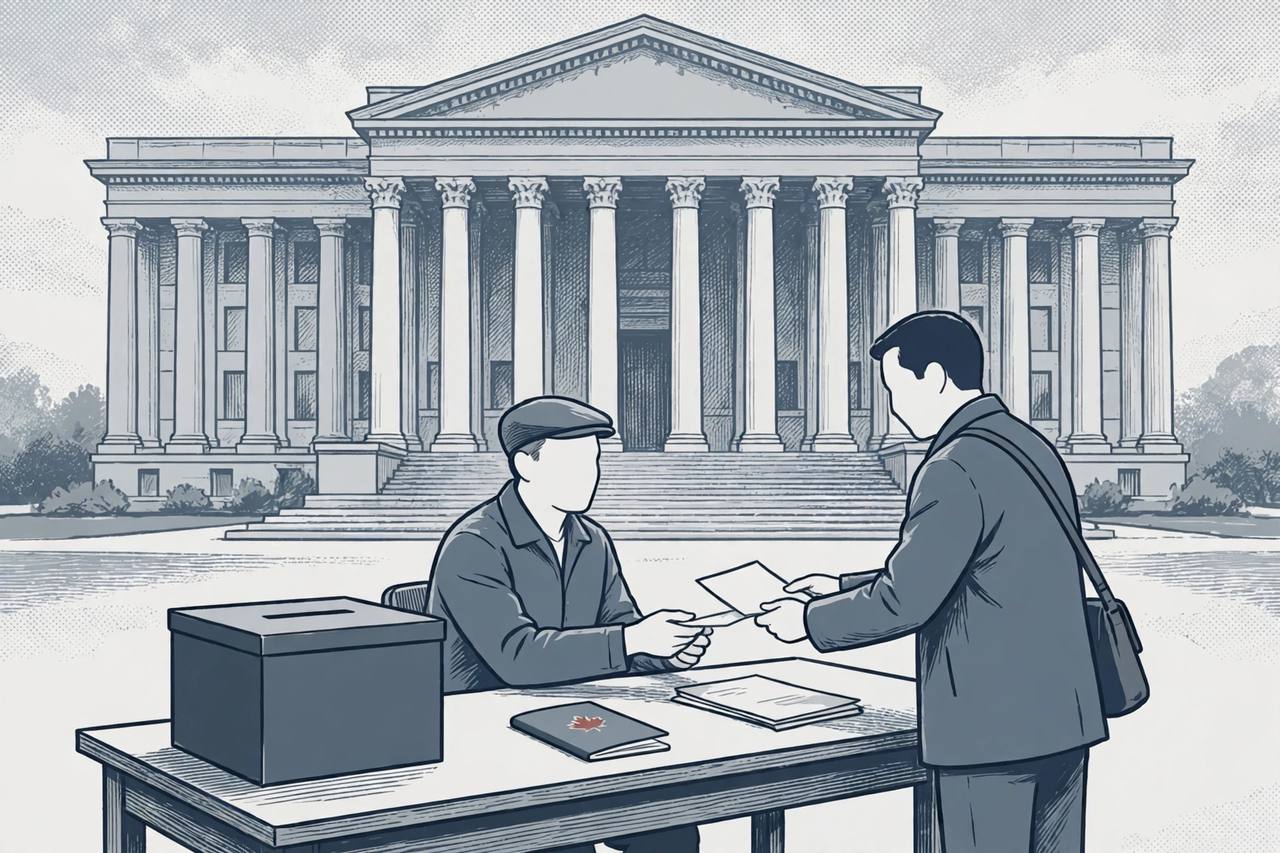
With Americans about to vote in the November 3 midterm elections, U.S. Immigration and Customs Enforcement (ICE) announced on Monday, November 2, that agents from ICE Homeland Security Investigations (HSI) in Tucson, Arizona, had taken Monique Gignac-Yochum into custody on October 28 for illegally voting as an alien. Gignac-Yochum, a lawful permanent resident from Canada, had registered to vote in Wisconsin and, according to ICE, falsely claimed U.S. citizenship and voted in the November 8, 2022, and November 5, 2024, general elections.
Source: U.S. Immigration and Customs Enforcement (ICE)
The Tucson arrest, more than a thousand miles from the ballot box
According to ICE, a federal misdemeanor arrest warrant was issued for Gignac-Yochum on October 23, 2026, out of the Western District of Wisconsin. By then she had moved to Arizona. HSI's Milwaukee office reached out to HSI Tucson, and Tucson agents arrested her five days later, on October 28 — a cross-country handoff between two field offices of the same investigative agency.
Source: U.S. Immigration and Customs Enforcement (ICE)
“Gignac-Yochum allegedly voted illegally in not one, but two federal elections, then moved more than a thousand miles away,” said ICE Assistant Director of Public Affairs Micah Bock. “Falsely claiming U.S. citizenship to vote isn't a paperwork mistake. It's a serious violation of federal law that undermines public trust in our elections. Moving across state lines didn't put her beyond the reach of federal law enforcement. If someone breaks our election laws, they should expect to be held accountable.”
Source: U.S. Immigration and Customs Enforcement (ICE)
The Wisconsin charges against Gignac-Yochum
The Justice Department's account runs through the federal court file in Madison. U.S. Attorney Chadwick M. Elgersma, of the Western District of Wisconsin, announced that a two-count criminal information issued on October 22, 2026, was unsealed following Gignac-Yochum's initial appearance in federal court. According to the information, on November 8, 2022, and November 5, 2024, Gignac-Yochum, knowing she was not a United States citizen, illegally voted in elections held in part to choose a member of the Senate, a member of the House of Representatives, the Vice President and the President. If convicted, she faces up to one year in prison.
Source: U.S. Attorney's Office, Western District of Wisconsin (Department of Justice)
Second Canadian charged: Rodger Dedrick of Stoughton
In a parallel case announced the same day, Rodger Dedrick, 66, a Canadian citizen living in Stoughton, Wisconsin, is charged with illegally voting as an alien on November 5, 2024, and with falsely claiming U.S. citizenship when he registered to vote on August 13, 2024. A two-count indictment against Dedrick was unsealed following his initial appearance in federal court. If convicted, Dedrick faces up to five years in prison on the false-registration charge and up to one year on the illegal-voting charge.
Source: U.S. Attorney's Office, Western District of Wisconsin (Department of Justice)
Both defendants were released pending further proceedings, the Justice Department said. Both cases were investigated by Homeland Security Investigations, and Assistant U.S. Attorney William M. Levins is handling both prosecutions. The department stressed that a criminal information and an indictment merely contain accusations, and that both defendants are presumed innocent unless and until proven guilty beyond a reasonable doubt in a court of law.
Source: U.S. Attorney's Office, Western District of Wisconsin (Department of Justice)
The law in the background: a green card is not a ballot
Under federal law, voting in a federal election is reserved to U.S. citizens. A lawful permanent resident — a green-card holder — may live and work in the United States indefinitely, but has no right to vote for President, Congress or any other federal office, and registering to vote by falsely claiming citizenship is itself a separate federal offence. That distinction is the heart of both Wisconsin cases: the government is not alleging the two Canadians were in the country unlawfully; it is alleging they crossed the one line permanent residency does not cross.
The announcements landed in the final stretch of an election-enforcement push. Separately, on November 2 the Justice Department announced voting-related charges against 63 people in 15 states, which it described as the largest surge of such arrests since President Donald Trump returned to office, and ICE said in late October that it had made another round of arrests in voter-fraud and election-related investigations. The Wisconsin charges were filed and unsealed in the last week of October, days before polls opened for the November 3 midterms, in which voters are deciding all 435 U.S. House seats, 35 Senate seats and 36 governorships.
For Punjabi and other South Asian diaspora readers in the United States and Canada, the practical lesson is direct and worth stating plainly: permanent residency, however long-held, does not include federal voting rights, and a registration form signed with a false citizenship claim can bring a federal criminal case, prison time on conviction, and an immigration-enforcement file — as the Tucson arrest of a woman who had moved more than a thousand miles from where she voted is meant to underline.
Both Gignac-Yochum and Dedrick have been released pending further proceedings. The Justice Department states that the charges are accusations only, and both are presumed innocent unless proven guilty beyond a reasonable doubt.
What happens next: both cases now proceed in federal court in the Western District of Wisconsin, where the charges were filed, with further hearings and trial dates to be set by the court. Gignac-Yochum faces a maximum of one year in prison if convicted; Dedrick faces up to five years on the false-claim charge and one year on the voting charge. ICE says anyone can report suspected voter fraud by calling 866-DHS-2-ICE (866-347-2423) or using its online tip form.
Source: U.S. Attorney's Office, Western District of Wisconsin (Department of Justice)