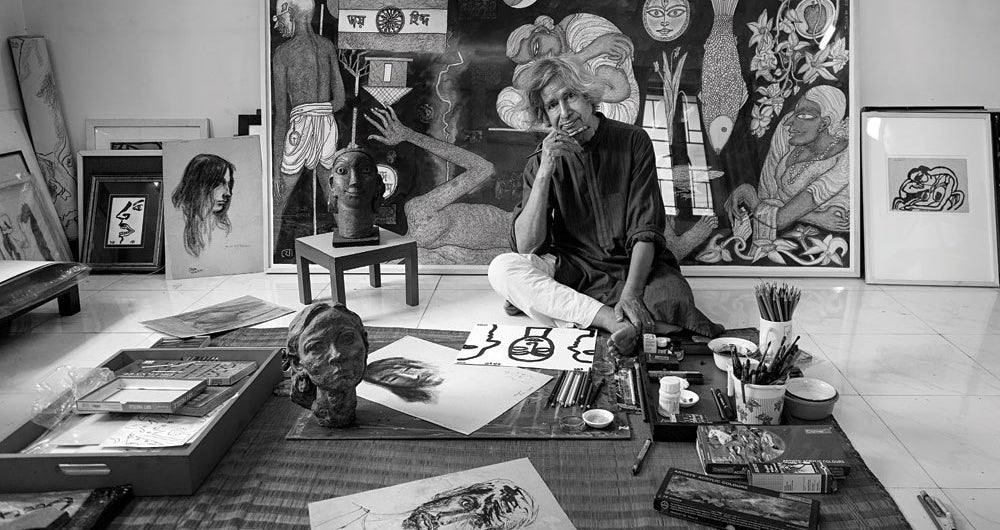
Eminent Indian painter Jogen Chowdhury, one of the most distinctive figures of modern Indian art and a former Rajya Sabha MP, died at a private hospital in Kolkata on Sunday morning (October 25). He was 87.
Source: Voice of Kolkata
Ruby General Hospital said in a statement that Chowdhury had been suffering from myeloproliferative neoplasm, a rare form of blood cancer, for the past 14 months and was undergoing chemotherapy. He had been hospitalised for urinary tract infections during his illness, developed severe sepsis leading to multiorgan failure, and died at 10.15 a.m. despite intensive medical care, the hospital said. He is survived by his wife.
Source: Indulge Express
Born in 1939 in Faridpur, in present-day Bangladesh, Chowdhury studied at the Government College of Art & Craft in Kolkata from 1955 to 1960 and later trained at the Ecole des Beaux-Arts in Paris, graduating in 1967. After returning from Paris he developed the individual style that made him famous — ink, watercolour and pastel figures built from intricate cross-hatched lines, often with a satirical edge on politics and society. He lived and worked in Santiniketan.
Chowdhury served as a Rajya Sabha member from 2014 to 2020 and received the Banga Bibhushan in 2012. West Bengal Chief Minister Suvendu Adhikari described him as an artist of exceptional stature whose legacy would remain immortal, saying the body of work he left behind is a treasure for the state and the nation, with works present in numerous government buildings including Rashtrapati Bhavan.
Painter Samir Aich termed Chowdhury's death a personal loss and the end of an era in Indian art, while writer Sirshendu Mukhopadhyay, a long-time friend, called it a great loss. Tributes poured in from across the art fraternity and the wider cultural community in Bengal and beyond.