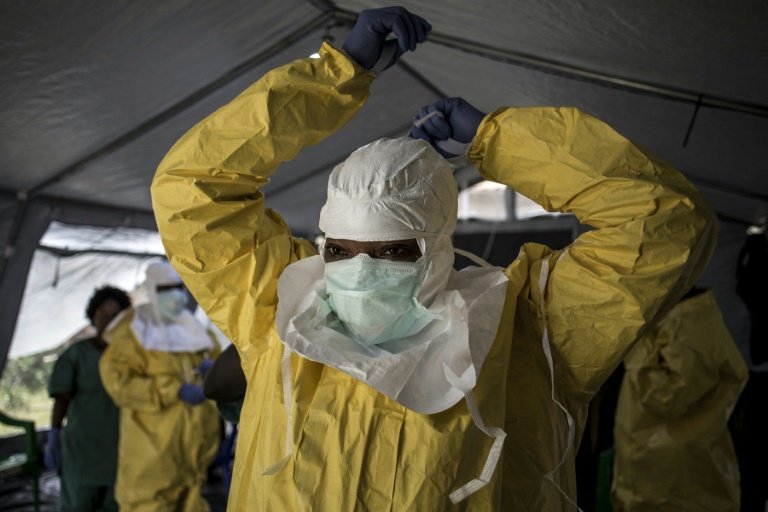
KINSHASA — The death toll from the Ebola outbreak centred on the Democratic Republic of the Congo has passed 5,300, according to data released by the Africa Centres for Disease Control and Prevention (Africa CDC) on Monday: 5,376 people have died in total — 5,372 of them in DR Congo and two each in Kenya and Uganda — Al Jazeera reported. The outbreak is driven by the Bundibugyo strain of the virus, for which there is still no approved vaccine or treatment.
Source: Al Jazeera / Africa CDC
Awaaz Punjab has tracked this outbreak milestone by milestone since the toll crossed 5,000 at the end of October. Read: Congo's Ebola deaths pass 5,026
A records review in Ituri added 314 deaths
Congo's health ministry said the higher toll partly reflects a data review — not only new deaths. A harmonisation exercise in Ituri province, the centre of the epidemic, lifted Ituri's recorded deaths from 3,436 to 3,750 after officials reviewed records from 97 percent of affected health zones there. As of October 30, the ministry counted 10,414 confirmed cases and 5,372 deaths in DR Congo, a case fatality rate of 51.6 percent, up from 48.6 percent before the review. Ituri alone accounts for 7,346 confirmed cases and 3,750 deaths — 71 percent of all infections — followed by North Kivu with 2,436 cases and 1,356 deaths. The outbreak has reached 67 of the country's 178 health zones across eight provinces, and dozens of new infections are still being reported each day: 63 new cases were recorded on October 30, and the test positivity rate fell to 14.4 percent from 17.9 percent a day earlier.
Source: DR Congo Ministry of Health via Africanews / Harava
Three countries, one strain — and a negative result in Nigeria
Across the three affected countries, the Bundibugyo strain has infected about 10,444 people, Africa CDC said. Kenya identified its first-ever Ebola cases in October and has confirmed nine cases with two deaths; Uganda has also recorded two deaths. In Nigeria, two suspected cases in the country's northeast tested negative after two rounds of testing — a result Awaaz Punjab reported on November 1 — which means the outbreak has not been confirmed in a fourth country. DR Congo declared this outbreak, its 17th, in mid-May; it is the country's largest on record and the second-largest Ebola epidemic ever, behind only the 2014–2016 West African epidemic that killed more than 11,325 people, according to the WHO.
Source: Africa CDC via Al Jazeera / WHO
Nigeria's two suspected cases were closely watched because an earlier Nigerian patient had travelled from the outbreak zone. Read: Nigeria's suspected Ebola cases test negative
Why the toll keeps climbing
Health officials say the response is chasing an outbreak that keeps escaping its net. Africa CDC says about 80 percent of new cases are coming from outside the chains of monitored contacts, and the WHO says about a third of recorded deaths are people who died outside treatment centres before they could be tested. Teams were following 37,367 contacts, but only 84.5 percent were seen within 24 hours, short of the 95 percent target. Dr Patrick Otim, a programme area manager with the World Health Organization, called the toll "a very tragic milestone because it is just not a number". Field response teams had received less than one-third of pledged funding as of November 3, and the WHO says staff and funding shortages are slowing the response. There is no approved vaccine or treatment for the Bundibugyo strain, although clinical trials of the Ervebo vaccine — proven against the more common Zaire strain — have begun in recent weeks.
Source: WHO / Africa CDC via Somalia Daily News
What is solid
- The tolls come from official sources: DR Congo's health ministry (5,372 deaths and 10,414 cases in Congo as of October 30) and Africa CDC (5,376 deaths across the three countries, including two each in Kenya and Uganda).
- The virus is the Bundibugyo strain, and no vaccine or treatment is approved for it; the outbreak was declared in mid-May and is DR Congo's 17th and largest.
What is only claimed
- The jump from 5,026 to 5,372 deaths is partly a records revision — 314 earlier deaths in Ituri were added after a data review — not 346 deaths in a few days; totals differ slightly by source and reporting date (5,340 as of October 29; 5,372 as of October 30).
- Case and death counts in remote health zones are still being consolidated, and the ministry says consolidated figures will be presented in the coming days.
This is now the second-deadliest Ebola epidemic in history, caused by the one major Ebola strain that medicine cannot yet vaccinate against. Twelve health zones have gone at least 42 days without a new case, which shows control is possible where teams can reach — the fight is over access, tracing and money, not knowledge.
What happens next
The WHO's Africa office says ending the outbreak needs a continued scale-up of control measures, greater access to affected areas and more community outreach, while Congo's health ministry is expected to present consolidated figures in the coming days. Until the share of cases appearing outside known contact chains falls, officials expect the toll to keep rising — each weekly update from Kinshasa and Africa CDC will show whether the response is finally getting ahead of the virus.
Source: WHO Africa / Al Jazeera