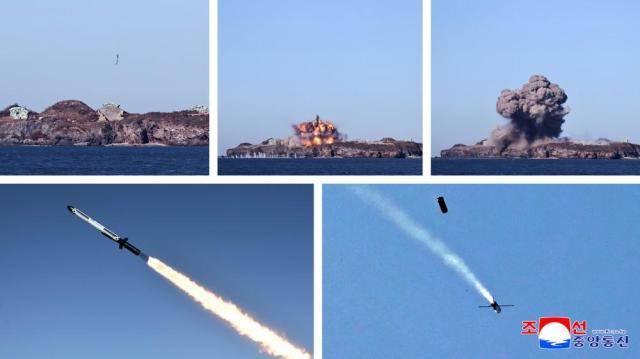
North Korea said on Tuesday it had tested a strategic cruise missile mounted with a dispersal warhead — a cluster-type warhead that scatters smaller explosives over a wide area — and assessed the missile's flight characteristics for a vertical strike, the state news agency KCNA reported, in a Reuters report from Seoul.
Source: Reuters
On Saturday, North Korea tested a Standard Type 2 cluster warhead for tactical ballistic missiles, which KCNA said can destroy 12 to 13 hectares, and vowed its units would be able to use all types of the bombs by the end of 2026. Monday's cruise-missile test extends the same cluster-warhead programme to a second, very different missile system. Read the Saturday ballistic cluster test report
What KCNA said was tested on Monday
According to KCNA, the Missile Administration conducted the tests on Monday to assess the destructive power of the dispersal warhead and the missile's ability to carry out a vertical strike against targets. Full General Kim Jong-sik, a member of the Workers' Party Central Military Commission and first vice department director of the Central Committee, oversaw the tests, the South Korean news agency Yonhap reported from KCNA's account.
Source: Yonhap via K-VIBE
“The Warhead Institute of the Missile Administration said it confirmed that the middle-sized dispersal warhead tipped on the cruise missile is capable of turning into ashes a target area of 5 to 6 hectares with its highest-density power,” KCNA said, as reported by Yonhap — yaani about 12 to 15 acres, roughly the area of 7 to 8 football pitches. The Cruise Missile System Institute said it had perfected the missile's vertical-strike capability by improving its terminal manoeuvrability, adjusted for the natural and geographical characteristics of the targeted area. KCNA provided no technical details or evidence demonstrating the extent of the improvement, Seoul's Aju Press noted, and it named neither the cruise missile nor its range.
Source: Aju Press
A cluster-warhead push across two missile systems
A cluster warhead carries multiple smaller explosive devices, known as submunitions, which scatter over a wide area after the main warhead detonates; such weapons are intended to strike multiple targets simultaneously and pose a serious threat to military personnel and equipment, Aju Press explained. The Missile Administration's director was quoted as saying that “the necessity of developing a variety of weapon systems is urgent than ever before… our armed forces should defend the security of the country and deter all sorts of threats”, and that the tests demonstrated the country's “practical combat power”. The bureau also vowed to develop several types of cluster warheads and equip military units with them by the end of this year, so they can be deployed according to operational requirements and targets.
South Korea's military responded to the claims by pointing out that it had already developed and deployed precision-strike capabilities surpassing those claimed by North Korea some two decades ago, and that details of its own weapons systems remain classified for strategic reasons, according to South Korean media reports of the military's response. Saturday's ballistic test had itself come days after Pyongyang fired around ten short-range ballistic missiles from Wonsan on October 29, and after the United States, Japan and South Korea reaffirmed North Korea's complete denuclearisation at talks in Atlanta — a demand Pyongyang continues to reject.
What is solid
- KCNA announced on Tuesday that the Missile Administration conducted the cruise-missile dispersal-warhead and vertical-strike tests on Monday; Reuters and Yonhap both reported the announcement the same day.
- The tests follow Saturday's test of a cluster warhead for tactical ballistic missiles, and North Korea has vowed to field several types of cluster warheads with its units by the end of this year.
- Full General Kim Jong-sik oversaw Monday's tests, according to KCNA.
What is only claimed
- Every performance figure — the 5-to-6-hectare destruction claim and the 'perfected' vertical-strike capability — comes from Pyongyang's own state media. No independent verification, technical evidence, missile type or range has been published.
Why cluster warheads draw international concern
Cluster munitions are banned under the Convention on Cluster Munitions, in force since 2010, because their submunitions scatter over wide areas and unexploded bomblets can kill civilians long after a conflict ends. Neither North Korea, South Korea nor the United States is a party to that convention. Pyongyang's move to standardise cluster warheads across both its ballistic and cruise missile forces — rather than treating them as an experiment — therefore puts a widely condemned class of weapon on a stated path into frontline units within weeks, at a moment when denuclearisation diplomacy with Washington, Seoul and Tokyo is stalled.
Watch for whether North Korea conducts further cluster-warhead tests before its end-of-year fielding deadline, whether South Korea's military publishes its own assessment of Monday's launches, and any response from the United States, Japan and South Korea, whose Atlanta talks last week reaffirmed complete denuclearisation of the North. KCNA said the latest tests followed similar ones conducted late last month, describing a wider weapons programme it says has become 'increasingly urgent'.