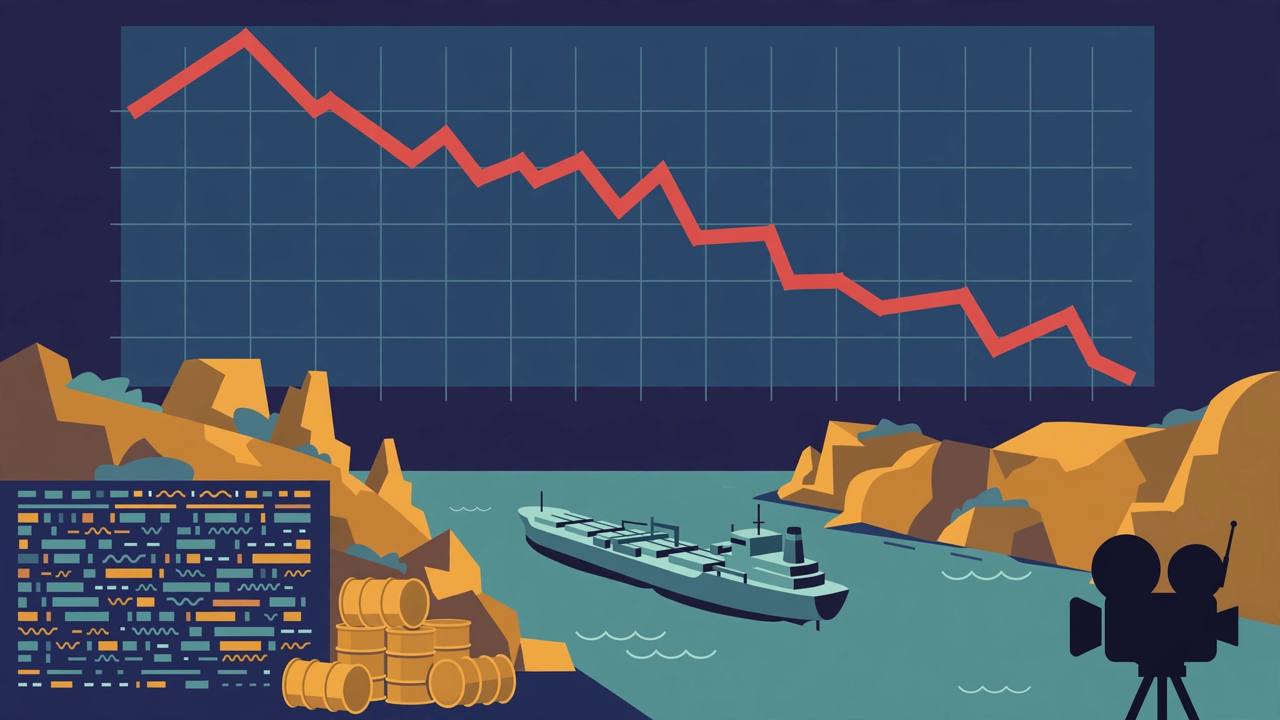
LONDON / NEW YORK — Oil prices whipsawed through their most violent session of the week on Tuesday, November 3, first rising above $107 a barrel on the US strikes on Iran's Qeshm Island and then sliding to a three-week low after President Donald Trump said the United States would end $4 billion a year in funding to Israel. Brent crude futures were down $3.45, or 3.3 per cent, at $101.32 a barrel by 1350 GMT — their lowest since October 8, having earlier traded above $107 — and US West Texas Intermediate was down $2.16, or 2.2 per cent, at $94.30, its lowest since October 15, Reuters reported.
Source: Reuters via Euronext Live
By the New York afternoon the fall had partly steadied but not reversed: Brent was down $1.63, or 2 per cent, at $103.14 a barrel at 10:44 a.m. ET (1544 GMT), on track for its lowest close since October 7, while WTI was down 67 cents, or 1 per cent, at $95.79, headed for its lowest close since October 14, Reuters reported from New York. The market, Reuters said, was weighing talks to end the wars in Iran and Ukraine against worries about fresh supply disruptions from attacks in both conflicts — on the day American voters deliver their verdict on the first two years of Trump's second term in the midterm elections.
Source: Reuters via Euronext Live
This report follows Awaaz Punjab's earlier coverage of the same barrel of oil moving the other way: Brent had risen $1.84 to $106.61 by 0744 GMT on Tuesday after US strikes on Iran's Qeshm Island and an Iranian official's warning that a deal was far off. What is new here is the reversal — Trump's Fox & Friends announcement that Washington will stop $4 billion a year in funding to Israel, Energy Secretary Chris Wright's assurance that the Qeshm strikes did not disrupt oil flows, and the slide that followed to the lowest prices in three weeks. Read the earlier report: Oil rises as US strikes Iran's Qeshm Island
What Trump said — and why oil traders heard a war winding down
The trigger was the president's own words on Fox News' Fox and Friends. “Now, as far as paying Israel, Bibi Netanyahu and I have made a deal that we give Israel $4 billion a year, and we made a deal months ago that we're stopping,” Trump said. “We've already agreed that by the end of this year we won't be paying Israel.” He said Israel no longer needed the funding, although the US would remain willing to provide other forms of support, Reuters and TradingView reported. Oil traders read an announced end to Washington's annual military funding for its closest Middle East ally — $4 billion a year, yaani four thousand million dollars — as one more signal that the administration is trying to close down the war economy around the Iran conflict rather than expand it, and they sold the war premium out of crude.
Source: Reuters via Euronext Live / TradingView
A second calming signal came from the administration's energy chief. US Energy Secretary Chris Wright said the overnight attacks on Iran's Qeshm Island had not affected oil flows, while indicating that additional refined products would be supplied from the Persian Gulf and India, TradingView reported. That assurance mattered because Qeshm sits at the mouth of the Strait of Hormuz, through which about one-fifth of the world's crude oil and natural gas — roughly 20 million barrels a day — passed before the war, and because Iran's conditions for reopening the strait remain the single largest unknown in the oil market.
Source: TradingView News
Diplomacy pulled one way, the war the other
The slide happened even though the war news itself had not improved. A senior Iranian official told Reuters on Tuesday that Tehran and Washington remain far from a deal to end the war and that Tehran will not accept Washington's “excessive demands”, and parliament speaker Mohammad Bagher Qalibaf said the “ball is in the US' court”. Qatar's foreign ministry spokesman said the US and Iran remain committed to mediation efforts and are reviewing proposals aimed at bridging their differences, Reuters reported. Iran's President Masoud Pezeshkian, meanwhile, signalled greater flexibility, saying Supreme Leader Mojtaba Khamenei had authorized discussions on issues previously considered non-negotiable, TradingView reported. “Despite these positive signals, it's probably too early to think escalation risks have passed,” ING said in a note quoted by Reuters. “What is clear, though, is that strong signals of progress in peace talks would mean more downside for prices.”
Source: Reuters via Euronext Live / TradingView
The strikes that pushed oil up in the morning — US forces hitting an Iranian air-defence system on Qeshm Island, later confirmed by Trump himself as a “minor attack” — were reported in full earlier: Read: US strikes Iran's Qeshm Island near the Strait of Hormuz
Stocks erased their losses as oil fell
Equity markets took the cheaper oil as relief. Stocks in Europe and the US reversed course to trade higher on Tuesday: the pan-European STOXX 600 rose 0.13 per cent to 650.3 points and futures tracking the S&P 500 added 0.14 per cent, Reuters reported, while in later New York trading the Dow Jones Industrial Average was down 0.18 per cent, the S&P 500 up 0.56 per cent and the Nasdaq Composite up 0.97 per cent. Asia had moved the other way on technology worries — South Korea's KOSPI fell 3.6 per cent and Taiwan's index also dropped 3.6 per cent, its steepest one-day decline since late July — and the yield on the US 10-year Treasury note rose 2.5 basis points to 4.9187 per cent. The dollar index was flat at 101.81, having hit a one-month low on Monday.
Source: Reuters via Kitco News
Background: a barrel hostage to Hormuz since February 28
The war between the United States, Israel and Iran began on February 28, and the effective blockade of the Strait of Hormuz has redrawn energy flows ever since: Brent ended October at its highest level in six months on fears the conflict could escalate again after the US midterm elections, and Goldman Sachs has raised its December Brent forecast to $105 from $90 while warning Brent could reach $140 in 2027 if Gulf output stays well below its 2025 average. Saudi Aramco is working to expand its East-West pipeline that circumvents the strait, its CEO Amin Nasser said — a sign the region's producers are building for a Hormuz that cannot be trusted. Tuesday's session contained the whole war in one chart: strikes pushed Brent above $107, diplomacy and a funding announcement dragged it to $101.32, and it closed the London day caught between the two.
Source: Reuters via Euronext Live
Aramco's plan to expand the pipeline that bypasses the Strait of Hormuz was reported separately: Read: Aramco expands East-West pipeline in Hormuz bypass
For Punjabi and Indian readers the direction of Brent is not abstract. Every dollar off a barrel lowers the fuel-price pressure that the war has imposed on Punjab, on India and on Canadian pump prices alike, and Energy Secretary Wright's remark that additional refined products would be supplied from the Persian Gulf and India puts Indian refineries inside the administration's own plan for keeping fuel moving. Lakhs of Punjabi and Indian workers in the Gulf, and the Indian seafarers crewing tankers that must still run the Hormuz gauntlet, remain exposed to the other side of the chart: a single verified strike has repeatedly been enough to put $5 back on a barrel within hours.
Source: Reuters via Euronext Live
What is solid
- Brent fell $3.45, or 3.3%, to $101.32 a barrel by 1350 GMT on Tuesday — its lowest since October 8 after trading above $107 earlier — and WTI fell $2.16 to $94.30, its lowest since October 15 — Reuters
- Trump said on Fox & Friends that the US gives Israel $4 billion a year and that “we've already agreed that by the end of this year we won't be paying Israel” — Reuters
- Energy Secretary Chris Wright said the overnight Qeshm attacks had not affected oil flows — TradingView, reporting Reuters
- Qatar's foreign ministry spokesman said the US and Iran remain committed to mediation and are reviewing proposals — Reuters
What is only claimed
- Why prices fell is market interpretation, not established fact: Reuters linked the slide to Trump's Israel-funding comments and peace-talk hopes, while a senior Iranian official said the same day that a deal remains far off and Tehran rejects “excessive demands”
- Iranian President Pezeshkian's reported signal — that Supreme Leader Mojtaba Khamenei authorized talks on previously non-negotiable issues — comes via TradingView's summary and had not been matched by an Iranian concession on the record by Tuesday evening
What happens next
The next hard numbers arrive within a day: the American Petroleum Institute's weekly storage report was due Tuesday and the US Energy Information Administration's on Wednesday, with analysts estimating energy firms added 2 million barrels of crude to US storage in the week ended October 30 — yaani 20 lakh barrels — which would be the first increase in five weeks, against an increase of 5.2 million barrels in the same week last year, Reuters reported. Beyond the data, three clocks decide Brent's next $5: the midterm results and what they do to Trump's room to settle or escalate; Qatar's mediation file, which both sides say they are studying; and the strait itself, where Tehran's offer to reopen Hormuz within two days of its conditions being met remains untested. Oil has now fallen on two consecutive days on nothing more than signals — the first verified strike, or the first signed paper, will move it further and faster.
Source: Reuters via Euronext Live