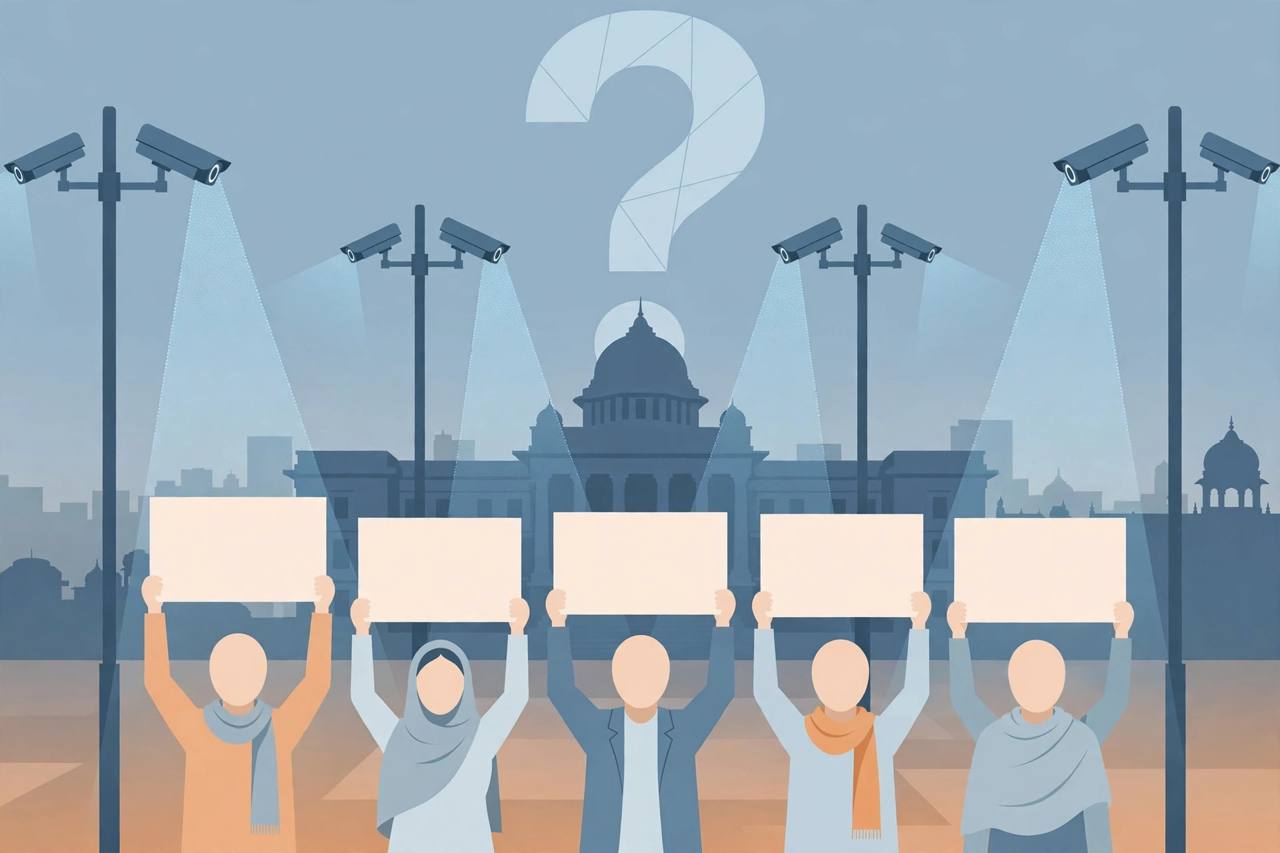
The Supreme Court on Tuesday (November 3) issued notice on a petition challenging facial surveillance at designated protest sites, with the Bench asking what constitutes a "reasonable expectation of privacy" when a person is present in a public place. The petition was filed by the Software Freedom Law Centre (SFLC.in), which alleges that the deployment of facial recognition and surveillance tools at protest sites infringes the right to privacy.
Source: LiveLaw
A Bench of Chief Justice of India Surya Kant, Justice Joymalya Bagchi and Justice V Mohana heard Advocate Prashant Bhushan for the petitioner and Solicitor General Tushar Mehta for the Centre. The exchanges were oral; the Court has not ruled on the merits of the plea.
Source: LiveLaw
"It's about reasonable expectation of privacy"
Bhushan submitted that the authorities should disclose the nature of the surveillance being undertaken and the legislative framework under which it is carried out. Mehta questioned the plea, asking, "Right to privacy in a public place? What kind of PILs are being filed?" He submitted that CCTV cameras were installed at designated protest sites to ensure no untoward incidents take place, and argued that accepting the petitioner's contention would mean CCTV cameras installed for women's safety would also have to be removed.
Source: LiveLaw
Justice Bagchi termed that argument "very simplistic", distinguishing between the mere association of a face with an individual and the subsequent utilisation of the data collected through surveillance. "It's about reasonable expectation of privacy. When I am standing in a public place, what's my reasonable expectation?" the judge asked, and also questioned whether the mere availability of surveillance footage and the collection of data would, by themselves, amount to a legitimate state interest. Mehta maintained that legitimate state interest is an exception to the right to privacy, and pointed out that 500-600 social media influencers were recording the protests live.
Source: LiveLaw
Justice Bagchi also referred to the amendment to the Identification of Prisoners Act, observing that the legislative change enabled the State to utilise iris identification for crime detection — a provision, he noted, that petitioners in such cases had not referred to. According to another court report, the Solicitor General submitted that facial recognition was not conclusive proof of a person's involvement in an offence and that a match would only trigger further verification.
Source: The Bar Bulletin
What the petition alleges
The petition alleges that the Delhi Police and other authorities deployed extensive surveillance mechanisms to identify and track individuals participating in, or intending to participate in, the October 10 protest at Jantar Mantar in Delhi. These are allegations in the petition, which the authorities have not been held to have established. It refers to reports of the Delhi Police's DP-Drishti and Ikshana surveillance vans, which allegedly use AI-assisted facial recognition technology to scan live CCTV feeds.
Source: LiveLaw
Citing an Indian Express investigation into facial recognition used during protests at Jantar Mantar in July 2026, the petition states that the police claimed to have identified 2,873 people through the systems, and that of 205 people examined who faced serious charges, 25 were already in jail when the system flagged them as present at the protest site. The petition further alleges that residential addresses, mobile numbers and social media accounts of key organisers were collected and shared among police teams, and that plainclothes personnel were stationed outside the homes, hotels and guest houses where organisers were staying.
Source: LawChakra
SFLC has sought disclosure of the records relating to the surveillance programmes, the legislative framework under which they operate and the safeguards against misuse of personal data, along with binding guidelines governing the collection, processing and dissemination of citizens' personal information. The petitioner relies on the Supreme Court's recognition of privacy as a fundamental right and invokes the 1997 People's Union for Civil Liberties judgment, which laid down safeguards for telephone interception. The Court had earlier sought the Centre's response on a similar petition filed by Rajya Sabha MP AA Rahim.
Source: LiveLaw
The plea was heard in the same batch of Delhi protest petitions in which the Court earlier on Tuesday said no group can occupy a protest site indefinitely and asked traders to add the protest organisers as parties. Read the earlier protest-site hearing