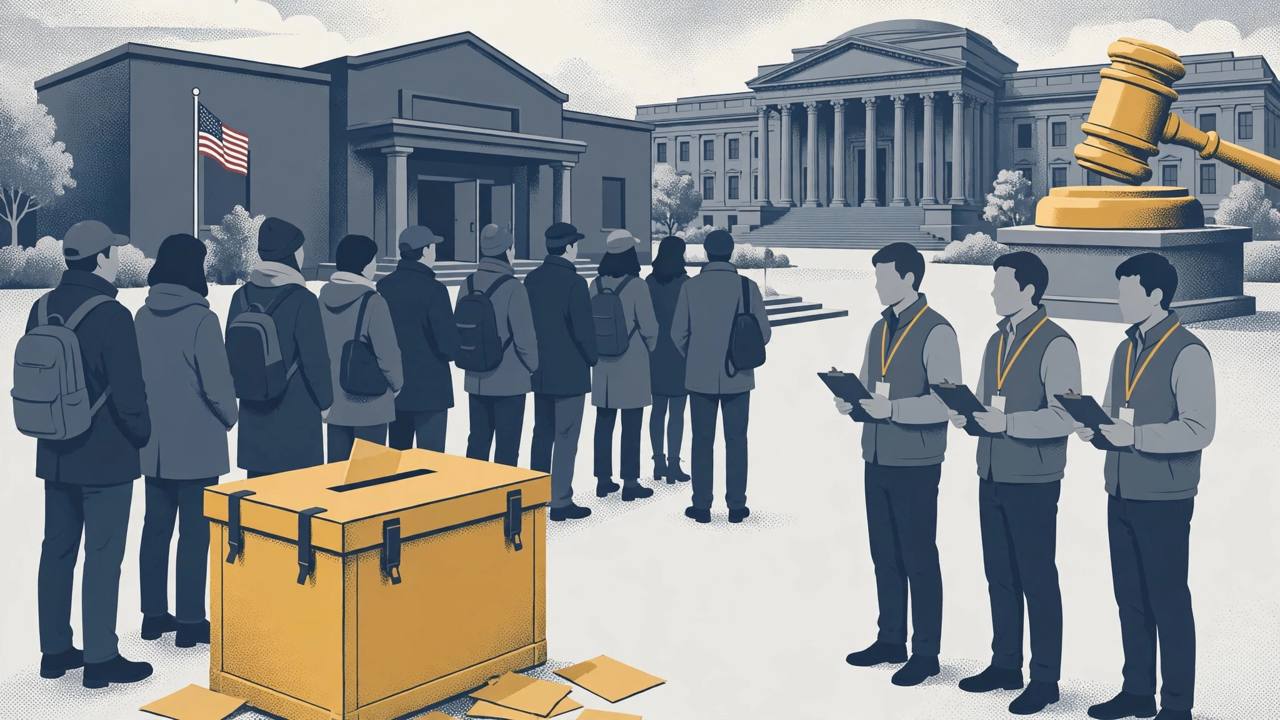
A federal judge in Washington late on Monday denied the NAACP's emergency request to block the Justice Department from using employees of federal law-enforcement agencies as election monitors at polling places on Tuesday, November 3, hours before polls opened in the midterm elections. U.S. District Judge Reggie B. Walton ruled that the civil rights group had not presented sufficient evidence that including such employees among the nearly 1,000 monitors the department is dispatching nationwide would amount to voter intimidation in violation of federal law.
Source: Bloomberg Law
The denial was without prejudice — it does not decide the underlying case for good — and it rested on the government's assurances that the feared conduct would not happen. Judge Walton ordered the Justice Department to file a status report by 7 a.m. on Tuesday, November 3, explaining how it confirmed that none of the monitors in its Poll Monitoring Program are in fact law-enforcement officials and therefore do not have the power to effect arrests.
Source: Just Security
What the NAACP asked the court to do
The NAACP, together with the Advancement Project and the Legal Defense Fund, filed the emergency challenge in NAACP v. Blanche (No. 1:26-cv-03626-RBW) in the U.S. District Court for the District of Columbia on October 16. The groups asked Judge Walton for a temporary restraining order barring the department from using personnel from the Bureau of Prisons, the Drug Enforcement Administration and the Bureau of Alcohol, Tobacco, Firearms and Explosives as monitors. In the alternative, they asked that any such personnel be barred from carrying firearms, badges or camera equipment, or from conducting law-enforcement activity at polling places.
Source: Democracy Docket
The about-face at Monday's hearing
At Monday's hearing, Justice Department attorney Kathryn Barragan told Judge Walton that the department "would have no problem" with an injunction requiring it to take reasonable efforts to exclude sworn officers from serving as polling monitors. She said the Bureau of Prisons, Drug Enforcement Administration and Bureau of Alcohol, Tobacco, Firearms and Explosives employees who would serve were administrative or clerical personnel, and that the Civil Rights Division had worked to exclude law-enforcement officials from the monitor effort.
Source: Democracy Docket
That position sat uneasily with a sworn declaration filed on October 28 by Eric Neff, acting chief of the Civil Rights Division's Voting Section, which had indicated that employees of those three agencies would watch the polls. Judge Walton noted the apparent inconsistency in court and warned the department's lawyers against misrepresenting who the monitors would be, saying, "I would have to hope and assume that an officer of the court would not misrepresent the reality of who these monitors are gonna be. Because if there is some type of misrepresentation — and I don't suggest there is — obviously there'd be hell to pay."
Source: Democracy Docket
The department has said it will place about 1,000 monitors across all 50 states for Tuesday's elections — the largest such deployment in its history — and Attorney General Todd Blanche, the named defendant in the case, has defended the programme as standard voting-rights enforcement. In a separate sworn filing, the department has said no Federal Bureau of Investigation or Immigration and Customs Enforcement employees will serve as monitors, and monitors will not carry firearms. The monitors observe and report; state and local officials, not federal monitors, run the polling places.
Source: Just Security
Why the ruling matters for voters
The fight matters because of what a uniformed or armed federal presence at a polling place can do to turnout. Federal law already makes it a crime for a federal official to bring armed personnel to a place where an election is held, except to repel armed enemies of the United States, and civil-rights groups argued that a visible federal law-enforcement presence would chill voters — particularly immigrant and minority voters, who make up a large share of the Punjabi diaspora in states such as California, New York and New Jersey. Judge Walton's ruling does not endorse the deployment; it holds only that, on the evidence before him, the groups had not shown the irreparable harm a last-minute restraining order requires.
Source: Bloomberg Law
The department's 7 a.m. Tuesday status report is the first test: it must explain, on the record, how it verified that no monitor is a law-enforcement official with arrest power. Because the denial was without prejudice, the NAACP can return to court if monitors are seen acting as law-enforcement officers at polling places. The underlying lawsuit continues after Election Day, and any dispute over what monitors did on Tuesday will be judged against what the department now tells the court in writing.
Awaaz Punjab reported on Sunday and Monday how the NAACP brought this emergency challenge and how Judge Walton set Monday's hearing just hours before Election Day. Read that earlier report here: NAACP asks judge to block federal agents as poll monitors
Judge Walton, who was nominated to the federal bench by former President George H.W. Bush, had said at Monday's hearing that he would try to rule by 5 p.m. Eastern. His ruling came late on Monday evening, after the hearing, and was reported by Bloomberg Law in the early hours of Tuesday. Polls opened across the country on Tuesday morning with the monitors in place under the terms the department has now sworn to — administrative staff only, no arrests, no firearms — and with the court's 7 a.m. verification report still to come.