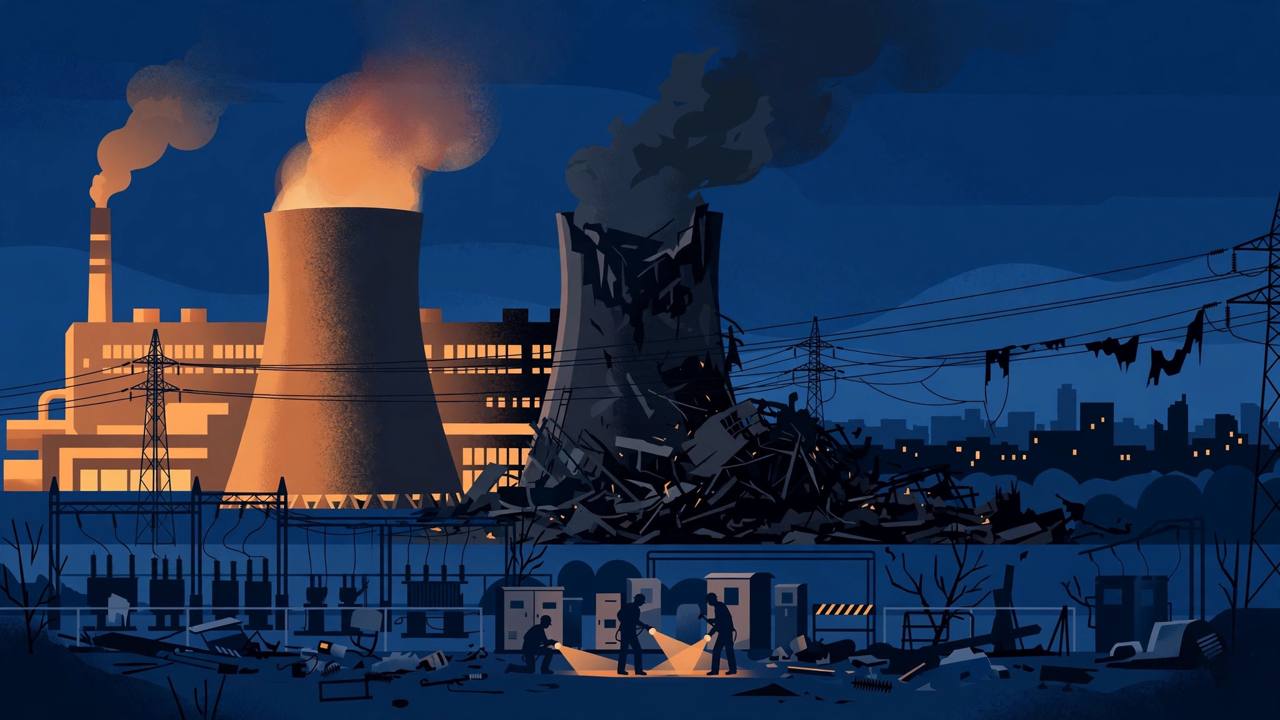
This report adds the energy-grid toll of the same overnight Russian barrage that Awaaz Punjab reported earlier today through its strike on a Kharkiv hospital. President Volodymyr Zelenskiy has since put the injured in that hospital strike at 73, and Ukraine's energy authorities have now detailed the damage to power plants and substations across nine regions. Read the earlier report: barrage hits Kharkiv hospital
KYIV, November 3 — Russia launched a sweeping, multi-wave bombardment of Ukraine's energy infrastructure on Tuesday, knocking out power to swathes of the country with hundreds of drones and dozens of missiles, a week before US-brokered peace talks are due to resume in Abu Dhabi.
Source: Reuters
President Volodymyr Zelenskiy said Russia had launched 289 drones, 17 ballistic missiles and 59 cruise missiles, hitting power plants and substations from the Black Sea port of Odesa in the south to Rivne in the west of the country. In his own account, Zelenskiy called it a complex, massive attack aimed primarily at critical infrastructure, with energy — power generation facilities and substations — as the main target.
Source: Reuters
DTEK, Ukraine's largest private energy-generating company, said three of its five thermal power plants had been knocked offline and halted generation after significant damage; the company reported no injuries at the plants. Ukraine's Energy Ministry counted 20 strikes in 10 regions overnight, and Ukrainian officials said the damage forced emergency and unscheduled power outages across the capital, Kyiv, and at least six other regions.
Source: AAP
Where the power went out
Zelenskiy named nine regions where energy facilities were hit: Odesa, Cherkasy, Zhytomyr, Vinnytsia, Kharkiv, Dnipro, Chernivtsi, Chernihiv and Rivne. In the Zhytomyr region, more than 180,000 customers were without electricity on Tuesday morning and about 130 settlements had lost power, according to the regional governor, Vitalii Bunechko. In the Odesa region, an attack shortly before midnight on Monday heavily damaged a facility run by DTEK Odesa Electric Networks, the company said, and scheduled power outages were in place across the region.
The strikes were not limited to the grid. Prime Minister Sergii Koretskyi said railways were also hit, damaging passenger carriages, locomotives and a train station, Reuters reported.
Zelenskiy: strikes timed for the US vote
"It is very telling that all of this is happening on the day of the US congressional elections," Zelenskiy said, calling for additional air defences for Ukraine. "The Russians believe that America will not notice this signal from them. But such terror must be noticed and stopped." Russia's Defence Ministry said its troops had struck Ukrainian electricity facilities in several regions that supply power to military factories and the Ukrainian army.
Ukraine answered the same night with a drone attack that set fire to a major oil refinery in the Russian city of Yaroslavl, Russian officials said — a strike Awaaz Punjab reported earlier today. Read: Ukraine drones set fire to Yaroslavl refinery
An energy ceasefire that never held
US President Donald Trump announced in September and October that both sides had agreed to halt attacks on energy targets, although neither side confirmed this, Reuters reported. Trump has largely criticised only Ukraine for continuing its strikes on Russia, while saying Russia's behaviour has been "fine". Through more than four years of war, Russia has repeatedly targeted the Ukrainian energy system, destroying generation, distribution and heating facilities in attacks that have worsened each year as the cold winter months approach, while Ukraine has stepped up strikes on Russian oil refineries this year.
What happens next: Kyiv and Moscow are planning trilateral peace talks with the United States in Abu Dhabi on November 10-11, the first since February, and Zelenskiy has said discussions on a proposed energy ceasefire will be high on Ukraine's agenda. The Kremlin has confirmed the Abu Dhabi talks, with Vladimir Medinsky as Moscow's chief negotiator. Whether the energy question moves there — and whether repair crews can restore the three halted DTEK plants before the next wave — will decide how dark Ukraine's winter begins.
The Kremlin has confirmed the November 10-11 Abu Dhabi format and named its chief negotiator. Read: Kremlin confirms Abu Dhabi trilateral talks