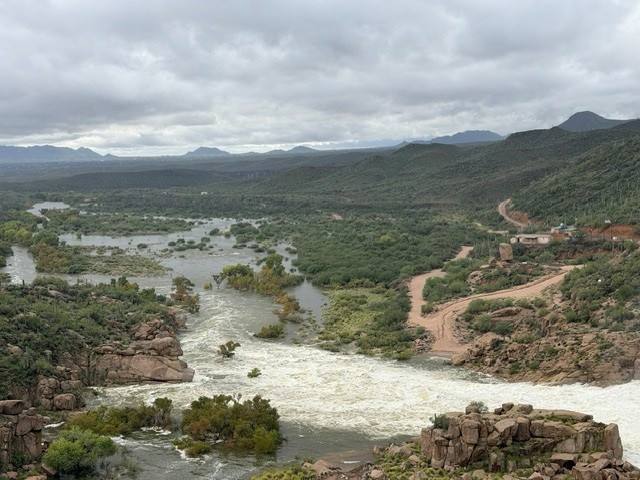
PHOENIX, Arizona — Arizona's Salt River Project (SRP) says its reservoir system captured about 120 billion gallons of water in just five days, as historic storm runoff poured into the Salt and Verde rivers and lifted total storage from 53 percent full on November 1 to 70 percent on November 6, the utility announced on Friday, November 6.
Source: Salt River Project (SRP)
In its November 6 announcement, SRP put the captured volume at about 370,000 acre-feet — roughly 120 billion gallons — collected between November 1 and November 6. KPHO in Phoenix reported the same figures, describing deadly storms that unleashed flooding across Arizona while sending the runoff into SRP reservoirs.
Source: KPHO / Arizona's Family via Gray
How fast the water came in
At the peak of the event, inflows into the Verde River reached an estimated 94,000 cubic feet per second, SRP said, and a regional water report citing SRP data put peak inflow to Theodore Roosevelt Lake, on the Salt River, at about 145,000 cubic feet per second. SRP said October and November inflows on the Verde watershed were on track to be the highest since 1972 — about eight times the average — after three consecutive low-runoff seasons.
Source: Western Water / SRP data
The runoff came from storm systems that moved across central Arizona in late October and early November. The same storms brought destructive and, in places, record-setting flooding to communities across the American Southwest, killed multiple people in Arizona, and led Governor Katie Hobbs to declare a statewide emergency on November 2, according to regional reporting on the floods.
Source: Western Water
Why SRP was releasing water at the same time
Even while storage was rising, SRP was letting large volumes out. On November 1 the utility said it was releasing about 20,000 cubic feet per second from Bartlett Dam, on the Verde River, and Stewart Mountain Dam, on the Salt River. By November 2 the combined releases had risen to about 54,000 cubic feet per second — 403,000 gallons every second — to create the storage space necessary for dam and public safety, SRP said.
Source: Salt River Project (SRP)
“SRP constantly monitors the weather, watershed conditions and reservoir levels to maintain our reliable water supply for the Valley,” Tim Skarupa, SRP's senior manager of atmospheric sciences and hydrology, said in the utility's November 1 release. “These releases create capacity to capture runoff from fall storms, winter precipitation and spring snowmelt.” The released water flowed over Granite Reef Diversion Dam and through the normally dry Salt River bed across the Valley, and KPHO reported that the releases turned Tempe Town Lake into a rushing river.
Source: Salt River Project (SRP)
Background: the system behind the numbers
SRP is a community-based, not-for-profit public power utility and the largest electricity provider in the greater Phoenix metropolitan area, serving about 1.2 million power customers. It provides water to about 2.5 million Valley residents, delivering about 260 billion gallons — 800,000 acre-feet — of water each year, and manages a 13,000-square-mile watershed with a system of reservoirs, wells and 131 miles of canals, the utility says. Unlike the Colorado River system, which has faced shortages during the long drought, SRP says its Salt and Verde system is nearly in balance in a normal year, with annual demand close to annual supply — but in a wet year, runoff can exceed the available storage capacity.
Source: Salt River Project (SRP)
For the roughly 2.5 million people who get water from SRP in the Phoenix Valley, a jump from 53 percent to 70 percent full in five days is a major strengthening of the water supply after three low-runoff seasons. It does not erase the flood damage the same storms caused in Arizona communities, and SRP says it is also evaluating ways to increase storage capacity on the Verde River system.
What happens next
SRP says it will keep monitoring weather, watershed conditions and reservoir levels, and further releases remain possible to balance flood control against storage as winter precipitation and spring snowmelt approach. Formal flood-damage totals for Arizona are still pending a joint state and federal assessment, according to regional reporting, even as the stored water begins the longer work of rebuilding the Valley's reserves. All figures in this report are SRP's announced totals and reporting that cites them; they are preliminary operational numbers and may be revised.
Source: Western Water