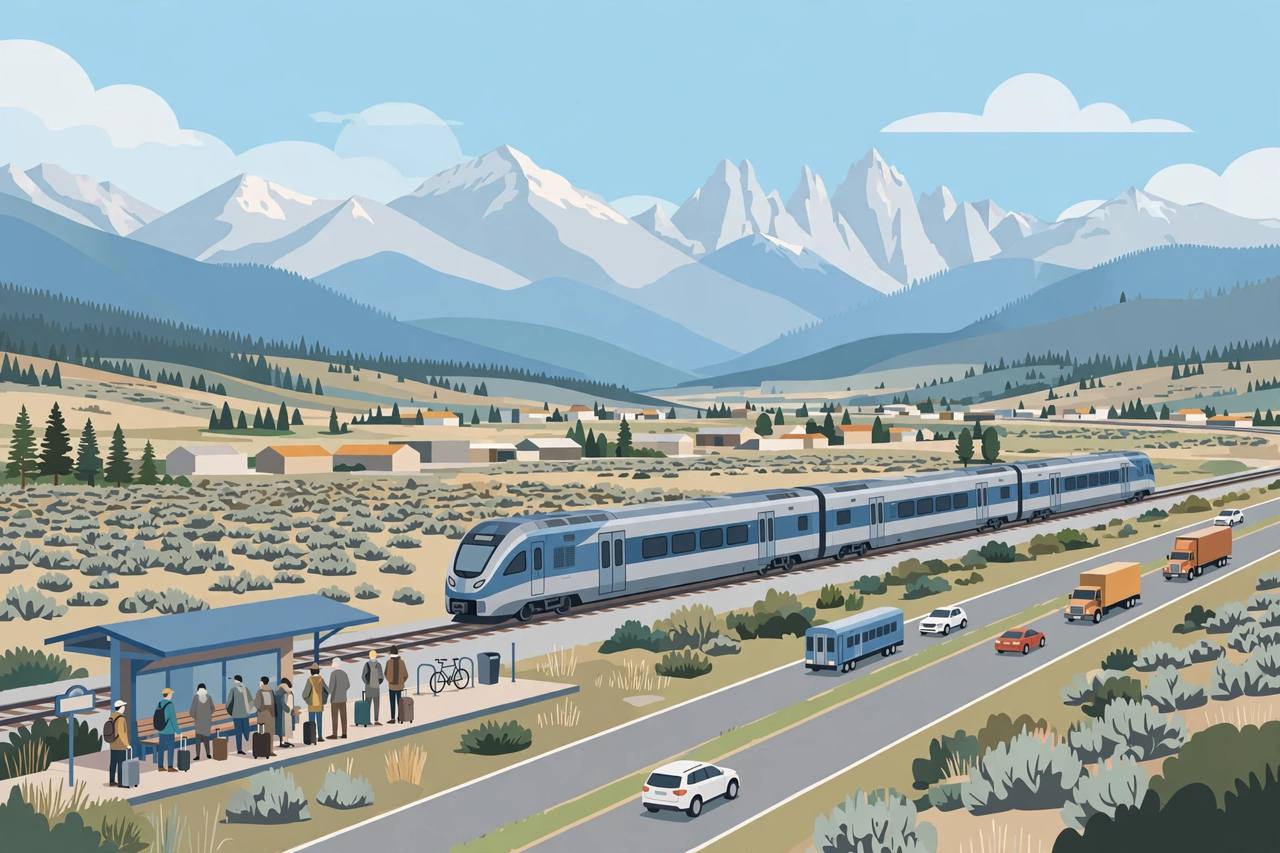
Colorado's long-discussed Front Range passenger railway now has its funding. Voters in the 31 municipalities that make up the Front Range Passenger Rail District approved Ballot Issue 7A, a 0.333% sales and use tax to fund the Colorado Connector service, by 55% to 45%, rail district officials said — a result they called a historic win for a project decades in the making.
Source: Daily Colorado News
The count behind that result was already clear by Saturday morning, November 7. As of 7:10 a.m. that day, 'yes' had 564,918 votes, or 56.95%, and 'no' had 427,060 votes, or 43.05%, in unofficial returns reported for the district. The measure also authorises up to $580 million in debt, on top of the annual tax revenue.
Source: Bucket List Community News
What the tax means for shoppers
A 0.333% sales tax is about 33 cents on every $100 of taxable purchases in the district. District officials project it will generate an estimated $295 million annually — money to build, operate and maintain passenger rail service connecting communities from Pueblo in the south to Fort Collins in the north, through Colorado Springs, Denver, Boulder, Longmont and Loveland.
The next job: final deals with the freight railroads
Passenger trains on this corridor must run on tracks owned by freight railroads, so the vote moves the project straight into its hardest negotiations. An agreement for the northern segment between Denver and Fort Collins, owned and operated by BNSF Railway, is 'close to wrapped up,' according to Sal Pace, the rail district's general manager, who said discussions with BNSF will continue next week. The southern segment between Denver and Pueblo is jointly owned by BNSF and Union Pacific Railroad, with negotiations likely beginning in early 2027, officials said.
Pace said five years of preliminary discussions mean the district already has a clear picture of what the railroads will require. 'We have laid all the groundwork,' Pace told reporters. 'We have a pretty good idea of what those railroads are going to be asking for, based on what we've already gone through with them over the last five years.'
What the service would look like
The full plan calls for 10 daily round trips north of Denver and eight daily round trips on the southern segment, according to district officials. Permanent stations are planned for Fort Collins, Loveland, Longmont, Boulder, Louisville, Broomfield, Westminster, Denver, Littleton, Sterling Ranch, Colorado Springs and Pueblo, with special-event stops also envisioned at the Broncos' future stadium at Burnham Yards and the planned Denver Summit soccer stadium at I-25 and Broadway.
Before any passenger service can begin, the track north of Denver must be upgraded with positive train control, the federally mandated signalling and automated safety system for rail lines carrying passengers. John Putnam, chair of the rail district's board, called that system the project's 'biggest single capital piece.' The northern segment is planned as a joint service with the Colorado Department of Transportation and the Denver area's Regional Transportation District (RTD).
Background: the B Line lesson officials say they learned
Officials have pointed to the history of RTD's B Line, a Denver-to-Boulder commuter route approved by voters in 2004, as a cautionary tale: that project was derailed in part by unexpectedly high costs of leasing tracks north of Denver from BNSF. Pace and other officials have said their extensive engagement with the railroads over the past five years is intended to prevent a similar outcome this time. Governor Jared Polis, who championed the service during his two terms and leaves office in January, said in a statement that the rail line 'will connect Colorado communities, reduce traffic, protect our clean air, and save Coloradans time and money.'
"It shows that Colorado believes in itself, and believes in the ability to do great things. And we've decided that we want to be connected, instead of allowing I-25 to continue to divide us." — Sal Pace, general manager of the Front Range Passenger Rail District, on the Issue 7A result.
The campaign supporting the measure, Coloradans for CoCo, raised about $1.3 million from donors including the Denver Broncos, the Colorado Rockies, Conservation Colorado and donor Pat Stryker, according to campaign finance records cited in reporting on the result.
Why it matters on the I-25 corridor
The Colorado Connector is a passenger service — it will not carry freight — but its corridor is the same I-25 spine that Front Range commuters, delivery drivers and long-haul truckers share every day, and reducing traffic on that highway is one of the benefits its champions cite first. For readers who drive the corridor for work, the practical tests will be the ones officials have now set themselves: a signed BNSF deal for the north, a start to southern talks in early 2027, and trains that actually arrive on the promised dates.
What happens next
BNSF discussions continue next week for the northern segment, and southern-segment negotiations with BNSF and Union Pacific are expected to begin in early 2027. The district has committed to launching service between Denver and Fort Collins by 2029 using already-secured funding, with the full buildout from Fort Collins to Pueblo targeted for 2032. One caution from the election reporting itself: the ballot measure does not guarantee a specific opening date — those 2029 and 2032 dates are district commitments and targets, and they now depend on the railroad agreements being finalised on schedule.