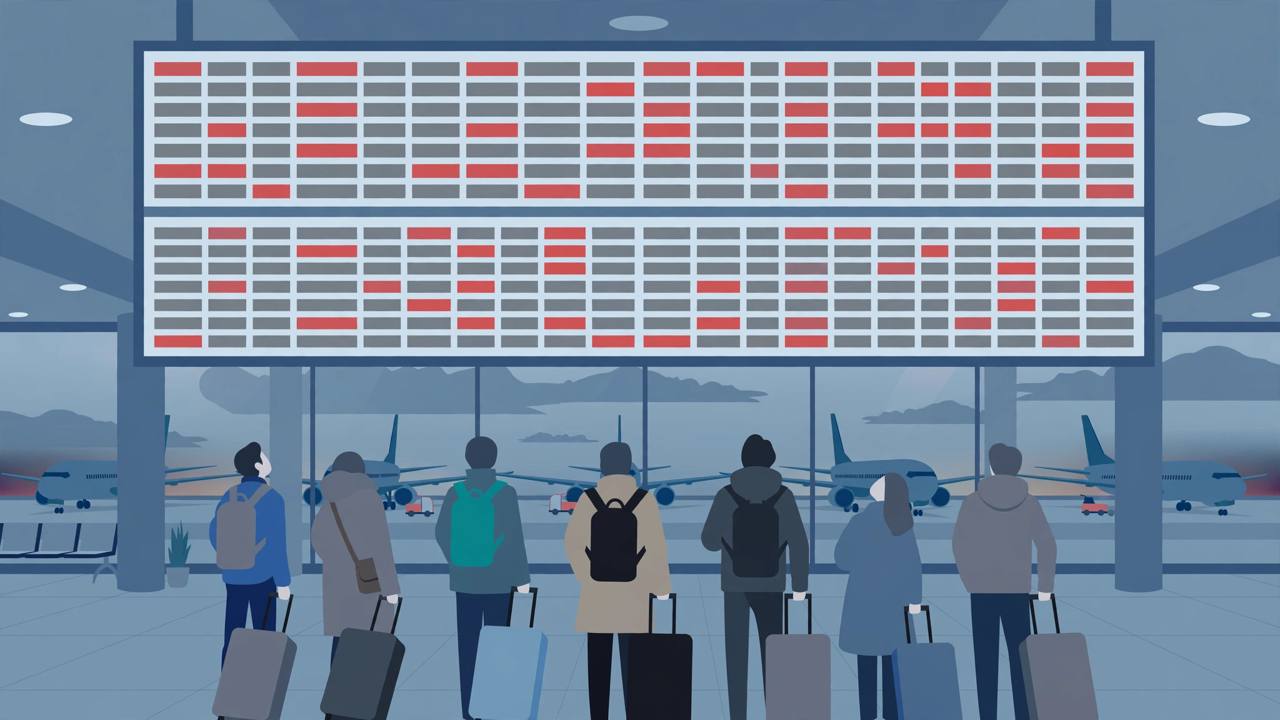
U.S. airlines cancelled more than 2,100 flights on Sunday, November 8, the third and worst day of the Federal Aviation Administration's emergency flight cuts at 40 of the nation's busiest airports, as the record-long federal government shutdown continued to squeeze the air traffic system, the Associated Press reported. In addition, some 7,000 flight delays were reported on Sunday alone, according to FlightAware, the flight-tracking service cited by the AP.
Source: Associated Press
This is a follow-up to the FAA order Awaaz Punjab reported on November 7, when the cuts first took effect. The disruption has grown every day since: more than 1,000 flights were cancelled on Friday, the first day, and more than 1,500 on Saturday, before Sunday's total passed 2,100 — a sign that the slowdown is spreading beyond the 40 listed airports as crews and aircraft end up in the wrong cities.
The FAA reductions started Friday at 4 percent and will increase to 10 percent by November 14 if the shutdown continues — under the order's published steps, 6 percent on November 11 and 8 percent on November 13. They are in effect from 6 a.m. to 10 p.m. local time and impact all commercial airlines at the 40 airports. Airlines choose which flights to cut, and carriers that fly above their limit face a fine of $75,000 per flight, according to the FAA order as reported by Reuters.
Atlanta and Newark hit hardest on Sunday
Hartsfield-Jackson International Airport in Atlanta had the most cancellations in the country on Sunday, with more than 570, followed by Newark Liberty International Airport in New Jersey, with at least 265, the AP reported. The FAA said staffing shortages at Newark and at LaGuardia Airport in New York were leading to average departure delays of about 75 minutes. In Georgia, weather could add to the problem: the National Weather Service office in Atlanta warned of widespread freezing conditions through Tuesday.
The strain was visible on the ground far from the coasts. Detroit Metropolitan Wayne County Airport in Michigan was mostly empty on Sunday morning, with minimal wait times at security checkpoints as delays and cancellations filled the departures and arrivals boards, the AP reported — a picture of travellers who had already been rebooked, or who had simply given up on flying for the day.
Duffy warns traffic could 'slow to a trickle'
Earlier on Sunday, Transportation Secretary Sean Duffy warned that U.S. air traffic could 'slow to a trickle' if the federal government shutdown lingers into the busy Thanksgiving travel holiday season, the AP reported. He said additional flight cuts — perhaps up to 20 percent — might be needed, particularly after air traffic controllers receive no pay for a second straight pay period. The FAA ordered the cuts last week as some controllers, who have gone unpaid since the shutdown began, stopped showing up for work.
The cuts apply to domestic flights at 40 major airports between 6 a.m. and 10 p.m.; international flights are exempt, but a cancelled domestic connection can still break an international trip. Airlines including United, Delta, American and JetBlue have offered flexible rebooking and refunds for affected travellers, according to earlier reporting on the FAA order. Check your flight before leaving for the airport, and expect the required cut to rise to 6 percent on November 11 if the shutdown is still on.
Why this is happening
The shutdown began on October 1 and is now the longest in American history, passing the 35-day record set in 2018-19. About 13,000 air traffic controllers and 50,000 airport security screeners have been working without pay, Reuters reported, and the FAA says the reductions are a safety measure to relieve pressure on a thinning controller workforce. Aviation analytics firm Cirium has estimated that at the full 10 percent reduction, about 1,800 flights and 268,000 airline seats a day would be cut. For the Punjabi diaspora — heavily represented among both US air travellers and the truckers who keep airports and cities supplied — the practical hit is missed family events, broken connections to India-bound flights through hubs such as Newark, Chicago and San Francisco, and tighter delivery schedules around congested airport cities.
What happens next
There was one hopeful development late on Sunday: the Senate voted 60-40 to advance a bipartisan deal to end the 40-day shutdown, funding the government through January 30 — a development the USA desk has covered separately. But Sunday's vote does not reopen the government by itself. The package must still clear final Senate passage and then the House of Representatives, which has not been in session since September 19; House Speaker Mike Johnson has told lawmakers to return to Washington, with the earliest House vote expected on Wednesday. Until a funding bill is signed, the FAA has said the limits stay in place — which means travellers face at least several more days of cuts, stepping up on November 11, even in the best case.