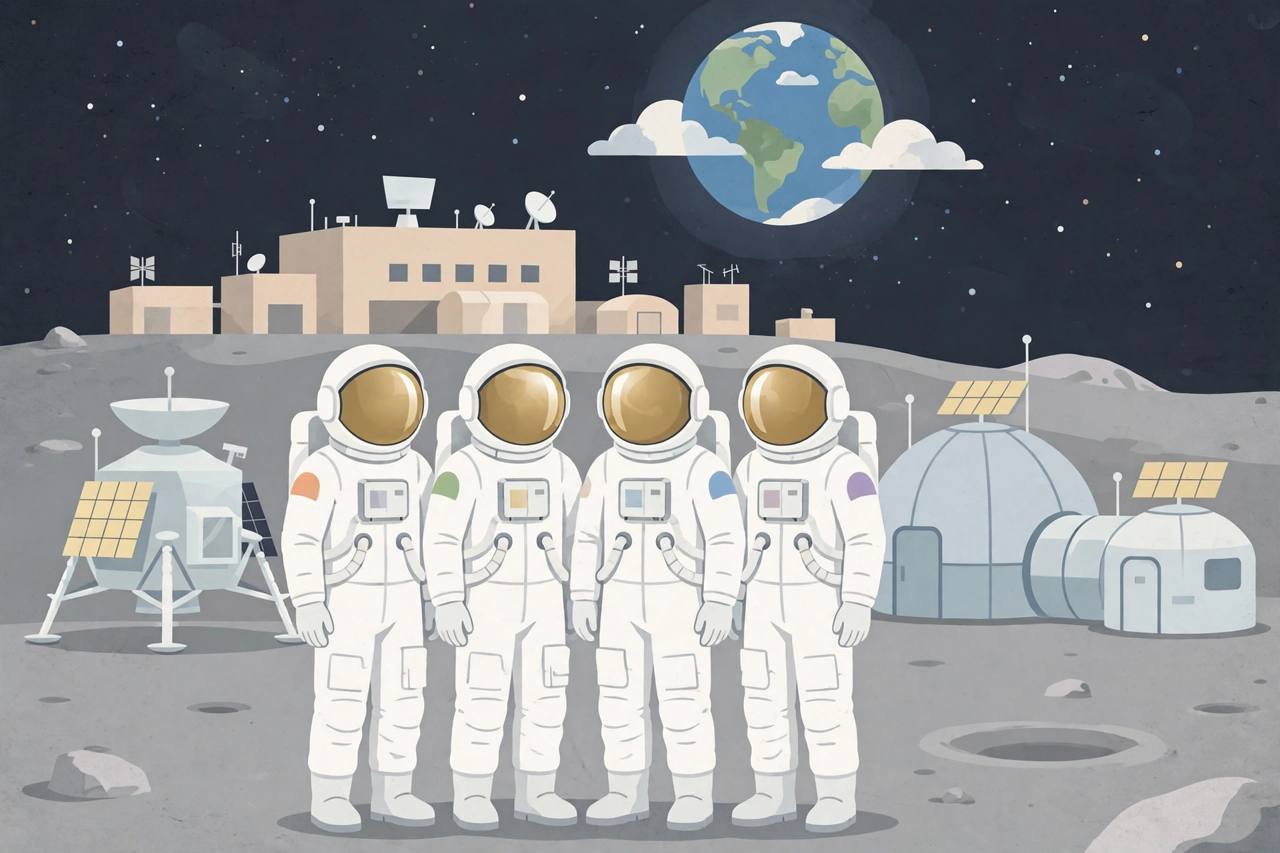
HOUSTON, Texas — NASA has opened applications for its next class of astronauts, inviting U.S. citizens to apply by 11:59 p.m. Eastern time on Thursday, December 3, 2026, for a place in the agency's 25th astronaut class — the first class recruited explicitly to walk on the Moon, live and work at a planned Moon Base and help prepare the first crewed missions to Mars. The agency announced the call on Saturday, November 7, in release RELEASE26-093, and officials unveiled it during an air show at Kennedy Space Center in Florida promoting lunar exploration and advances in aviation and technology, according to the Associated Press.
Source: NASA via NASA Watch
NASA Administrator Jared Isaacman said: “The people we select could walk on the Moon, live and work at the Moon Base, and help pioneer the systems and operations that will ultimately carry crews to Mars.” Deputy Administrator Matt Anderson put the invitation more briefly: “The window is open. The mission is waiting.” Scott Tingle, NASA's chief astronaut, chairs the Astronaut Selection Board at Johnson Space Center in Houston, which will run the selection.
Source: NASA via NASA Watch
Who can apply: a master's degree, three years of experience — and no flying background required
Applicants must be U.S. citizens with a master's degree in a science, technology, engineering or mathematics (STEM) field — engineering, biological science, physical science or computer science — from an accredited institution. NASA also accepts at least two years of doctoral work in a qualifying field or mathematics, a medical degree, or completion of, or current enrolment in, a nationally recognised Test Pilot School programme that finishes by July 2027. Candidates also need at least three years of related professional experience after their qualifying degree.
Source: NASA via NASA Watch
Pilots can meet the experience requirement with 750 hours as pilot in command in high-performance jets, or with other fixed-wing or rotary-wing time at set thresholds. Doctors can count residency training if it is completed by July 2027, and Test Pilot School must also be finished by that date. Everyone must pass NASA's long-duration astronaut flight physical and show leadership, teamwork and communication skills. NASA's selection guidance states explicitly that neither military service nor flying experience is necessary.
Source: NASA via NASA Watch
Why NASA is hiring now: “We have far more work than we have astronauts”
The corps NASA is recruiting into is small for the work ahead of it. The agency has only 32 active astronauts, and its last call for new astronauts was two years ago: more than 8,000 people applied in 2024, with 10 making the final cut in September 2025 — a ratio of roughly 800 applicants for every place, on the last round's numbers. That 2025 class is now nearing the end of roughly two years of training. “We have far more work than we have astronauts,” Artemis III commander Randy Bresnik told the Associated Press on Saturday, urging candidates not to delay: by the time the new class flies, he said, “we're going to have people on the moon.”
Source: Associated Press via Phys.org
The timetable explains the urgency. April's lunar flyaround by the Artemis II crew kicked off the lunar campaign. Next summer, Bresnik and his three Artemis III crewmates will blast into orbit to practise docking their capsule with a pair of lunar landers — one built by Elon Musk's SpaceX and the other by Jeff Bezos' Blue Origin — in a dress rehearsal close to Earth, with no lunar flyby. The following year, Artemis IV will attempt to land two astronauts near the lunar south pole. NASA intends to return astronauts to the lunar surface in 2028, after an absence of more than half a century, and the Moon Base is expected to materialise as more rovers, robots, structures and power grids are launched.
Source: Associated Press via Phys.org
Artemis III astronaut Frank Rubio, whose 371 consecutive days in space is a U.S. endurance record, cautioned applicants that patience is essential: the two years of mandatory training can be gruelling, and it can take several more years before a candidate finally rockets into space. “It's important for them to realise most of that work is not going to the moon,” Rubio told the AP. “That will be about 1% of your experience. What you're doing is contributing to the mission of going to the moon.” Training covers spacewalking, lunar geology and flying high-performance aircraft.
Background: from the Mercury Seven to a Moon Base class
This will be NASA's 25th astronaut class since the original Mercury Seven were selected in 1959, and the agency has selected 370 people as astronaut candidates since the 1960s. Earlier classes were recruited mainly for the International Space Station, which for decades was the main destination for new astronauts. NASA's announcement for this class does not centre on the station: it points instead to operating on the lunar surface, living and working beyond Earth, and building an enduring human presence on the Moon as groundwork for Mars — a shift in what a new astronaut is most likely to spend a career doing.
Source: NASA via NASA Watch
For readers in the Punjabi diaspora — including the engineers, doctors, pilots and scientists in families across California, Texas, New York and Canada — the eligibility rules are the practical part of this story: the door is open to any U.S. citizen who meets the education and experience bar, military service is not required, and the application window is short. NASA has not said how many places the new class will have, so the odds cannot be calculated until the class size is announced.
Source: Associated Press via Phys.org
What happens next
Applications close at 11:59 p.m. EST on Thursday, December 3, 2026. NASA's published timetable then runs through application review from December into April 2027, initial interviews and assessments at Johnson Space Center in Houston in the spring, and final interviews during the summer. The agency expects to make its final selection in late 2027, with the chosen candidates reporting to Johnson Space Center and beginning their training in winter 2027–28 — the same period in which NASA intends its return to the lunar surface. Full details and the application link are on NASA's astronaut recruitment page.
Source: NASA via NASA Watch