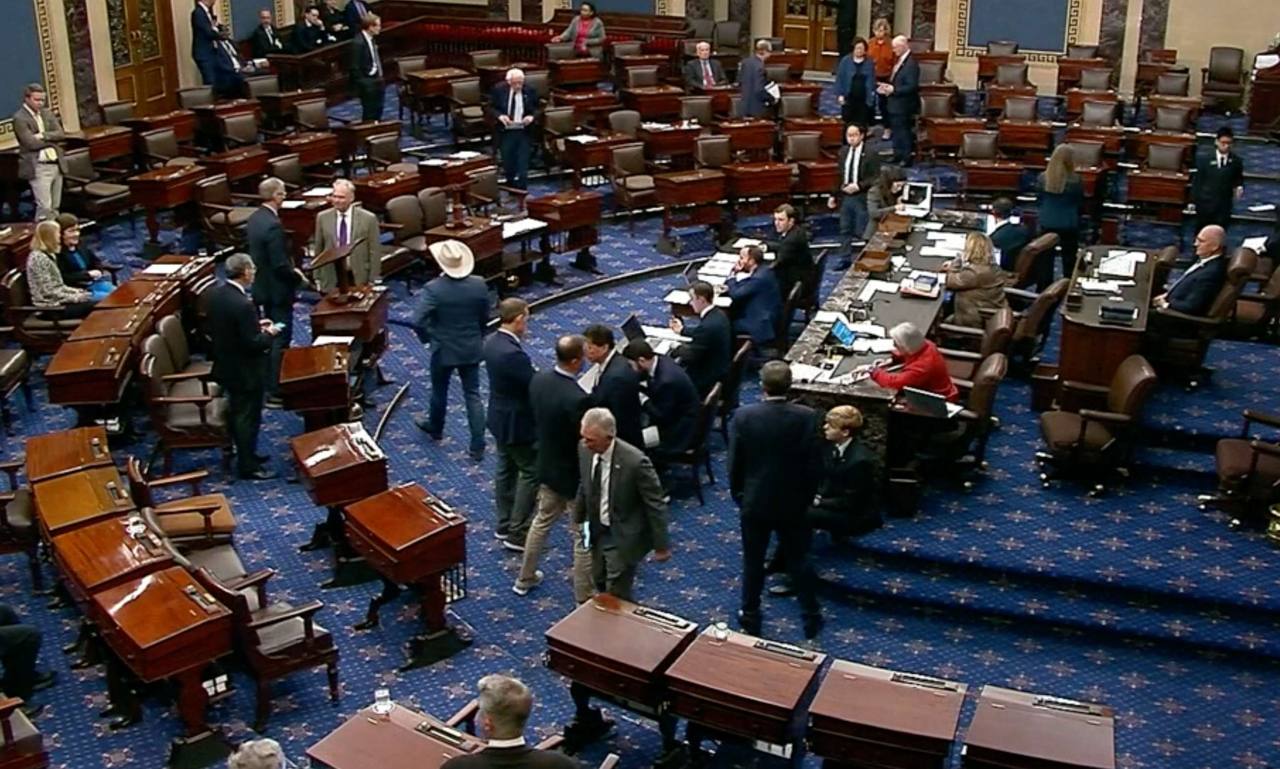
The United States Senate voted 60-40 late on Sunday night to advance a bipartisan deal that could end the longest government shutdown in American history, breaking a 40-day stalemate that has left federal workers unpaid, delayed food aid for millions of Americans and snarled air travel across the country.
Source: States Newsroom via Panhandle Post
Seven Senate Democrats and one independent joined Republicans to clear the 60-vote procedural hurdle, known as a cloture vote. The Democrats who broke with their party leadership were Dick Durbin of Illinois, John Fetterman of Pennsylvania, Maggie Hassan and Jeanne Shaheen of New Hampshire, Tim Kaine of Virginia, and Catherine Cortez Masto and Jacky Rosen of Nevada. Angus King of Maine, an independent who caucuses with Democrats, also voted in favour. Republican Senator Rand Paul of Kentucky was the only member of his party to vote no.
What the deal contains
The package uses a House-passed stopgap bill as its vehicle and combines it with three full-year fiscal 2026 spending bills — covering agriculture programs, veterans benefits and military construction, and Congress itself — alongside an updated continuing resolution that would fund the rest of the government through January 30. The agreement would reinstate all federal employees fired after the shutdown began, restoring their jobs with back pay, and would prohibit any further layoffs until the temporary funding expires.
The deal fully funds the Supplemental Nutrition Assistance Program, known as SNAP, which serves about 42 million lower-income Americans, as well as children's nutrition programs including subsidised school breakfasts and lunches. It would direct $8.2 billion to the Special Supplemental Nutrition Program for Women, Infants and Children, known as WIC — roughly a $600 million increase over last year — including fresh fruit and vegetable subsidies for mothers with children and monthly food boxes for low-income seniors, and it would replenish the $150 million in Agriculture Department contingency money used to keep WIC running during the shutdown.
Source: States Newsroom via Panhandle Post
Health care was left out — and Democrats are divided
On the central sticking point of the 40-day fight, the deal does not extend the Affordable Care Act premium subsidies that expire at the end of this year. Instead, Senate Majority Leader John Thune of South Dakota committed on the Senate floor to holding a separate vote on extending the subsidies no later than the second week of December — a vote with no guaranteed outcome. Senate Democratic leader Chuck Schumer voted against advancing the package, along with most of his caucus. Senator Richard Blumenthal of Connecticut said before the vote: 'So far as I'm concerned, health care isn't included, so I'll be a no.' Senators Chris Van Hollen of Maryland, Tammy Baldwin of Wisconsin and Andy Kim of New Jersey also declared their opposition.
Those who crossed over defended the compromise. Senator Jacky Rosen said Democrats now have 'an opportunity also to put Republicans on the record on the ACA,' adding: 'If Republicans want to join us in lowering costs for working families, they have the perfect opportunity to show the American public.' Senator Tim Kaine, whose Virginia is home to a large federal workforce, said: 'This deal guarantees a vote to extend Affordable Care Act premium tax credits, which Republicans weren't willing to do.' Fetterman, King and Cortez Masto had already voted with Republicans on all 14 previous votes to reopen the government; until Sunday, Republicans did not have the 60 votes needed to clear the filibuster threshold.
Source: Al Jazeera explainer
The shutdown that began on October 1 has hit services immigrant families use every week: food benefits for about 42 million people were disrupted at the start of November, nearly a million federal workers have missed paycheques, and the Federal Aviation Administration began cutting flights at 40 major airports on Friday, with cuts set to rise to 10 percent — affecting routes through hubs such as Chicago, New York, Los Angeles and San Francisco that diaspora families and Punjabi truckers' freight schedules depend on. A reopening would restore pay, benefits and normal airport operations, but only after the House also passes the bill.
The human cost of 40 days
The shutdown began on October 1 and has lasted 40 days, the longest in United States history, passing the previous 35-day record. Nearly a million federal workers have missed paycheques, including about 13,000 air traffic controllers who have been working without pay. Food benefits for the poorest Americans stopped flowing at the beginning of November, setting off a court fight: a Rhode Island federal judge ordered the administration to release November SNAP benefits in full, the Supreme Court stayed that decision after an administration appeal, and a department memo on Saturday told states that had released full benefits to take back a portion of them. President Donald Trump, leaving a Washington Commanders football game in Landover, Maryland, on Sunday night alongside House Speaker Mike Johnson, told reporters: 'It looks like we're getting very close to the shutdown ending.'
A hemp provision is already drawing fire
One little-noticed provision has alarmed hemp farmers. The Hemp Industry and Farmers of America said in a Sunday statement that a clause in the bill would 'effectively eliminate the legal hemp industry built under the 2018 farm bill.' The group's executive director, Brian Swensen, said lawmakers were 'slamming the door on 325,000 American jobs and forcing consumers back to dangerous black markets,' and argued the industry had offered to work on responsible regulation — age restrictions, testing requirements and proper labelling — instead of what it called a prohibition slipped into an appropriations deal. The job figure is the industry group's own claim and has not been independently verified.
What happens next
Sunday's vote does not reopen the government by itself. The legislation must clear further Senate procedural steps and final passage, then win approval in the House of Representatives — which has not been in session since September 19 — before going to President Trump for his signature, a process that could take several days. House Democratic leaders reacted angrily on Sunday night: Minority Leader Hakeem Jeffries said the bill 'fails to extend the Affordable Care Act tax credits' and warned that 'tens of millions of everyday Americans are going to see their costs skyrocket,' while Representative Rosa DeLauro, the top House Democratic appropriator, said she had not agreed to attach the veterans and military construction bill to the deal, and Representative Angie Craig of Minnesota called herself 'a no.' If the package clears both chambers and is signed, federal agencies would reopen, fired workers would return with back pay, SNAP and WIC funding would be secured, and the FAA flight cuts would be lifted — but the fight over health-care subsidies would return in December, and the stopgap itself expires on January 30.