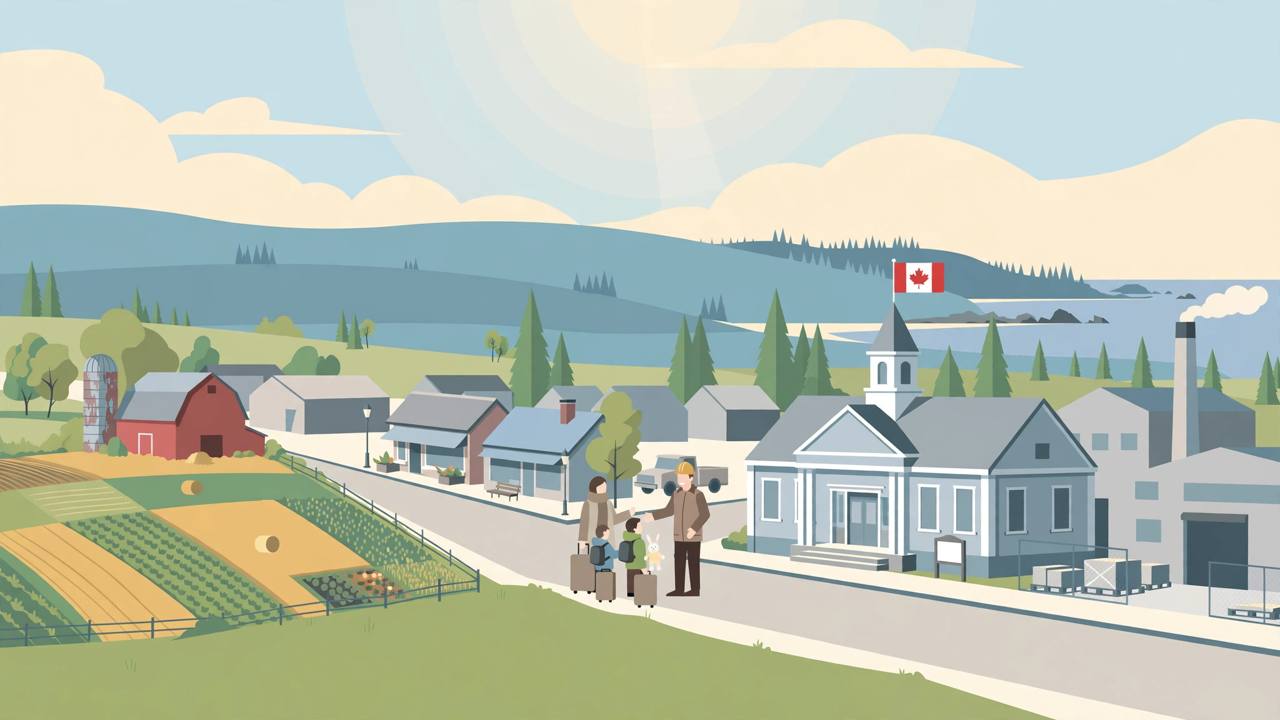
PICTOU COUNTY, Nova Scotia — Canada has made its Rural Community Immigration Pilot a permanent program, Immigration, Refugees and Citizenship Minister Lena Metlege Diab announced on Monday, November 9, in Pictou County, Nova Scotia. The change, first announced in Budget 2026, turns a pilot launched in January 2025 into a standing permanent-residence pathway for skilled workers and international graduates willing to settle in smaller, rural and remote communities facing persistent labour shortages.
Source: Immigration, Refugees and Citizenship Canada news release, Nov 9 2026
"Our government understands that rural communities play a critical role in powering Canada's economy. At the same time, many face real challenges finding the workers they need," Diab said. "That's why we're transitioning our successful rural immigration pilot into a permanent program — helping smaller communities attract and retain essential workers who deliver services and drive economic growth." Sean Fraser, the minister responsible for the Atlantic Canada Opportunities Agency and MP for Central Nova, said the program was helping Pictou County businesses keep workers who "have become our neighbours and friends, and want to build their lives here."
Source: IRCC news release, Nov 9 2026
The 14 communities — and how the program works
The permanent program intends to continue with the 14 pilot communities: Pictou County (Nova Scotia); North Bay, Sudbury, Timmins, Sault Ste. Marie and Thunder Bay (Ontario); Steinbach, Altona/Rhineland and Brandon (Manitoba); Moose Jaw (Saskatchewan); Claresholm (Alberta); and West Kootenay, North Okanagan Shuswap and Peace Liard (British Columbia). More communities may be added later; a community qualifies if its population is under 200,000 and it scores 0.20 or higher on Statistics Canada's Index of Remoteness. Each community names its own priority sectors and occupations, vets and designates employers in good standing, and only designated employers can hire through the program. New employer training, monitoring and reporting rules are meant to strengthen program integrity.
Source: IRCC backgrounder: Overview of the Rural Community Immigration Program, Nov 9 2026
What the numbers say — and what happens next
Under Canada's 2027–2029 Immigration Levels Plan, the rural program has its own admissions line: 5,500 spaces in 2027, rising to 6,000 in 2028 and 6,500 in 2029, according to the plan's published tables. Communities are expected to begin issuing recommendations under the permanent program from January 1, 2027, while recommendations under the existing pilot can be finalised until the end of 2026, according to the implementation information published with the announcement. The program builds on the earlier Rural and Northern Immigration Pilot (2019–2024), in which more than 2,800 employers took part and over 12,500 candidates and family members were admitted. In 2025 and 2026, pilot newcomers filled shortages in health care, education, and sales and services, IRCC said.
Source: IRCC news release and backgrounder, Nov 9 2026; levels-plan tables via Moving2Canada, Nov 5 2026
Canada's immigration shifts land directly on Punjabi and Indian workers and international graduates, who form a large share of Canada's temporary workforce. A permanent rural pathway means a designated job in a smaller community — including trucking, health care and service-sector hubs across Ontario, Manitoba, Alberta and British Columbia — can now lead to permanent residence without the pilot's expiry date hanging over the application. Eligibility still runs through the community: a genuine job offer from a designated employer in a priority occupation comes first.
The announcement is part of a wider reset in which Ottawa says it is bringing down the temporary-resident population while keeping pathways open for workers already living and contributing in Canada. For applicants, the practical next step is the community itself: each of the 14 communities publishes its priority occupations and designated-employer process, and IRCC says the criteria for new communities in any future expansion will come in a later announcement.