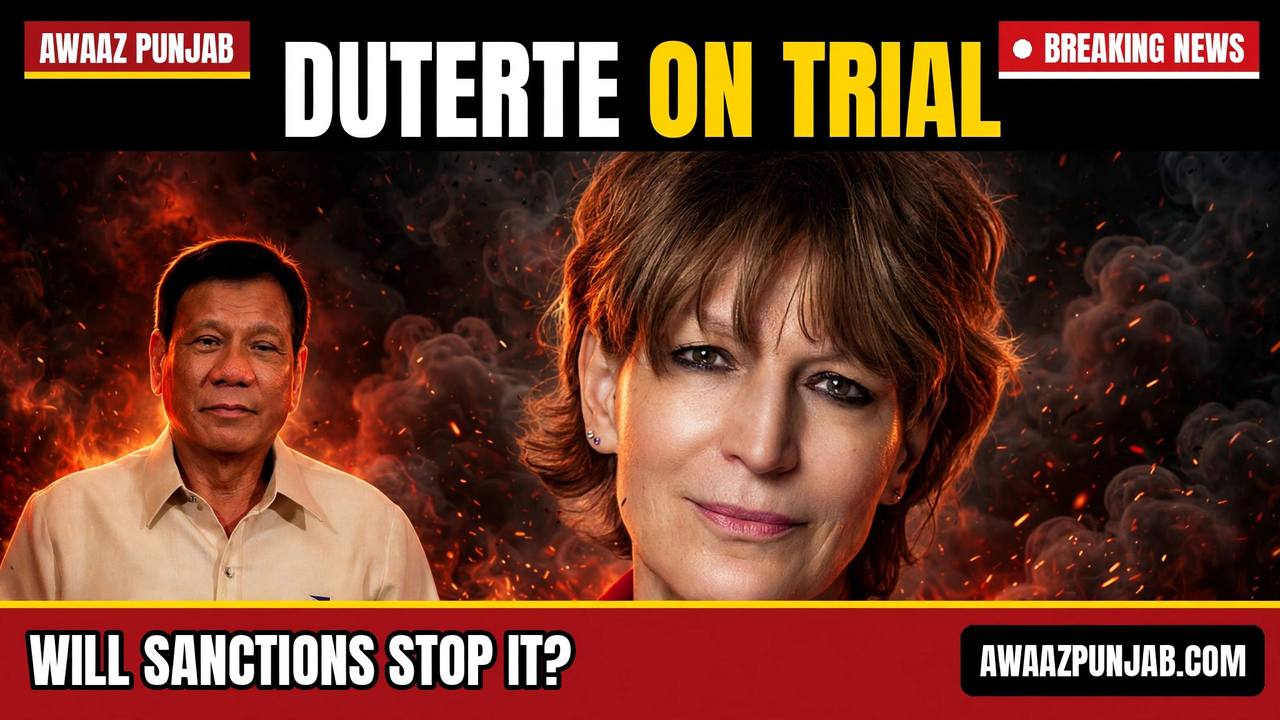
Former Philippine president Rodrigo Duterte goes on trial at the International Criminal Court in The Hague on November 30, facing three counts of crimes against humanity over killings during his war on drugs — and the head of Amnesty International is warning that the trial itself is now at risk from the United States' sanctions campaign against the court.
Source: ICC
Amnesty International secretary general Agnès Callamard raised the warning in Quezon City on November 20, ten days before the trial opens, at the launch of 'Walang Pahimakas', an anthology of poems remembering the victims of Duterte's anti-drug campaign. Callamard is back in the Philippines after the government lifted an immigration ban imposed on her during the Duterte administration, when she was the United Nations special rapporteur on extrajudicial executions.
Source: Amnesty International Philippines
The warning: sanctions could stop the trial
Callamard said the US sanctions against the ICC threaten the court's ability to function, and with it the Duterte case. In a message posted on November 20, Amnesty said the trial is due to start on November 30, could take a year or more to reach a judgment, and 'if no action is taken to protect the ICC against the US sanctions, the trial may never proceed past the month of April.'
Source: Amnesty International
She appealed directly to the governments of the G7 — including Canada, Britain, France, Italy and Germany — not to appease Washington over the court, saying the families of the victims have one message: the threats and sanctions mean they may never see justice for thousands of state-sanctioned killings carried out with near-total impunity.
Callamard also said that although Duterte is detained in The Hague, the families of victims in the Philippines are still afraid to seek justice at home. 'How can it be that Duterte is in prison in The Hague, and yet people are scared here now?' she asked on November 20, after spending two days meeting victims' families. She said accountability in the Philippines is still not possible, calling that an indictment of the current government, and urged the Marcos administration to deliver independent investigations, witness protection and prosecutions.
Source: Europe Says
How the US sanctions campaign reached the court
The Trump administration has built the pressure in stages under Executive Order 14203. On August 18, 2026, Secretary of State Marco Rubio sanctioned ICC President Tomoko Akane and senior trial lawyer Abdoulaye Seye. On October 9, the US designated the court itself on its sanctions list, with Rubio saying: 'We will ban transactions with this rogue court, cutting off their resources and crippling its ability to operate against us,' and adding, 'Either the ICC will end its threats, or we will end the ICC.'
Source: Reuters
The October 9 designation blocks the court's property in the United States and bars Americans from dealing with it, with four general licences allowing a 180-day wind-down and limited activity such as telecommunications, software, pensions and detention matters. The 180-day period runs to about April 2027 — the same month Callamard warned the trial may not reach.
Source: Reuters
The US has now designated 18 people under the order, including nine of the court's 18 judges. UN Secretary-General António Guterres condemned the October move, and the court called the August sanctions a 'flagrant attack' on its independence.
Source: UN News
The charges Duterte faces
Duterte, 81, is charged with three counts of crimes against humanity — murder and attempted murder — allegedly committed between November 1, 2011 and March 16, 2019. The first count covers murders in and around Davao City by the so-called Davao Death Squad while he was mayor; the second covers the killing of high-value targets after he became president; the third covers murders and attempted murders in village clearance operations. The confirmed charges rest on 76 killings and two attempted murders, drawn from a far larger toll: Philippine police put the number killed in anti-drug operations at about 6,000.
Source: ICC
The case has moved unusually fast for the court. Duterte was surrendered to ICC custody on March 12, 2025, five days after the arrest warrant was issued. Pre-Trial Chamber I confirmed all three charges unanimously on April 23, 2026, after a confirmation hearing in February, and Trial Chamber III ruled on October 8 that he is fit to stand trial. Prosecutors expect to call 60 to 70 witnesses, including 31 insiders said to have direct knowledge of how the killings were planned. The Philippines left the Rome Statute in 2019 on Duterte's own instruction, but the court's Appeals Chamber ruled in April 2026 that it keeps jurisdiction over crimes committed while the country was a member.
What happens on November 30
The trial opens at 10:00 in The Hague before Trial Chamber III — Presiding Judge Joanna Korner, Judge Keebong Paek and Judge Nicolas Guillou. The judges will first confirm Duterte understands the charges and take his plea, then hear opening statements: six hours for the prosecution and three hours for the victims' representatives. The first prosecution witness follows. Hearings will be streamed with a 30-minute delay. Duterte has not appeared in person at earlier hearings, and his lawyers have pressed health and memory concerns; the court has ordered measures to help him take part.
Source: Diplomat Magazine
What is solid
- The trial opens on November 30, 2026, before Trial Chamber III in The Hague.
- All three charges were confirmed unanimously on April 23, 2026.
- The United States designated the ICC itself on its sanctions list on October 9, 2026.
What is only claimed
- Whether US sanctions will in practice stop the Duterte trial from reaching a verdict.
- The full death toll of the drug war — police put anti-drug operation deaths at about 6,000; the confirmed charges cover 76 killings.
This is the first time a former Asian head of state stands trial at the ICC, and the court's biggest test is no longer only the case in front of it — it is whether the court can keep functioning while the United States tries to cut off its money and services. For the victims' families, November 30 is the first fixed date in a wait that began years ago.
What happens next will be decided in two places at once: in the courtroom in The Hague, where the trial is expected to run for a year or more, and in capitals, where Callamard is pressing governments to protect the court rather than appease Washington. If the court's funding and services hold, the trial proceeds; if they do not, the case that took more than a year to bring to trial could stall before it reaches a verdict. For the large Filipino community in Canada and the Gulf, many of whom followed the drug war from abroad, the opening on November 30 is the moment the case finally moves from charges to evidence.