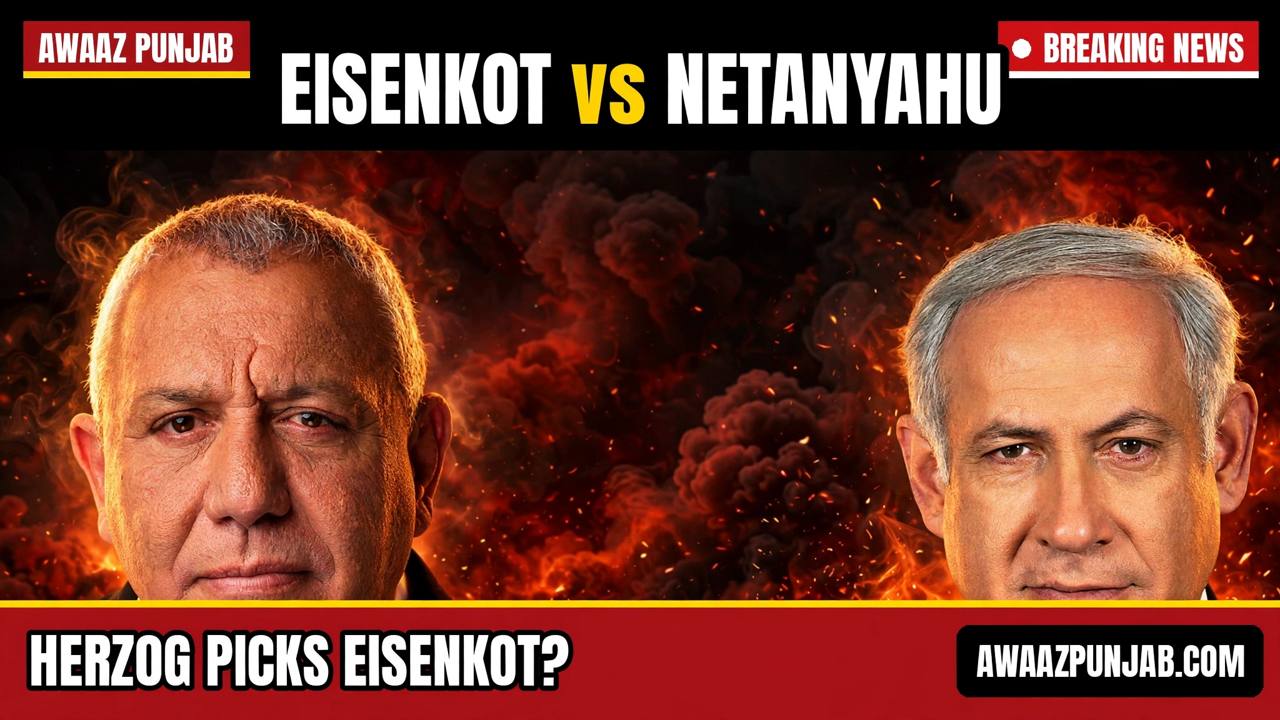
This report follows our earlier story on the presidential consultations, in which Eisenkot won the backing of 67 lawmakers to Netanyahu's 46. President Herzog has now made the decision those consultations pointed to: Eisenkot, not Netanyahu, gets the first chance to form a government. Read the earlier recommendations report
Jerusalem, November 7: Israeli President Isaac Herzog said on Saturday night that he was giving opposition candidate Gadi Eisenkot the first opportunity to form a governing coalition following the elections of October 27, the Associated Press reported — a setback for Prime Minister Benjamin Netanyahu, Israel's longest-serving premier, who ran against Eisenkot as his main challenger.
Source: Associated Press via WHRO
Herzog's office confirmed the decision on Saturday. 'President Herzog has invited Gadi Eisenkot to the President's Residence, where he will be tasked with forming the government tomorrow,' a spokesperson said, according to AAP. NPR reported the formal handover of the mandate will take place at 5 p.m. local time on Sunday. The president's role in nominating a candidate to form a coalition after an election is largely ceremonial, but the choice decides who negotiates first.
Source: AAP — Israeli president picks Eisenkot to form government
Neither Eisenkot nor Netanyahu won a clear majority on October 27. Netanyahu's Likud party won 27 seats — six more than Eisenkot's Yashar party — in the 120-seat Knesset, but neither man commands the 61 seats needed for a majority. In this week's presidential consultations, Eisenkot collected recommendations from 67 lawmakers against 46 for Netanyahu, after the two Arab-led parties — the Joint List, with 11 seats, and Ra'am, with 8 — recommended him, joining 48 lawmakers from four Jewish-led parties.
Source: The Media Line — Eisenkot secures majority of endorsements (Nov 5)
The blocs behind the two men are narrower than the recommendation tally: Eisenkot's own four-party bloc holds 48 seats and Netanyahu's allies 53, while Arab-majority parties hold 19 — so Eisenkot's 67 recommendations are endorsements, not a signed coalition agreement, and the Arab parties' support does not by itself mean they will join his government.
Source: Associated Press via WHRO
The announcement, which had been expected on Sunday, came shortly after Netanyahu called in a video statement for a 'national unity government' and warned against 'hastily swearing in a government with terrorist supporters' — an apparent reference to the Arab-led parties backing Eisenkot, the AP reported. Netanyahu and his allies have repeatedly portrayed the Arab-led parties as a threat to national security. Eisenkot's Yashar party slammed the prime minister's video in a statement posted on X and urged members of Likud to disavow their alliance with the religious-nationalist parties in Netanyahu's coalition, the AP reported.
Source: Associated Press via WHRO
Eisenkot, a former chief of staff of the Israel Defense Forces who served as the country's top military commander from 2015 to 2019, leads Yashar, the centrist party he founded on an anti-corruption and government-reform platform. After the October 7, 2023 Hamas attacks he joined Netanyahu's emergency war cabinet, but left the following year, accusing Netanyahu of failing to make progress toward ending the Gaza war and securing the release of hostages. Eisenkot lost his son Gal, a reservist killed in Gaza, as well as two nephews, during the war.
Source: NPR — Israel's president taps opposition candidate
His path to 61 is not straightforward. AAP reported that Eisenkot has declined to join forces with the Arab parties — whose support would give him a majority — even though Arab leaders, angered by what they view as the racist policies of Netanyahu and his ultranationalist allies, still nominated him to go first. The AP reported Eisenkot has indicated a willingness to work with them under certain conditions, including calling Hamas a terrorist group that needs to be destroyed. His possible routes, as AAP listed them, are a minority government with Arab support from outside, a coalition with ultra-Orthodox parties he and his allies have shunned, or a unity government with Netanyahu — and analysts cited by AAP say all three options are unlikely to take shape.
Source: AAP — Israeli president picks Eisenkot to form government
What happens next
Once he formally receives the mandate on Sunday, Eisenkot has 28 days to forge a government, with a possible 14-day extension — up to six weeks of negotiations. Netanyahu remains caretaker prime minister in the meantime. If Eisenkot fails, Herzog can give another lawmaker a chance; if that effort and any parliamentary nomination also fail — the whole process has a deadline of about 100 days — Israel would face another election, AAP reported.
What is solid
- Herzog announced on Saturday night that Eisenkot gets the first opportunity to form a government, and his office confirmed Eisenkot will be tasked at the President's Residence on Sunday
- Likud won 27 seats and Yashar 21; neither bloc holds the 61 seats needed for a Knesset majority
- Eisenkot won 67 recommendations to Netanyahu's 46 in the presidential consultations
- Eisenkot has 28 days, plus a possible 14-day extension, once the mandate is formally handed over
What is only claimed
- Whether Eisenkot can turn 67 recommendations into a governing coalition is unresolved — his own bloc holds 48 seats and the Arab parties that recommended him have not agreed to join his government
- Netanyahu's warning about a government with 'terrorist supporters' is his characterisation of Arab-party backing for Eisenkot; Yashar rejects it and calls his unity appeal divisive
How Eisenkot reached this point — the consultations in which he won 67 recommendations — is in our earlier report: Read the recommendations report