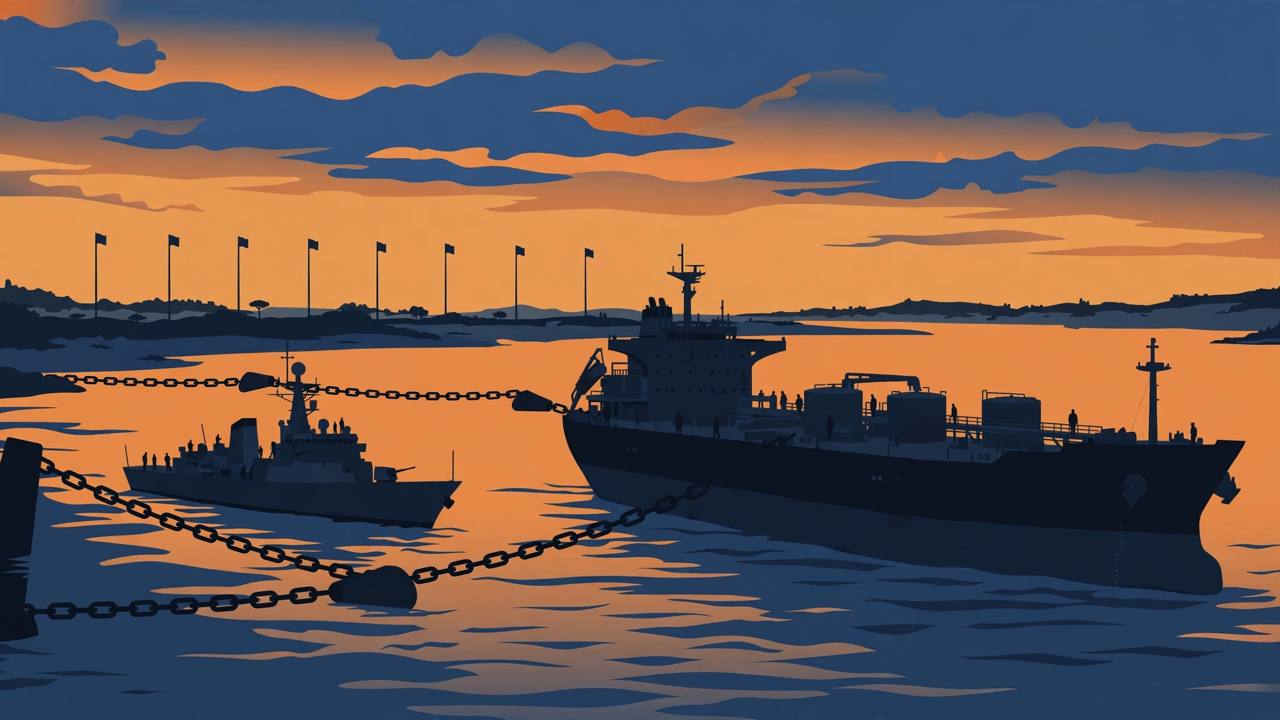
Iran warned every foreign government on Thursday, November 12, that helping the United States in any form — sending warships, moving military equipment, or providing logistical support — will be treated as taking part in the attack on Iran itself. Foreign Ministry spokesman Esmaeil Baqaei issued the warning in a post on X, reacting to the joint statement the G7 foreign ministers issued after their meeting in Paris, and said any state that joins in will bear full responsibility for the consequences.
Source: Press TV, Nov 12, 2026
"Any direct or indirect involvement in acts of aggression or in inhumane economic terrorism against Iran — including the deployment of naval forces, military and logistical support equipment and personnel — will be regarded as a hostile and unlawful act amounting to participation in the US aggression against Iran," Baqaei wrote. The warning was reported independently the same day by Hatha Alyoum English and in Pakistan TV's Middle East live coverage, which carried the same statement at 22:33 GMT.
Source: Hatha Alyoum English, Nov 12, 2026
Baqaei closed off the legal cover that escort missions usually sail under. "Invoking seemingly legitimate pretexts such as 'protecting freedom of navigation' or 'countering piracy' does not alter the unlawful and hostile nature of such actions," he said. "No bilateral agreement or commitment with the United States can constitute legitimate grounds for violating a state's obligations under international law or for participating in the US-Israeli military aggression against Iran," he added. "Any state that may participate in such unlawful aggressions, in whatever form, shall bear full responsibility for the resulting repercussions."
Source: Press TV, Nov 12, 2026
Tehran grounded the warning in international law, invoking Article 2(4) of the UN Charter — which prohibits the threat or use of force against a state's territorial integrity or political independence — and UN General Assembly Resolution 3314, the UN's definition of aggression. The statement is an Iranian government position, attributed here to its spokesman; it is not a UN ruling, and no G7 government had publicly answered Baqaei's post by Thursday evening Washington time, according to reporting tracking the statement.
Source: Press TV, Nov 12, 2026
What Tehran was answering — the G7's Paris demands
The G7 foreign ministers — Canada, France, Germany, Italy, Japan, the United Kingdom and the United States, with the European Union — met in Paris on November 9 and 10 and issued their joint declaration on November 11. In it they demanded that Iran halt attacks on civilian shipping in the Strait of Hormuz and condemned Tehran's interference with maritime traffic through the narrow waterway, a vital route for global oil exports, The Media Line reported, adding that US Secretary of State Marco Rubio advocated continued economic pressure on Iran, citing Reuters reporting from diplomats at the talks. The ministers also condemned Houthi attacks on Saudi Arabia and called for Hezbollah to surrender its weapons in Lebanon.
Source: The Media Line, Nov 12, 2026
Awaaz Punjab's full report on the G7 Paris joint statement — its ceasefire demand for Ukraine, its Hormuz terms and its line that Iran must never get a nuclear weapon — is here: Read: G7 Paris Joint Statement in full
A Korean proverb, aimed at Seoul
Baqaei opened his message with a Korean proverb: "A sparrow that tries to fly after a stork will eventually break its legs." Press TV noted the choice of a Korean saying appeared deliberate, in light of reports that South Korea is considering expanding the operating area of its Cheonghae anti-piracy naval unit towards waters south of Oman, bringing it closer to the Strait of Hormuz. Seoul announced on November 5 that it plans to expand the Cheonghae mission — adding a P-8A Poseidon patrol aircraft and mine-clearing specialists — while keeping its forces outside the strait itself; Seoul has said the mission is intended to protect South Korean vessels and nationals and safeguard maritime navigation, while Tehran has cautioned against letting the expanded deployment facilitate US-led military action against Iran.
Source: Press TV, Nov 12, 2026
Why the warning matters beyond the warships
The Strait of Hormuz carries a large share of the world's seaborne oil, and the US-Israeli war on Iran that began on February 28 has kept the waterway at the centre of the conflict — this week alone has brought Iranian claims of tankers catching fire after hitting mines in and near the strait, claims Awaaz Punjab has reported as attributed Iranian statements. A warning that formally puts third countries on notice raises the stakes for every navy weighing an escort or mine-clearing deployment near the Gulf — and for the Gulf states themselves, where lakhs of Indian and Punjabi workers live and work and whose ports, airports and energy plants sit inside the war's geography.
Source: Pakistan TV Middle East live blog, Nov 12, 2026
The statement also lands in a week of hardening Iranian positions: on November 7 the IRGC said Iran's self-imposed 2,000-kilometre ballistic-missile range limit had been lifted on the Supreme Leader's directive, and Iran's security chief Mohsen Rezaei has warned that US bases involved in any new attack — from West Asia to Europe — would be targets. Those are Iranian officials' stated positions, reported here as such; Washington has said its forces continue to work to keep Hormuz open for commercial shipping.
Source: Press TV, Nov 12, 2026
Watch three things: whether any country announces a naval escort or mine-clearing deployment near Hormuz anyway — South Korea's Cheonghae expansion still needs parliamentary approval in Seoul; whether a G7 capital or Washington answers Baqaei's legal warning publicly; and the UN Security Council's urgent Middle East meeting requested by Bahrain, where Gulf security and the Hormuz shipping crisis are expected to be at the centre of the debate.