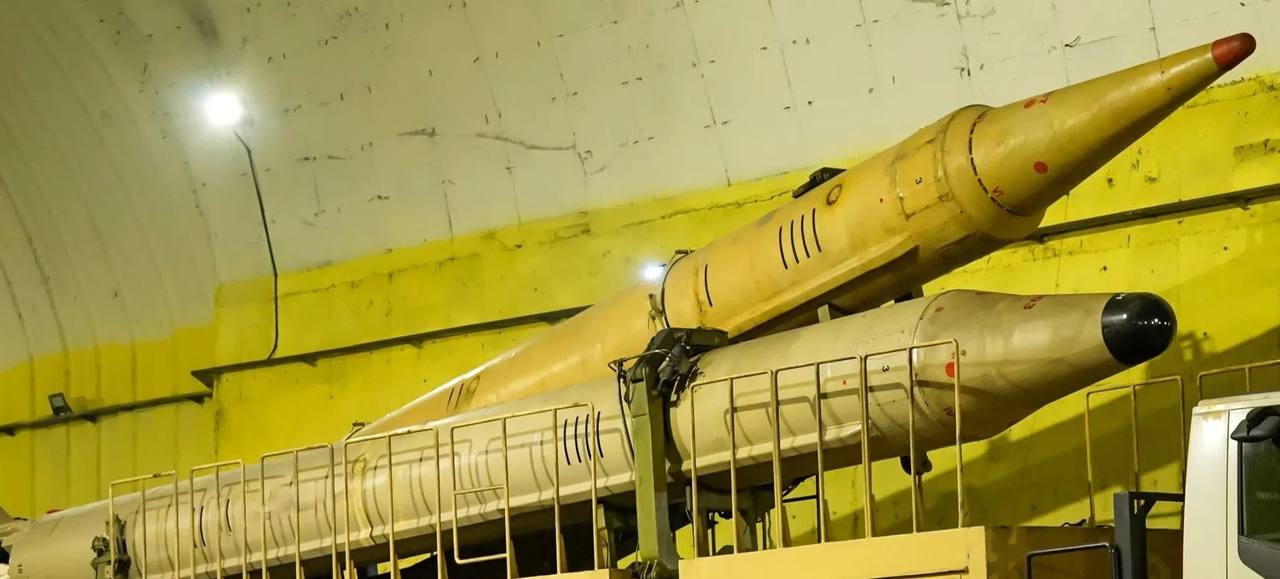
Iran's Islamic Revolutionary Guard Corps (IRGC) has unveiled a new launcher able to carry and fire two liquid-fuel ballistic missiles at the same time, in footage from an underground missile base aired by Iranian state television on Saturday, November 21.
Source: Associated Press
The launcher was shown during the first visit by the Guards' commander-in-chief, Maj. Gen. Ahmad Vahidi, to one of the force's underground 'missile cities'. The location of the base was not disclosed.
Brig. Gen. Seyyed Majid Mousavi, commander of the Guards' Aerospace Force, hosted the visit and said Iran's 'capabilities have expanded significantly'. 'We have integrated surprises and highly effective assets into our combat structure,' he said, according to the Associated Press. He added: 'Our capabilities have increased in the period between the two wars,' and said, 'The battlefield is in Iran's hands, and we decide the scene of battle.'
An advance over the earlier twin launcher
The new system appears to be an advance over a dual launcher Iran previously used that fired two solid-fuel missiles at a time. The Guards fired that earlier launcher on April 7, in what Iranian media described as the final days of the previous war, according to the AP.
Liquid fuel is more efficient and gives operators some capability to adjust the missiles' speed and trajectory in flight, which Iranian media said could help them evade or deceive air defences. Liquid-fuel missiles are launched vertically, Iranian media said.
What is solid
- Iranian state television aired footage on Saturday, November 21, showing the new twin launcher at an underground IRGC missile base.
- IRGC chief Ahmad Vahidi toured the base with Aerospace Force commander Majid Mousavi — Vahidi's first visit to one of the underground 'missile cities'.
- The Guards showed off another underground missile base on November 10, attended by armed forces chief of staff Maj. Gen. Ali Abdollahi.
What is only claimed
- Iranian media said upgraded missiles on display have longer range, better accuracy and guidance systems that do not rely on GPS — none of these claims could be independently verified.
- Vahidi said all NATO countries had stood against Iran but failed, and cited what he said was an admission by NATO's secretary-general that the alliance flew more than 5,000 sorties against Iran — that claim has not been independently verified.
Why Tehran is showing it now
The broadcast aimed to tout Iran's missile capabilities and counter statements from Washington that the US has destroyed the missile programme, amid fears the war could intensify once again, the AP reported.
CBS News reported on Friday, citing sources familiar with the matter, that the United States and Israel were considering a new assault on Iran, with Israel concerned about how quickly Iran is rebuilding its missile production. US President Donald Trump has said he is in no rush to decide his next move.
The United States and Israel attacked Iran on February 28, prompting Tehran to launch strikes against Israel and Gulf states hosting US military bases. Since then the two sides have fought over the Strait of Hormuz, through which nearly one-fifth of the world's crude oil passed before the war, and Washington has imposed a blockade on Iranian ports.
For the lakhs of Punjabi and Indian workers in the Gulf, the stakes are direct: the shipping war has disrupted oil flows, flights and remittances, and any new escalation would hit the region's workers first. On Saturday, US Central Command rejected an Iranian army claim that its air defences had damaged a US F-16 fighter jet over the Gulf, saying all American fighter jets in the region were safe and accounted for.
What happens next is unclear. Iranian Deputy Foreign Minister Kazem Gharibabadi said on Saturday that Tehran remained in contact with mediators from Qatar who visited Iran on Friday to explore 'whether another opportunity can be given to diplomacy'.