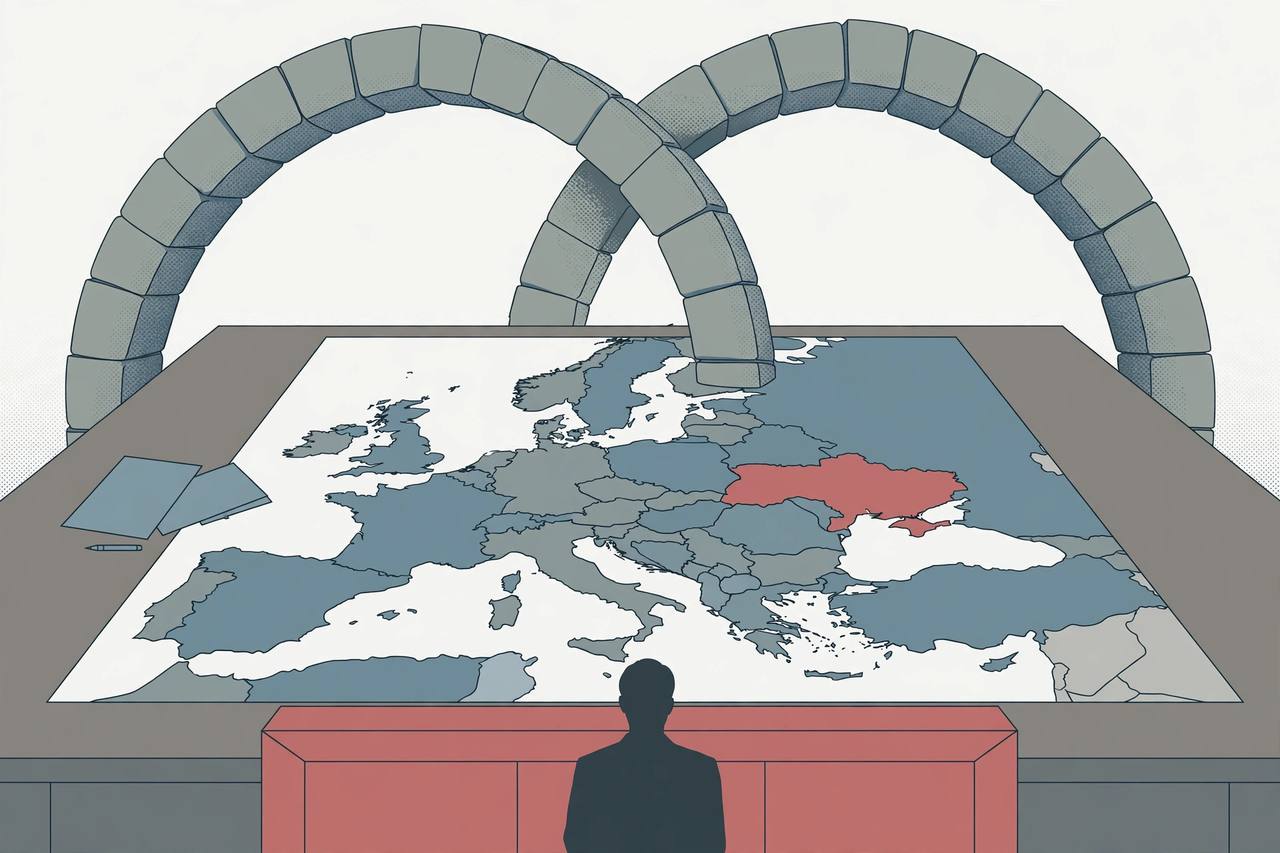
MOSCOW — A settlement of the war in Ukraine cannot be separated from building a new security architecture for Europe, Kremlin spokesman Dmitry Peskov said on Sunday, warning that if European governments do not genuinely want peace, Russia will have to achieve its objectives by force.
Source: LaPresse, reporting Russian news agencies (Interfax)
"It is obvious that, one way or another, the settlement in Ukraine will be linked to a new security architecture on the European continent. These are two component parts, and neither can exist without the other," Peskov told Russian journalist Pavel Zarubin in an interview for Vesti, according to Sputnik's account of the same remarks.
Source: Sputnik, via Aletho News
"Of course, at some point we will have to discuss this with the Europeans. It is another matter entirely if they do not genuinely want peace: in that case, it will be pointless, and we will have to press ahead. In the absence of any room for negotiation, we will have to do so by force," Peskov added, in LaPresse's report of the interview.
Europe has not made contact, Moscow says
Earlier, Peskov told the TASS news agency that the negotiators chosen by Europe had not yet attempted to establish contact with Russia. He also accused European governments of disunity, saying they were incapable of taking timely decisions and that this was holding everything back — remarks reported by Russian agencies and carried by LaPresse.
The comments are Moscow's clearest statement yet of the price it is attaching to any Ukraine settlement after last week's trilateral talks: not only territory and Ukraine's alignment, but a renegotiation of how security is organised across the whole European continent, including NATO's position in Eastern Europe.
Peskov's interview follows the first direct Russia–Ukraine–US negotiations in nine months, held in Abu Dhabi on November 10–11, which ended with a prisoner exchange agreed in principle and no published text. Read the earlier report: Abu Dhabi talks end with prisoner swap agreed, Medinsky says
Russian presidential aide Vladimir Medinsky, who headed the Russian delegation in Abu Dhabi, said the European security architecture became a central topic at that meeting, according to Sputnik. The Associated Press reported that the Abu Dhabi round made no major breakthrough.
Europe is organising its own seat at the table
European Council President António Costa has announced that Europe will be represented in the talks by officials from EU institutions and five countries — Britain, France, Germany, Italy and Poland — the Associated Press reported. US envoy Jared Kushner has said Russia and Ukraine agreed to expand the next round of negotiations to include European partners.
Ukraine's President Volodymyr Zelenskyy has warned that Washington's proposed European security framework could be exploited by Moscow to weaken NATO and redraw the continent's borders, and he has said the United States asked for the first time whether Ukraine would leave the Donbas in return for NATO membership — positions that show how far apart the sides remain on what a settlement would even cover.
The economic backdrop: growth slows to 1 per cent
The diplomacy is unfolding against a weakening Russian economy. Russia's gross domestic product grew 1.0 per cent year on year in the third quarter of 2026, down from 1.3 per cent in the second quarter and after a 0.2 per cent contraction in the first, according to a preliminary estimate by the state statistics agency Rosstat released on Friday and reported by AFP. The figure beat the economy ministry's 0.6 per cent forecast and matched the central bank's 1 per cent projection; the ministry put growth for the first nine months at 0.8 per cent.
Source: AFP, via The News
What is solid
- Peskov made the linkage and the 'by force' warning on Sunday, Nov 15, in a Vesti interview reported by Interfax, TASS and Sputnik.
- Russia, Ukraine and US delegations met in Abu Dhabi on Nov 10–11; no ceasefire or settlement text was published.
- Europe has named a negotiating format: EU institutions plus Britain, France, Germany, Italy and Poland (Costa, via AP).
What is only claimed
- Whether the 'by force' line is a new escalation or a restatement of Moscow's long-standing position — European governments have not yet responded on the record.
- Peskov's claim that European negotiators have made no contact is Moscow's account; no European confirmation or denial had been published when this was written.
What happens next
The immediate test of Peskov's framing is procedural: whether the European team Costa announced actually contacts Moscow, and whether the next round of talks — expected to expand beyond the Abu Dhabi trilateral format — takes up the wider security-architecture agenda Russia is demanding, or stays on ceasefire and territory. Fighting, meanwhile, has not paused for the diplomacy: both sides reported large drone exchanges again overnight.