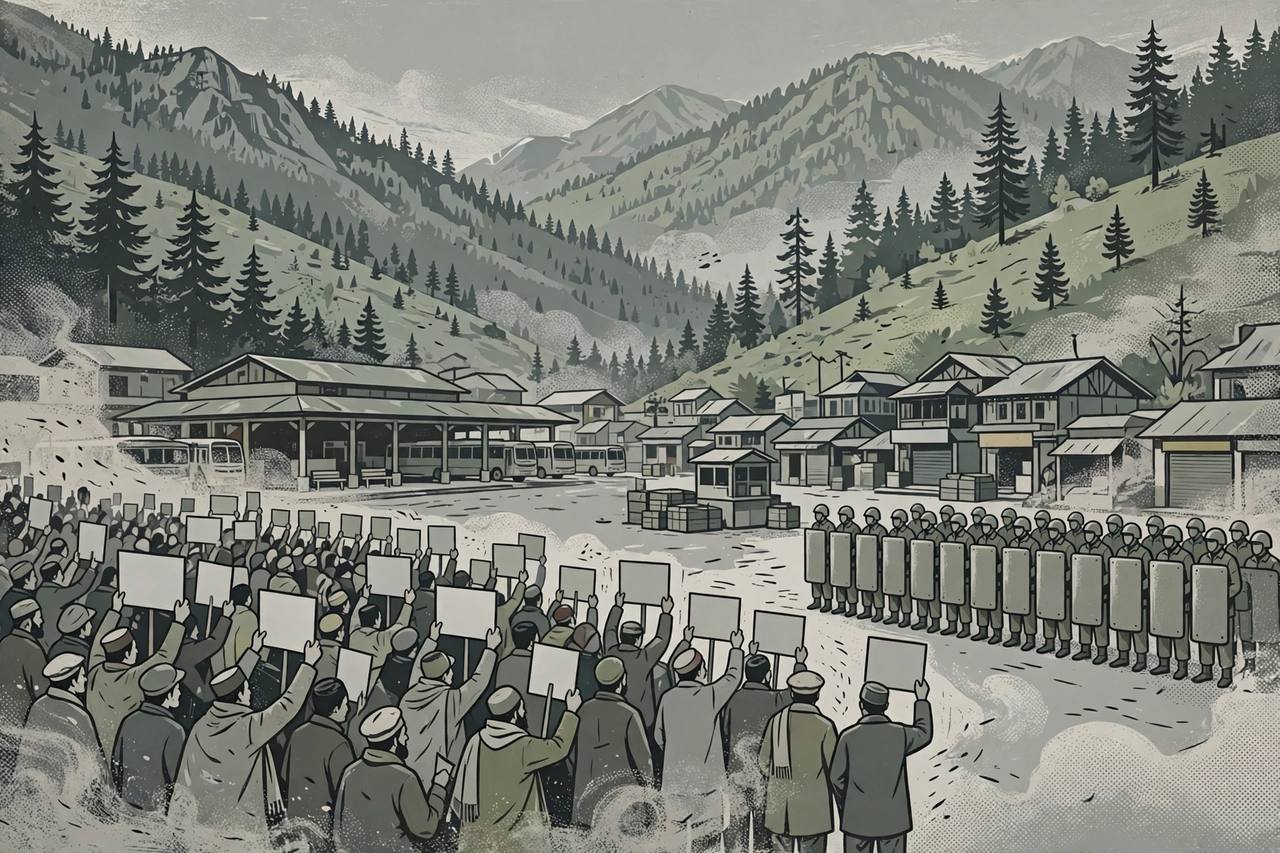
Clashes between protesters and law-enforcement personnel in Rawalakot, in Pakistan-administered Kashmir, left at least three people reported killed and more than a dozen injured on Thursday, November 5, on the 153rd day of a sit-in organised by the Jammu Kashmir Joint Awami Action Committee (JAAC), the Pakistani human-rights outlet Voicepk reported on Friday. Wider Indian reporting put the toll higher — NDTV and India Today reported at least seven people killed and between 18 and 23 injured — and no toll has been officially confirmed.
Source: Voicepk.net
According to local journalist Ajmal Shaheen, cited by Voicepk, tensions rose around 6 a.m. on Thursday when law-enforcement personnel advanced toward the bus terminal and D-Chowk, two of the main sit-in sites in Rawalakot. By 9 a.m., he said, reports of three deaths near D-Chowk had been received; he named those allegedly killed as Ehtesham Younis, Atif Jarjees and Adil Rasheed, and said more than a dozen people were reported injured. The figures could not be independently verified, Voicepk said.
Source: Voicepk.net
Two versions of Thursday morning
The Azad Jammu and Kashmir (AJK) police, in a statement carried by Voicepk, confirmed an exchange of fire in which, they said, some police personnel were injured; the statement said some armed individuals among the protesters opened fire first and that there were also reports of some of them being wounded. The spokesperson for the AJK police, the DIG of the Poonch Region, said law-enforcement agencies acted on November 5 to remove “illegal barriers” from public thoroughfares near the Rawalakot bus terminal and restore the movement of citizens, and dismissed reports circulating on social media as “baseless and misleading propaganda”.
Source: Voicepk.net (AJK police statement)
JAAC activists said security personnel moved toward the Matyalmarah bus terminal, D-Chowk and other sit-in sites and surrounded them. Umar Nazir Kashmiri, a core member of the JAAC, said several people were wounded in drone attacks: “A state of war has been imposed upon us. Drone attacks have been ongoing for the past two to three hours.” The drone claims could not be independently verified, and no police statement mentioned such an incident, Voicepk said. NDTV reported that Pakistani Rangers and the Frontier Corps, together with police, took part in the crackdown, and that protesters alleged drones were used against protest sites and private homes — allegations the outlets did not independently confirm.
Source: Voicepk.net / NDTV via Times Now World
Even the official accounts do not fully agree: Poonch Commissioner Sardar Waheed told Voicepk that no security personnel were injured during the operation — contradicting the police statement — and he did not confirm any civilian deaths, saying no injured civilians had been brought to the hospital, so he could not say whether any had been hurt or killed. The administration of the local government hospital did not respond to requests for information on the dead and injured.
Source: Voicepk.net
A five-month movement over flour, power and rights
The sit-ins began on June 5, after the AJK government declared the JAAC a banned organisation and launched a crackdown on its leaders and activists, Voicepk reported. That night, JAAC leader Umar Nazir Kashmiri was attacked by masked individuals near Khai Galla, about eight kilometres from Rawalakot; Kashmiri was injured and his associate Shazib Habib was killed, and activists placed Habib's body outside the Combined Military Hospital (CMH) in Rawalakot in protest — the demonstration then grew into sit-ins at several locations that have now run for 153 days.
Source: Voicepk.net
The movement's demands centre on affordable electricity and flour, employment, better education and public services, greater political representation and autonomy, and an end to the privileges of officials — a campaign the wire agency IANS, in a November 6 analysis, traced to long-standing complaints that the region generates substantial hydropower yet residents pay high electricity charges for inconsistent services. A JAAC core member, Sardar Aman Khan, told the ANI news agency that more than 117 people had been killed during the five-month movement and alleged that drones and prohibited weapons had been used against protesters — a movement claim, not an independently verified toll; NDTV reported the latest deaths brought its count of civilian deaths since June to 153.
Source: ANI via DevDiscourse / IANS
Verification is unusually hard in Rawalakot: mobile internet has been suspended across the Poonch division for the past five months, mobile services around the bus terminal were disrupted during the clashes, and access to the affected areas was not possible, Voicepk reported — which is why the death toll, the drone claims and even whether police were injured remain disputed between the accounts.
Source: Voicepk.net
What happens next: the JAAC sit-ins were continuing after Thursday's clashes, and the conflicting tolls — three named dead in local reporting, seven in the wider Indian reporting, none confirmed by the AJK administration — leave an independent investigation as the only route to a settled account. For Pakistan, the unrest in Rawalakot is now a five-month challenge to its administration of the region, driven by the cost of flour and electricity as much as by politics.
Source: Voicepk.net / ANI via DevDiscourse
What is solid
- Clashes took place in Rawalakot on November 5 at JAAC sit-in sites near the bus terminal and D-Chowk (Voicepk; AJK police statement)
- Local sources reported three people killed, naming Ehtesham Younis, Atif Jarjees and Adil Rasheed, and more than a dozen injured (Voicepk)
- AJK police said they acted to remove ‘illegal barriers’ and that armed individuals among protesters opened fire first; the JAAC sit-in has run since June 5 and the committee is banned by the AJK government
What is only claimed
- The death toll — three in local reporting, at least seven in NDTV/India Today reporting, none confirmed by Commissioner Sardar Waheed
- Whether drones were used against protesters — alleged by JAAC leader Umar Nazir Kashmiri, not independently verified and not mentioned in any police statement
- Whether police personnel were injured — the police statement said some were; Commissioner Waheed said none were
- The movement's cumulative toll — JAAC's Aman Khan said more than 117 killed in five months; NDTV put the figure at 153; neither is independently verified