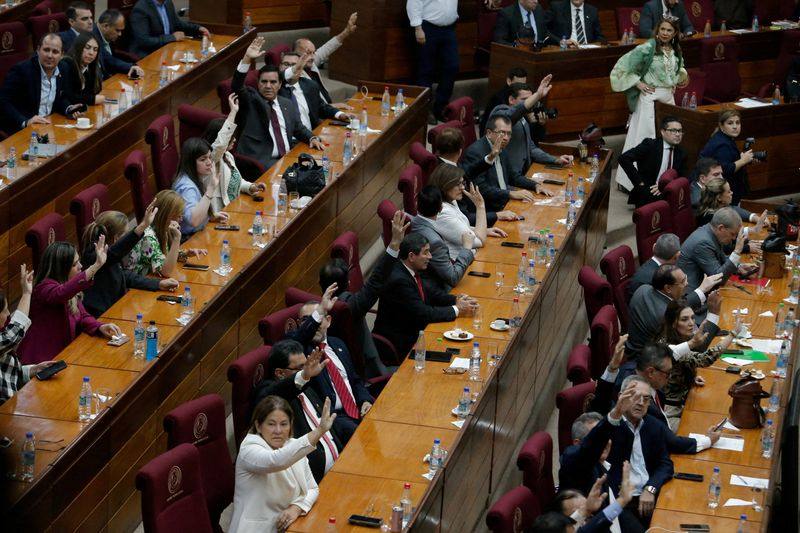
Paraguay's Senate on Friday voted to remove President Santiago Peña from office over his connection to the collapse of local bank ueno, which sparked a political and financial crisis and froze access to millions of accounts, Reuters reported from Asunción.
Source: Reuters, Nov 6, 2026
Lawmakers voted in favour of Peña's dismissal in rapid impeachment proceedings despite his resignation a day earlier, Reuters said. The Asunción Times, reporting the full sitting, said the proceedings concluded with 44 votes in favour of removing Peña from office, after prosecutors presented their arguments and Peña's defence lawyers were heard; ANI, citing CNN, put the vote at 44 to 1. By impeaching and convicting him instead of accepting his resignation, senators stripped Peña of the lifetime Senate seat and immunity granted to former presidents, leaving him vulnerable to prosecution.
Source: Reuters, Nov 6, 2026; Asuncion Times, Nov 6-7, 2026
Earlier on Friday this desk reported that the Senate had opened Peña's impeachment trial, rejected his lawyers' plea for a 72-hour delay and summoned him to appear, while Vice President Pedro Alliana had still not been sworn in. The Senate has now gone the whole way: Peña is removed, and Alliana has taken the presidency. Read: Senate opens Pena trial, rejects delay plea
Alliana sworn in the same day
Vice President Pedro Alliana was sworn in as president on Friday and will serve the rest of the presidential term, which ends in August 2028 - the Asunción Times gave the constitutional end date as 15 August 2028, and said Senator Antonio Barrios takes over the vice-presidency. Alliana, a Colorado Party politician and former president of the Chamber of Deputies, had served as Peña's vice-president since August 2023. Peña becomes only the second Paraguayan president removed through impeachment, after Fernando Lugo in June 2012.
Source: DW via VidiaNews and Asuncion Times, Nov 6-7, 2026
Following the Senate vote, prosecutors ordered the arrest of the ousted president alongside former central bank chief Carlos Carvallo as part of a criminal investigation, and officials later said Peña was placed under house arrest pending a decision by the public prosecutor's office on the final charges against him, the DW account reported. The Asunción Times said the house-arrest measure was issued in criminal case No. 92/2026 for alleged breach of trust and related offences tied to his past shareholding and the bank's failure, requiring him to remain at home under police custody. Dozens of protesters gathered outside his residence in Asunción while police maintained a security cordon around the property. Peña has denied wrongdoing.
Source: DW via VidiaNews, Nov 6, 2026; Asuncion Times, Nov 7, 2026
The bank that brought down a president
Ueno, a digital lender that became one of Paraguay's biggest banks, served about 2.94 million customers - roughly 60 percent of the country's adult population - and its accounts were also used to process pension payments. As of last month the bank said it held roughly $800 million in public-sector deposits - yaani about 80 crore US dollars, about a quarter of its total deposits - including money from the operators of Paraguay's giant hydroelectric dams. The Asunción Times put the public resources reportedly involved at approximately $900 million - yaani about 90 crore US dollars - including funds from the Social Security Institute (IPS), Caja Fiscal, Petropar, Senave and ANDE.
Source: DW via VidiaNews, Nov 6, 2026; Asuncion Times, Nov 7, 2026
Paraguay's central bank ordered a resolution or closure process on Tuesday after finding that Ueno's solvency ratio had fallen below half the required minimum. Ueno's app, card payments and transfers stopped working and branches closed, leaving customers queueing outside, unable to withdraw their savings. Retirees, depositors, students and workers marched through Asunción on Wednesday demanding Peña's impeachment and holding signs saying 'Give us back our money', and hundreds of employees of Ueno and its parent conglomerate protested outside the Labor Ministry on Thursday demanding unpaid wages and severance. Authorities detained eight senior executives, including founder Miguel Vázquez and bank president Juan Manuel Gustale, and prosecutors charged 27 bank officials and business associates with offences including breach of trust and attempted fraud; lawyers for several detainees said they needed time to review the allegations before commenting.
Source: DW via VidiaNews, Nov 6, 2026
The allegations, and Peña's fall
Thirty-five opposition lawmakers and ruling-party dissidents submitted the impeachment articles in the 80-seat Chamber of Deputies - which the Asunción Times said later approved the proceedings with 78 votes - accusing Peña of conflicts of interest, misuse of pension funds and institutional cover-ups linked to Ueno. The articles alleged improper presidential interference in the IPS and preferential treatment for Ueno: IPS manages pension and health care funds for most Paraguayan workers and held $355 million at the bank, about 9 percent of its investments, according to its financial manager Gladys Vera. Lawmakers also cited two loans Peña received from Ueno, and questioned his 2023 appointment of central bank chief Carvallo, who previously chaired Financiera Ueno; according to the impeachment document, the central bank approved the company's conversion into a bank just 83 days after Carvallo's appointment. Peña sold his shares in Ueno Holding, whose businesses include the bank, in April 2025. These are the lawmakers' allegations; Peña has denied wrongdoing.
Source: DW via VidiaNews, Nov 6, 2026; Asuncion Times, Nov 7, 2026
Peña announced his resignation on Thursday in a video shared on social media, citing institutional stability and social peace, after Congress President Basilio Núñez and ruling conservative Colorado Party leader Horacio Cartes withdrew their support. Congress could not formally consider the resignation for lack of a quorum, so it did not take effect and the Senate went ahead with the trial. A day before resigning, Peña had sought to reassure customers in a video message, pledging legislation 'that will return to every saver what they are entitled to as quickly as possible', and the crisis forced him to cancel his attendance at the Ibero-American summit in Madrid. Peña, a conservative economist, took office in August 2023 for a five-year term.
Source: DW via VidiaNews, Nov 6, 2026; Asuncion Times, Nov 7, 2026
What is solid
- Paraguay's Senate voted on Friday to remove President Santiago Pena from office in impeachment proceedings over the Ueno bank collapse, despite his resignation a day earlier - Reuters
- 44 senators voted in favour of removal, per the Asuncion Times (ANI/CNN put it at 44-1); Vice President Pedro Alliana was sworn in the same day to serve the term ending in August 2028
- Paraguay's central bank ordered a resolution or closure process for Ueno on Tuesday after its solvency ratio fell below half the required minimum; about 2.94 million customers lost access to their accounts
What is only claimed
- The impeachment charges - conflicts of interest, misuse of pension funds, preferential treatment for Ueno and interference in the IPS - are the lawmakers' allegations; Pena has denied wrongdoing and the criminal cases are still being decided by prosecutors
- The exact scale of public money at risk: Ueno itself said about $800 million in public-sector deposits last month, while the Asuncion Times put public resources reportedly involved at about $900 million
Alliana inherits two crises at once: a presidency that begins under a bank failure, and millions of depositors - including pensioners whose IPS money sat at Ueno - still waiting to learn when they can reach their savings. The criminal track now runs separately from the political one: prosecutors must decide final charges against the ousted president and the former central bank chief, while the central bank's resolution process decides how much of Ueno's deposits and recoverable assets move to other institutions, and how quickly.