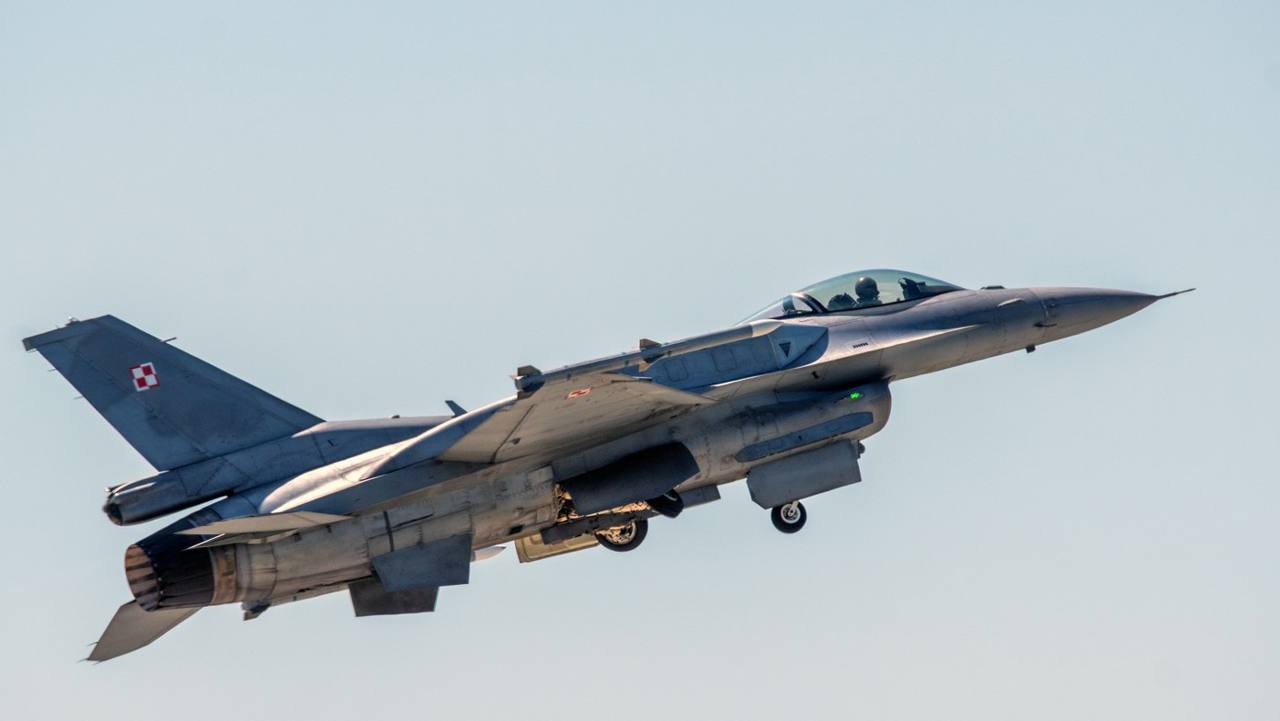
Earlier on Wednesday, Poland asked its NATO allies to consider shooting down Russian missiles over Ukraine when they are heading towards alliance territory. This is the next step Warsaw announced the same day — a no-fly zone of its own, inside Polish territory. Read the earlier story
Poland plans to establish a no-fly zone along its eastern border, Deputy Defence Minister Cezary Tomczyk said at a briefing in Warsaw on Wednesday, 25 November. The zone would stretch from a dozen to several dozen kilometres inland, and the government wants the regulation in force by late December or early January.
Source: Reuters
The zone is meant to support a new "positive identification" procedure for Polish pilots. Instead of needing to see an intruding aircraft with their own eyes, pilots would be able to decide from radar data, intelligence from allies, and the object's altitude and speed — and, if it enters the zone from Ukraine at a certain height and speed with radar confirmation, that would be grounds to shoot it down, Tomczyk said.
Source: Defence24
Why now: three missiles and a drone in four days
The announcement follows a run of Russian airspace violations during attacks on Ukraine. On 20 November, three Russian Kh-101 cruise missiles came down in south-eastern Poland during a large-scale Russian attack on Ukraine; Polish prosecutors have since confirmed that all three objects were Russian Kh-101 missiles. On 23 and 24 November, Russian missiles and a drone again entered Polish airspace, and on 24 November a Russian reconnaissance drone briefly crossed the border near Dorohusk before turning back into Ukraine.
Source: European Pravda
Poland has been on the edge of Russia's air war since 2022, and the pressure has grown. In September 2025, a mass drone incursion into Poland prompted NATO aircraft to shoot some of the drones down — the first time a NATO member had engaged Russian aerial targets since the start of the full-scale war. Poland's air navigation agency then imposed a restricted zone along the borders with Belarus and Ukraine.
Source: Kyiv Independent
NATO still says no to strikes over Ukraine
Tomczyk was blunt about the alliance's position on the bigger question: whether NATO should shoot down Russian missiles while they are still over Ukraine. "NATO is in no way in favour of this. It would create numerous complications," he said, adding that an earlier discussion had ended with a decision against it and that any decision on airspace over Ukraine "must always be made by all of NATO."
Source: Defence24
Foreign Minister Radosław Sikorski took a different line on Wednesday, telling Polish public radio that shooting down a Russian missile over Ukraine at Kyiv's request could constitute an act of self-defence. Bloomberg reported that Warsaw raised the intercept idea at a meeting of NATO ambassadors in Brussels on 23 November; some allies were receptive to discussing it, but the talks were preliminary and no decision was reached. Any such move would need the unanimous consent of all 32 allies. Defence Minister Władysław Kosiniak-Kamysz said the allies were not yet showing enough resolve on the idea.
Source: Bloomberg
NATO's concrete response so far has been an AWACS early-warning aircraft deployed to Poland, with the alliance's Supreme Allied Commander Europe assessing whether more forces and equipment should be moved to the country. Poland has also asked NATO Secretary-General Mark Rutte for air and missile defences and reconnaissance systems.
Source: Reuters
Tomczyk said Poland would also urge its allies on NATO's eastern flank to adopt similar no-fly rules, and noted that the Baltic states had already followed Poland's earlier approach to airspace restrictions. Poland already restricts flights near its eastern border below an altitude of roughly three kilometres during the day, and flights are generally prohibited between sunset and sunrise, with exemptions including essential medical operations.
Source: Reuters
The planned zone sits inside Polish territory, along the border — it is not a no-fly zone over Ukraine. Warsaw's separate request for NATO to intercept Russian missiles over Ukraine itself remains undecided, and the alliance has so far ruled it out.
What happens next
The ordinance is already being prepared, Tomczyk said, and the government wants it in effect by late December or early January. The exact boundaries of the zone and how civilian flights and drones inside it would be treated have not yet been specified. What is clear is that the zone would give Polish pilots clearer grounds to fire on objects entering from the east — and every further Russian missile that strays towards the border will add pressure on the allies to decide.
Source: AFP