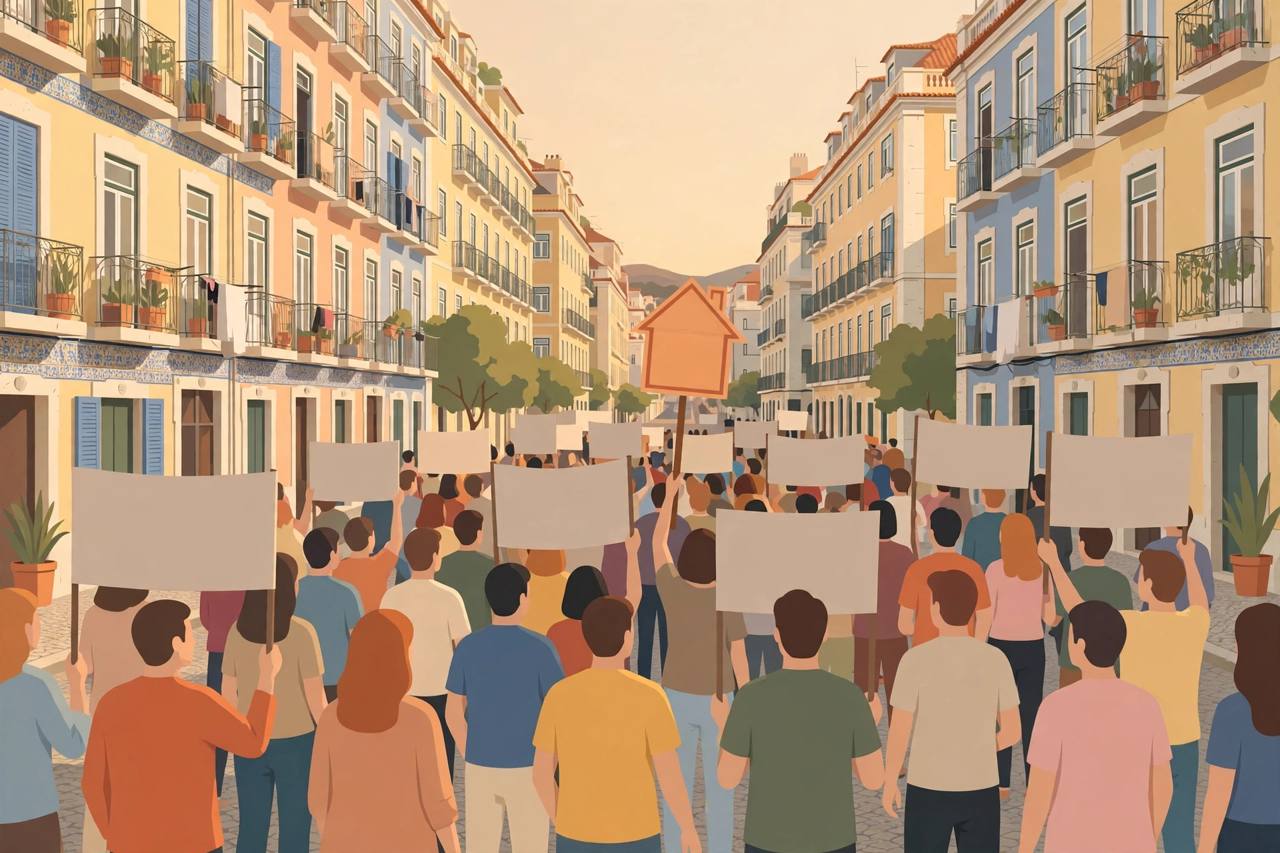
Tens of thousands of people marched through more than 30 cities and towns across Portugal on Saturday, November 14, in the largest demonstration yet against soaring housing costs that many say have put buying or renting a home beyond their reach, the Associated Press reported. The Portugal Post, citing the organising platform Casa Para Viver, counted protests in 32 cities, from the Azores to the Algarve.
Source: Associated Press via 24seven News
Marching under the slogan “We won’t let them steal our right to housing”, participants ranged from teenagers to retirees, with drums, music and chants accompanying the Lisbon march. The housing crisis has fuelled weeks of demonstrations, and some activists have camped in central squares in Lisbon and Porto, the country’s two largest cities.
Source: Associated Press via 24seven News
What the protesters are demanding
Activists want ceilings on rent increases, greater legal protection for tenants against eviction and more affordable housing. Saturday’s coordinated action, organised by Casa Para Viver, also demanded repeal of the government’s new rental law, controls on short-term tourist lets and a significant expansion of public housing, the Portugal Post reported. The proposed rental law, approved in general terms with votes from the right and the far right, paves the way for more flexible contracts and faster evictions.
Source: The Portugal Post
“I’m really worried about young people,” Susana Pacheco, a 35-year-old data analyst who works part-time as an astrologer to help pay her mortgage, told AP, saying she did not know how her younger sister would afford to move out of their parents’ home. “Things have become intolerable,” said Ana Encarnação, 42, citing rising living costs and the widening gap between rich and poor.
From Covilhã to the Azores: a crisis no longer confined to Lisbon and Porto
In Covilhã, about 200 people marched from the public gardens to the municipal square, where Marisa Marques of Movimento Porta a Porta said investment funds building luxury micro-apartments were distorting the market: student rooms now cost €220 to €300 a month on average, with some luxury residences charging up to €700. In Leiria, university graduates told reporters they were sharing rooms for €380 and moving back in with their parents because salaries — some above the minimum wage — could not cover independent living. António Gonçalves, a national spokesperson for Movimento Porta a Porta, told the Lusa news agency this was likely the broadest day of housing mobilisation since the 25 April 1974 revolution.
Source: The Portugal Post
The numbers behind the anger are stark. Between 2015 and 2025 Portugal posted the European Union’s biggest jump in the home price-to-income ratio, up 61%, followed by the Netherlands at 34%, the EU statistical office Eurostat said last week. A professional body cited a 141% house-price rise between 2010 and 2025 against wage growth of just one-third of that, and said rent or mortgage payments in Lisbon reach 116% of income for minimum-wage earners. Foreign buyers and investment funds, digital nomads, retirees and a tourism surge that has switched city-centre apartments to short-term rentals have all fuelled the rises, AP reported.
Government pledges, a president listening — and a 0.3% budget line
The government has responded with lower taxes on new construction, restrictions on short-term rentals and a promise to build 145,000 new homes, while acknowledging the effects will not be immediate. President António José Seguro convened the Council of State, an advisory body, to discuss the protests earlier this month and met some protesters on Friday; the presidency said he appealed for cross-party agreements on urgent measures, particularly for young people. Protesters in Covilhã noted that the 2027 national budget allocates just 0.3% of GDP to housing — the lowest in decades — and said it gave them little confidence.
Source: The Portugal Post
What happens next is a test of whether Saturday’s scale changes the politics: the rental law still has to complete its passage, the government’s building pledge has no quick delivery date, and the protest movement — which took inspiration from housing protests that began in neighbouring Spain last month — says sustained mobilisation is the only route to change. Awaaz Punjab has covered this crisis since October, when police cleared the Lisbon and Porto tent camps and thousands rallied outside Parliament.