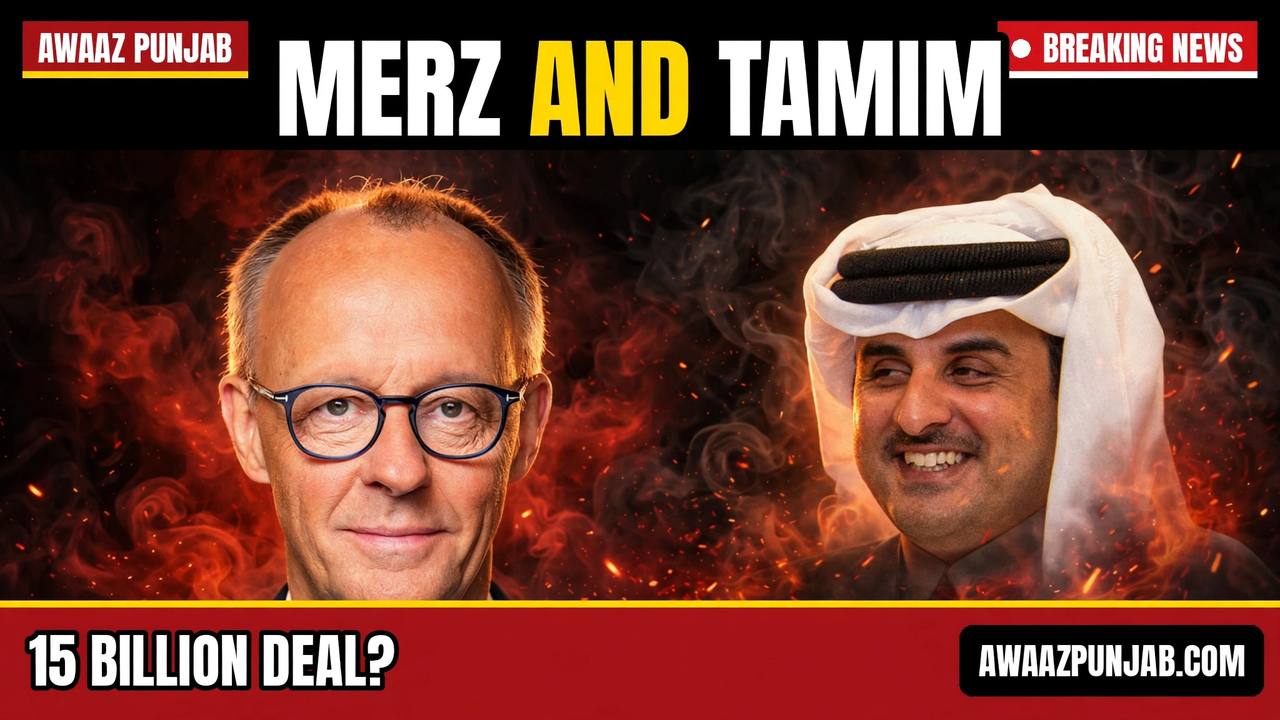
Qatar has pledged an additional €15 billion ($16.5 billion) in new investment in Germany, German Chancellor Friedrich Merz said on Friday, as he and Qatar's Emir Sheikh Tamim bin Hamad Al Thani met in Berlin to deepen a strategic partnership spanning defence, technology and energy. The pledge — yaani lagbhag 1,650 crore dollar — was announced at a joint news conference after talks between the two leaders, and Merz said it would strengthen both countries, particularly in future technologies such as artificial intelligence, semiconductors and aviation.
Source: Reuters
“We Germans attach great importance to this strategic partnership in a world increasingly shaped by great-power politics and an erosion of the international order,” Merz said. “We want to build a network of global partners. This is beneficial for all involved. It serves our sovereignty, our security, and our prosperity,” he said, calling for a “360-degree partnership” with Qatar.
Two defence agreements signed
After the talks, Germany and Qatar signed two agreements to boost security and defence cooperation, according to reports of the meeting. The agreements widen a relationship that has long been focused on trade and investment, and put defence and technology at its centre.
Source: MENAFN
Sheikh Tamim called Germany an important partner and voiced confidence that relations would gain new momentum, including through a stronger strategic dialogue between the two countries.
Qatar's mediation role praised
Merz praised Qatar's diplomatic efforts to ease tensions in the Middle East, particularly its mediation to end the war between the US and Iran and restore regional stability. He also called for the Strait of Hormuz to reopen permanently — the waterway through which much of the world's oil moves and which has been at the centre of the war's shipping disruption.
Source: Al Jazeera
The Emir also held talks with German President Frank-Walter Steinmeier, who proposed a regional security conference for the Middle East. The two leaders also reviewed other regional developments and agreed that the reconstruction of Syria remains a shared priority, according to reports of the visit.
Why it matters for the Gulf
Qatar is one of the Gulf states where lakhs of Indians, including Punjabis, live and work, and its mediation role has made it a central player in efforts to end the US–Iran war. A durable settlement — and a permanently reopened Strait of Hormuz — would ease pressure on shipping, oil prices and the daily lives of Gulf-based workers, whose jobs, flights home and remittances all depend on regional stability.
The visit also underlines how Qatar's influence now reaches well beyond energy. Doha has mediated between Washington and Tehran, hosted talks on Gaza, and is using its wealth to buy a stake in Europe's future industries — from AI to aviation — at a moment when Germany is looking for partners beyond its traditional allies.
What happens next
The two governments are expected to follow through on the investment pledge and the defence agreements in the coming months, with AI, semiconductors and aviation named as the first areas of cooperation. The bigger test is diplomatic: whether Qatar's mediation can deliver a lasting US–Iran settlement and a permanently reopened Strait of Hormuz — the outcome Merz publicly called for in Berlin.
€15 billion is the additional amount Qatar pledged to invest in Germany — $16.5 billion, yaani lagbhag 1,650 crore dollar — on top of its existing investments in Europe's largest economy.