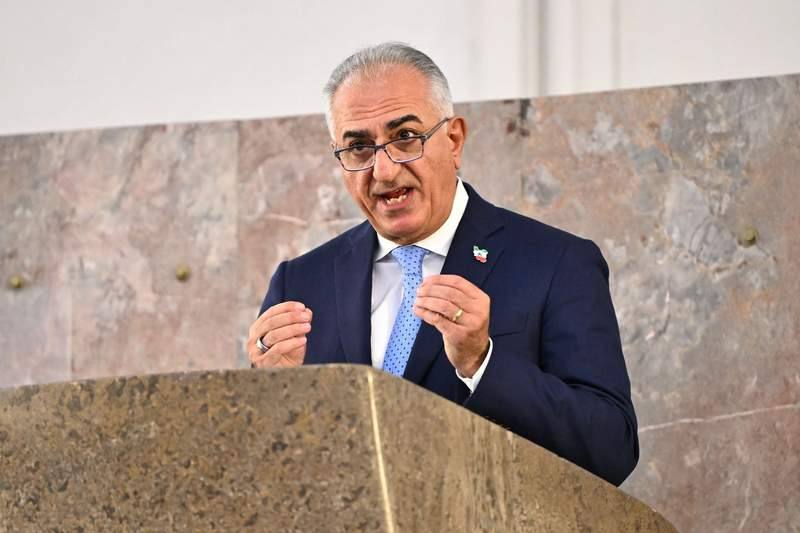
FRANKFURT — Iranian opposition politician Reza Pahlavi accepted the Friedrich Naumann Foundation's Freedom Prize in the German city of Frankfurt on behalf of the Iranian people on Saturday, November 7, against the backdrop of large demonstrations, the German news agency dpa reported. He accepted the award in recognition of the Iranian people's resistance to oppression by the government in Tehran.
Source: dpa via Ekkow
Speaking at the ceremony in Frankfurt's historic St Paul's Church — the Paulskirche, a landmark of German democracy — Pahlavi announced that one day he would place the award in the hands of the Iranian people 'not on foreign soil, but in our capital, Tehran', dpa reported. The audience, consisting largely of people of Iranian origin, repeatedly drowned out the ceremony with chants of 'Long live the shah, long live Iran!'. Deutsche Welle's report of the same ceremony, summarised by GhanaSummary, likewise recorded that Pahlavi received the 'Freedom Prize' in Frankfurt on Saturday.
Source: Deutsche Welle via GhanaSummary
The foundation, which has close ties to the German liberal party, the Free Democrats (FDP), awarded the prize in recognition of the people's commitment to freedom, dpa reported; the award has been presented every two years since 2006 in recognition of outstanding commitment to a liberal civil society. FDP Member of the European Parliament Marie-Agnes Strack-Zimmermann emphasised at the ceremony that Pahlavi had always said that the Iranian people themselves should decide their own future, dpa reported.
Who Pahlavi is — and the role he claims
Pahlavi, who lives in exile in the US, is a son of the former shah, who was deposed in 1979, dpa reported. He has put himself forward as a transitional leader should the current regime in Tehran be overthrown, but many view him critically, not least because of the country's past under his autocratic father. DW's reporting added that others have criticised him for his vocal support for Israel and accused him of failing to distance himself from his father's autocratic rule, and that Pahlavi has said he does not aim to use a proposed transitional position to reinstate the monarchy, instead planning to leave the decision to a later referendum.
Why the prize is controversial
The foundation's decision to award the 2026 prize to the Iranian people, with Pahlavi accepting it in trust until it can be transferred to freely elected Iranian representatives, was announced in September and has been contested ever since. In an open letter, 71 prominent figures from German political, judicial, diplomatic, academic and cultural life urged the foundation to reconsider, an initiative led by Joachim Rücker, a former president of the UN Human Rights Council, according to reporting on the controversy by the NCRI-US editorial team and the Diplomatic Post. Supporters, including Iranian groups that issued a joint statement backing the decision, argue the prize honours the courage of a people who have stood for freedom against repression, and note Pahlavi's repeated position that Iran's future form of government must be decided by a free vote.
What is solid
- Reza Pahlavi accepted the Friedrich Naumann Foundation's Freedom Prize at Frankfurt's Paulskirche on Saturday, Nov 7, on behalf of / in trust for the Iranian people (dpa; DW).
- Police put the Frankfurt demonstrations at some 5,000 people, the majority Pahlavi supporters (dpa).
- Pahlavi said he would one day place the award in the Iranian people's hands in Tehran, and FDP MEP Marie-Agnes Strack-Zimmermann stressed his position that Iranians should decide their own future (dpa).
What is only claimed
- Crowd expectations and counts diverged: pre-event reporting spoke of a registered march of about 24,000 and gatherings of up to 30,000 expected, while police reported some 5,000 demonstrators on the streets (dpa vs pre-event reporting) — the police figure is the confirmed count for Saturday.
- Whether Pahlavi legitimately represents the Iranian people is itself the dispute: critics, including 71 signatories of an open letter led by former UN Human Rights Council president Joachim Rücker, object to an unelected exile figure accepting the prize in the people's name, while supporters back the foundation's choice (reporting on the controversy).
- Pahlavi's claim to a transitional role is his own stated position, not an elected mandate; he says a referendum should decide Iran's future system (dpa / DW).
What happens next
Pahlavi's supporters planned a rally in Frankfurt later on Saturday, and the argument over the prize is unlikely to end with the ceremony: the split it has exposed — between monarchist-leaning supporters, other Iranian opposition groups, and German critics of the foundation — will follow Pahlavi as he campaigns for a transitional role while the US-Iran war that began on February 28 continues to reshape Iranian politics from outside. The foundation's stated plan remains that the prize is ultimately handed to freely elected Iranian representatives; who those representatives will be, and when, is exactly what Iran's unresolved future will decide.