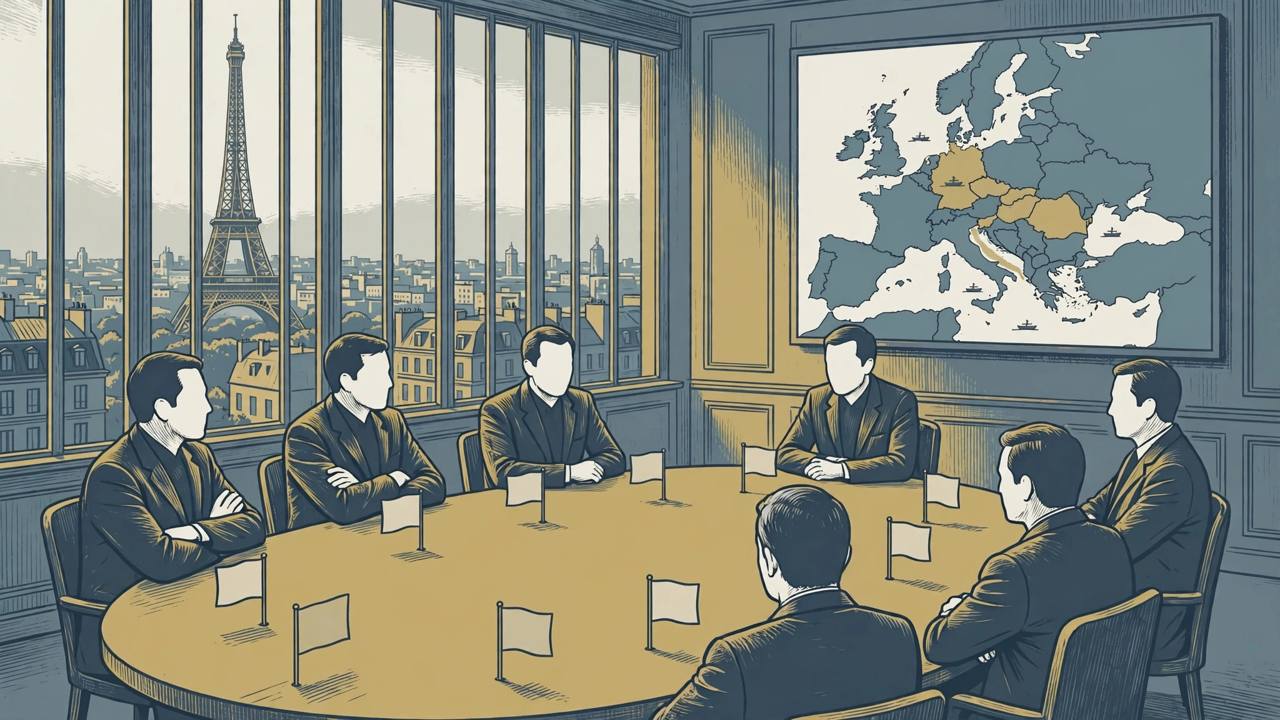
US Secretary of State Marco Rubio will travel to Paris from November 8 to 10 for a meeting of Group of Seven foreign ministers, the State Department said on Friday, Reuters reported. In a brief statement, the department said Rubio will "advance American interests in engagements with his G7 counterparts." France moved the meeting of the informal grouping of wealthy nations from Marseille to Paris at the last minute amid nationwide protests.
Source: Reuters
The trip is Rubio's first international journey since Tuesday's midterm elections dealt the Republicans a severe blow, the Associated Press reported. Policies like the Iran war helped Democrats seize control of Congress, and in Paris Rubio will face repeated questions about whether President Donald Trump will adjust his aggressive approach to allies and foes alike after the losses. Rubio is seen by many as presenting a gentler side of Trump's approach; there has been speculation — denied vehemently by him and his aides — that he might leave the administration early to prepare a 2028 presidential run.
Source: Associated Press
The G7 comprises the world's biggest industrialised democracies — Britain, Canada, France, Germany, Italy and Japan, alongside the United States — and unlike the wider G20 it is made up entirely of US allies. The Paris meetings on Monday and Tuesday follow a larger diplomatic gathering Rubio hosted in Atlanta just last weekend for G20 foreign ministers, which included Russia and China and ended without a joint communique, producing only a chairman's statement from Rubio. The differences that prevented broad agreement in Atlanta are expected to confound the Paris talks too, especially on global security, AP reported.
The agenda, set out by the French hosts, is heavy: the Iran and Russia-Ukraine wars, deteriorating energy and food security, and freedom of navigation in the Strait of Hormuz and the Red Sea. France also wants discussion of the broader Middle East — Israel, the West Bank, Gaza, Lebanon and Syria — plus Africa, the Indo-Pacific and China, and Venezuela, Cuba and Haiti. Ministers will hold a separate session on support for Ukraine and a meeting on artificial intelligence, according to the French foreign ministry. Brazil, Egypt, Saudi Arabia and Ukraine have been invited to take part in some of the discussions — a guest list that underlines how far the G7's concerns now reach beyond its own members, from Gulf shipping lanes that carry the oil Punjabi and Indian workers in the Gulf depend on, to the war in Ukraine.
The allies Rubio meets have been rattled by the Trump administration on several fronts at once, AP reported: scaled-back US military assistance to Ukraine, repeated suggestions that America might not defend a NATO ally under attack unless allies step up defence spending, proposed reductions in the US military footprint in Europe, tariffs and trade fights, and severe US sanctions on the International Criminal Court, to which every G7 member except the United States belongs. The European Union is considering a "blocking statute" to protect its institutions from US secondary sanctions — a step the Trump administration has called hostile. All G7 members except Japan, which has a separate treaty alliance with Washington, are in NATO.
What happens next: Rubio leaves this weekend, and the ministerial sessions run Monday and Tuesday, November 9 and 10. With France already signalling that no joint communique will emerge, the test of the meeting will be in the bilateral readouts — above all whether Washington and its allies can present any common line on the Iran war and Hormuz shipping before the next round of Ukraine talks in Abu Dhabi on November 10–11, and whether the midterm result changes the tone, if not the substance, of US diplomacy.