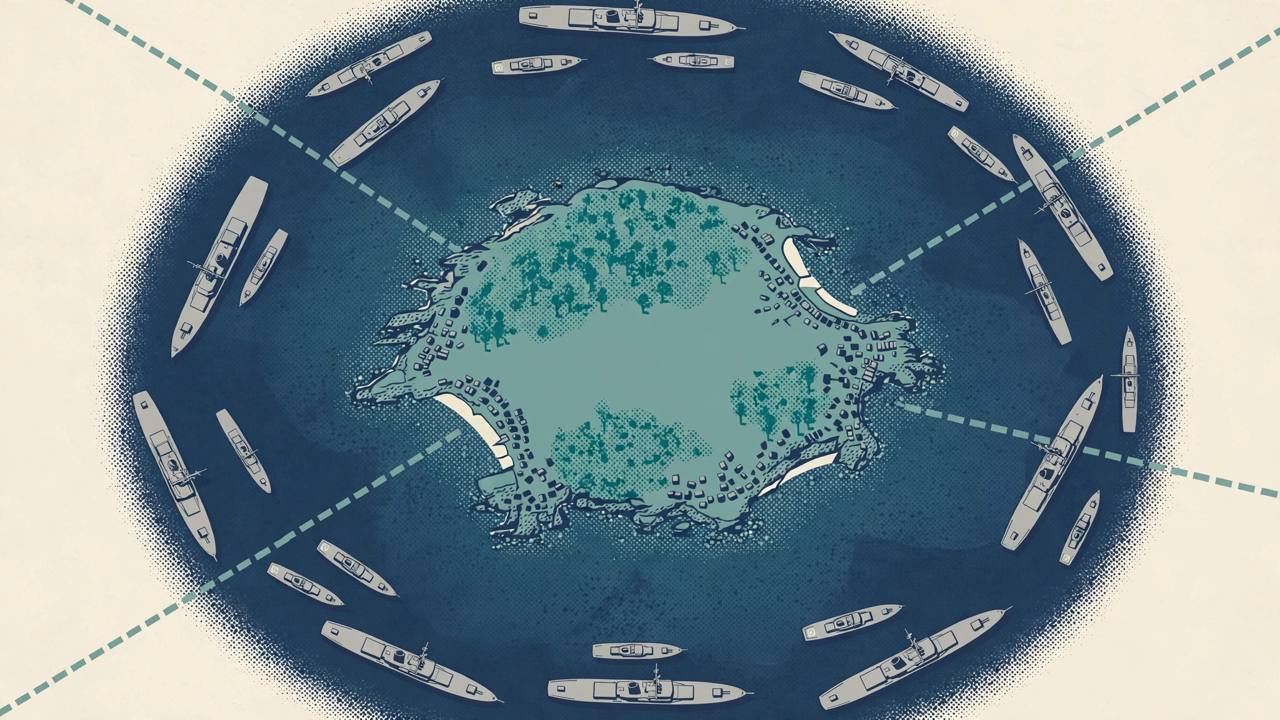
China's navy and coast guard have put more than 100 vessels to sea across the West Pacific in a deployment that analysts say looks like a rehearsal for isolating Taiwan — and Beijing, unusually, has announced nothing. Taiwan's National Security Council Secretary-General Joseph Wu reported on November 3 that over 100 People's Liberation Army Navy (PLAN) and China Coast Guard vessels were operating in the region, the Institute for the Study of War (ISW) said in its China & Taiwan Update of November 6.
Source: ISW China & Taiwan Update (Nov 6, 2026)
Wu's data, as assessed by ISW, showed two main concentrations. The first sits between Taiwan and Guam — the direction US reinforcements would come from — and consists of four task forces drawn from three different PLA theater commands, including the Liaoning aircraft carrier strike group, which moved into the West Pacific through the Basilan Strait in the Philippines between October 23 and 26. The second concentration, at least six coast guard vessels and an unspecified number of navy ships, surrounds Taiwan itself.
A surge in the air, and a second carrier at sea
Taiwan's Ministry of National Defense detected 49 PLA air sorties around the island on November 2 — an unusually high number, and the highest single-day figure recorded this year, with 31 aircraft crossing the median line of the Taiwan Strait; 36 of the sorties flew south of Taiwan, possibly in support of the task forces in the West Pacific. The count fell to 22 by the following morning. Satellite imagery from November 2 also detected China's most advanced carrier, the Fujian, leaving its base at Sanya on Hainan island and heading east, possibly toward southern Taiwan, and imagery suggested at least three other major surface combatants left the same base between October 26 and November 2.
Source: Taiwan MND figures via Taiwan News / Security Signal
The scale is what makes analysts pay attention: ISW assessed that the number of vessels and the geographic range of the deployment are greater than in the PLA's most recent named exercise around Taiwan, Justice Mission 2025, and that coordinating surface forces from the Eastern, Northern and Southern theater commands at once is rare.
The silence is part of the signal
China normally announces and names its major exercises aimed at Taiwan — it has done so for the last four. This time, at the time of ISW's writing, there had been no announcement at all. ISW assessed that the decision not to announce may itself be the message: to demonstrate that the PLA can isolate Taiwan at will, cutting it off from air and sea in a conflict and eroding Taiwanese confidence that the island could resist — or that help could reach it.
The deployment is a sharp escalation from the picture only days earlier: on October 28, Wu published a map showing 53 Chinese vessels around Taiwan and in the West Pacific. The count has since roughly doubled, two of China's three aircraft carriers are at sea in different parts of the region, and the third, the Shandong, reportedly left dry dock on November 1 after nine months of maintenance and appeared to be starting sea trials.
What is solid
- Taiwan's NSC Secretary-General Joseph Wu disclosed on Nov 3 that over 100 PLAN and coast guard vessels were operating in the West Pacific, and published deployment data
- Taiwan's defence ministry counted 49 PLA sorties in the 24 hours to 6am on Nov 3 (31 crossing the median line), falling to 22 the next day — official Taiwanese figures
- The Liaoning carrier group entered the West Pacific via the Basilan Strait on Oct 23-26, and satellite imagery placed the Fujian at sea east of Sanya on Nov 2
What is only claimed
- That the deployment is an exercise simulating the isolation of Taiwan is ISW's analytical assessment ('may be conducting') — China has announced no exercise and has not commented, and Beijing has not confirmed any purpose for the movements
- Wu's vessel counts are Taiwan's official figures; the exact number in each concentration was not disclosed
What happens next will be read in the water: if the armada disperses without an announcement, Taipei and Washington will treat the episode as a new template — isolation rehearsed in silence. If Beijing names the exercise after the fact, it will confirm that the point was never secrecy at all, but showing that the ring around Taiwan can be closed whenever China chooses.