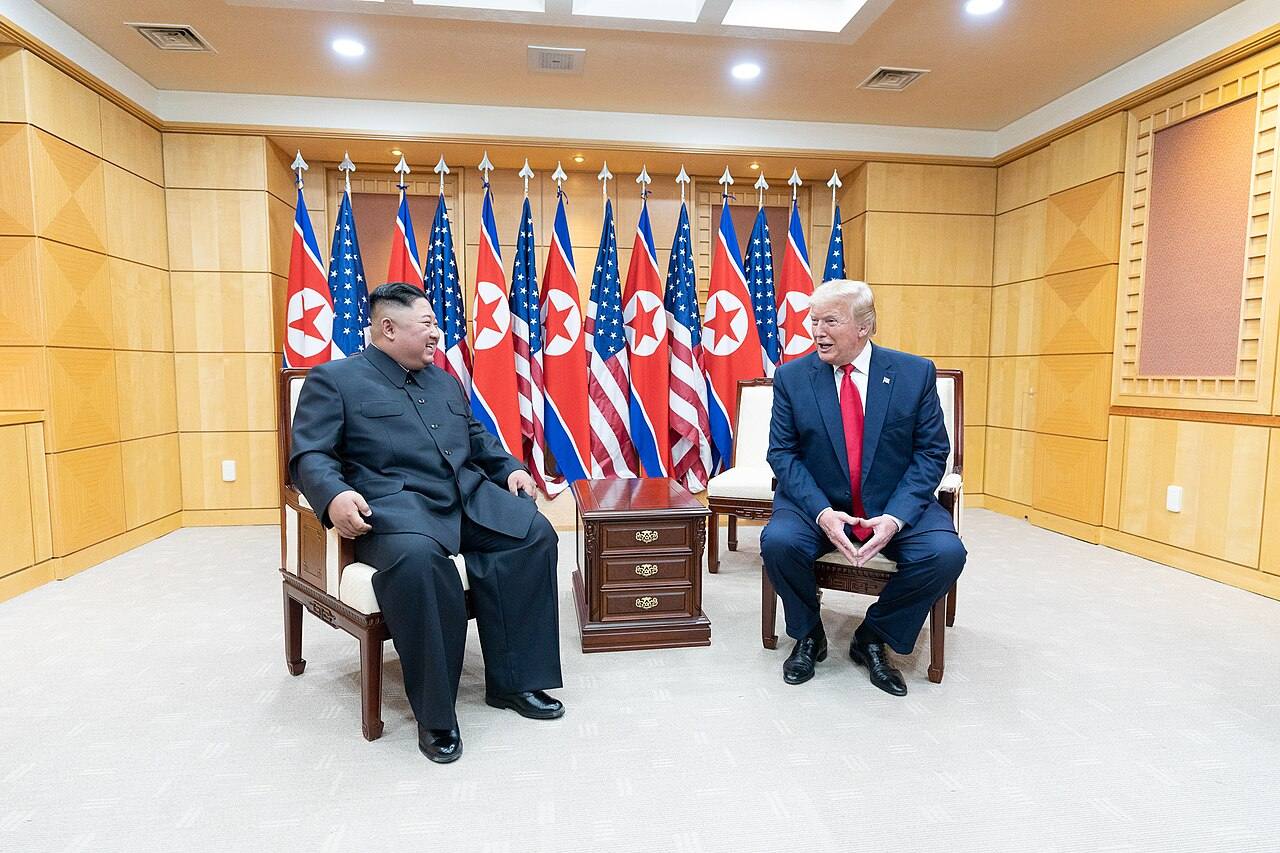
US President Donald Trump pushed until the last minute during his Asia trip for a summit with North Korean leader Kim Jong Un, but the effort collapsed after Pyongyang set conditions Washington found unacceptable, the Wall Street Journal reported on Saturday, November 21. The report, citing people familiar with the discussions, says the specific conditions North Korea set have not been disclosed.
Source: Seoul Economic Daily
The failed summit bid followed months of unanswered outreach, according to the Journal. Trump tried to reach Kim last year through established phone lines and communication channels, but nobody called back. He then wrote a letter to Kim — and getting it to him became a problem in itself. White House officials arranged for a group to wait outside North Korea's permanent mission to the United Nations in Manhattan and thrust the letter into the hands of a North Korean diplomat walking past. At a later UN meeting, the diplomat tossed the unopened letter in front of a US representative, the people familiar with the matter said.
What Washington offered — and what Pyongyang wanted
According to the Journal, US officials discussed declaring a formal end to the Korean War — the 1950–1953 conflict that ended with an armistice more than seven decades ago — as a step towards arranging the meeting. They also weighed issuing a statement that would neither recognise North Korea as a nuclear weapons state nor demand that it dismantle its nuclear programme. In return, Washington planned to ask Pyongyang to limit its nuclear and missile tests, and officials considered establishing liaison offices as a first step towards diplomatic relations. The two countries still have no official diplomatic ties.
The exact conditions Kim set have not been confirmed. Analysts say Pyongyang is demanding recognition as a nuclear power and an end to what it calls hostile US policy. During the Asia trip itself, Kim stayed far from the diplomacy: North Korean state media reported he inspected construction sites and a naval academy in South Hamgyong province on November 17 and 18, moving away from China. Lim Eul-chul, a professor at Kyungnam University's Institute for Far Eastern Studies, called the itinerary a non-verbal signal of rejection.
The Asia trip that ended without a meeting
Trump had raised the possibility himself. Before leaving the White House for the trip on November 16, he told reporters: "I might meet with Kim Jong Un." After arriving in Manila for ASEAN and Quad meetings, he said of Kim: "He would like to come, too. Let's see what happens." He then travelled to Shenzhen, China, for the APEC summit and the first-ever trilateral summit with Chinese President Xi Jinping and Russian President Vladimir Putin on November 18–19 — and flew home on November 19 with no meeting having taken place.
A bigger arsenal than in 2019
Since Trump last met Kim — in Singapore in June 2018, in Hanoi in February 2019, and at the Demilitarized Zone on June 30, 2019, when Trump became the first sitting US president to step onto North Korean soil — Pyongyang has sharply expanded its nuclear capabilities. The Journal reports the arsenal has grown from an estimated 20 to 30 warheads in 2019 to around 60 now, and that North Korea has deployed solid-fuel intercontinental ballistic missiles capable of reaching the US mainland, while also strengthening military ties with Russia. The last round of denuclearisation talks broke down after the Hanoi summit in 2019, and the two sides have not returned to the table since.
A Trump administration official told the Journal on Saturday that there had been no efforts to broker a meeting with Kim, and the White House said its position on denuclearisation has not changed. North Korea's mission to the United Nations did not respond to requests for comment.
What is solid
- No Trump–Kim meeting took place during the Asia trip; Trump left China on November 19.
- Trump met Kim three times in his first term — Singapore in June 2018, Hanoi in February 2019 and the DMZ on June 30, 2019.
- The Wall Street Journal reported on November 21 that the summit effort collapsed over conditions set by Pyongyang.
What is only claimed
- Whether the White House was actively pushing for a summit — the Journal reports it was, citing people familiar with the discussions; a Trump administration official denies any such effort.
- The exact conditions North Korea set — the Journal reports they were unacceptable to Washington but does not say what they were.
What happens next
There is no signal that talks will resume soon. The two governments remain without official diplomatic relations, and the path back to direct engagement is unresolved. Experts cited by the Journal warn that entering negotiations without making denuclearisation a central demand would raise concerns among allies, including South Korea and Japan — and for now, the White House maintains that its commitment to North Korea's denuclearisation has not changed.