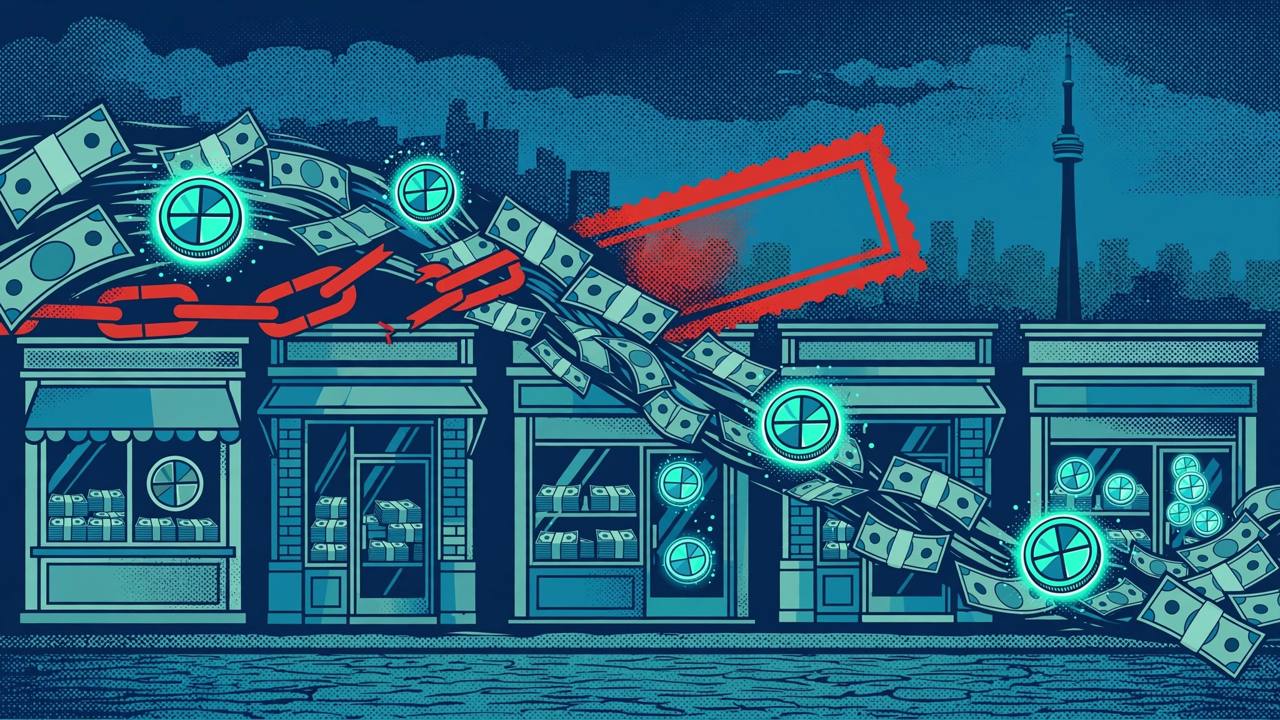
The US Treasury Department said on Friday, November 6, that it had imposed financial sanctions on eight money services firms based in Canada that it alleges have facilitated transactions with sanctioned Iranian entities, Reuters reported. The designations, by the Treasury's Office of Foreign Assets Control (OFAC), effectively cut the firms off from the dollar-based financial system: any assets they hold in the United States are blocked, and US persons and entities are prohibited from doing business with them.
Source: Reuters
"Canada cannot be a safe haven for illicit financial facilitators that provide sanctions evasion services to the Iranian regime and its proxies," Treasury Secretary Scott Bessent said. "Treasury will pursue and disrupt the Iranian regime's financial channels anywhere in the world." The action is part of a Treasury campaign called Operation Economic Outcast, aimed at the channels Iran uses to move money around US sanctions while the US-Israel war on Iran, which began on February 28, continues.
OFAC said the eight businesses — six in the Toronto area and two in Vancouver, according to The Bureau's reading of the Treasury listings — exchange Iranian rials and other currencies for cryptocurrency, and that many had transacted with sanctioned Iranian digital asset exchanges and with cryptocurrency addresses tied to Iran's Islamic Revolutionary Guard Corps (IRGC). The designated businesses are Diverse Trade Inc, doing business as Million Exchange; 1380079 BC Limited; Top PC Technician Inc; NIA Nations Currency Ltd; 2397639 Ontario Ltd, doing business as Farah Exchange; CCC Inc; B Galaxy Inc; and Darvish Exchange. Treasury also recorded trade names including Sarafi Amin, Sarafi Capital, Parsis Exchange and Salam Exchange — 'sarafi' is the Persian word for an exchange house.
Source: The Bureau (citing OFAC)
Six of the eight companies give addresses along a stretch of Yonge Street running about 10 kilometres from North York to Richmond Hill, and several share units — two list the same suite at 7181 Yonge Street in Thornhill, The Bureau reported. Treasury said Canada is home to hundreds of money services businesses that move funds into and out of Iran, through cash-based value transfer systems and by converting cash into cryptocurrency, and that the entities designated on Friday remain operational despite the risks being flagged in Canadian and international media. Several, Treasury said, had changed their business names and addresses in an attempt to evade detection. The designations are not criminal charges, but they carry secondary-sanctions risk: foreign banks and businesses that deal with the named firms can themselves face US penalties.
Treasury also alleged a direct bridge between the Iran-linked exchanges and organised crime. Former Olympic snowboarder Ryan Wedding, accused of running a billion-dollar cocaine network for Mexico's Sinaloa Cartel, "has used money exchange businesses in the Vancouver and Toronto areas to launder billions of dollars in drug proceeds," Treasury said, adding that he used couriers to move bulk cash to the firms, which converted it into digital assets to send abroad. Treasury named three of Friday's designated businesses in connection with Wedding and said he worked with several of them to transfer millions of dollars in digital assets before he was taken into US custody. Wedding was arrested in Mexico City in January 2026 after nearly a year on the FBI's Ten Most Wanted list; he has pleaded not guilty and is held without bond in the United States, with federal trials in Los Angeles scheduled for March 31 and October 26, 2027. These are Treasury's allegations, not findings of a court.
In a parallel move, the Treasury's Financial Crimes Enforcement Network (FinCEN) — its anti-money-laundering unit — issued an order cutting the virtual currency exchanger MEXC Global off from the US financial system. FinCEN said the order prevents US financial institutions from processing fund transfers involving Seychelles-incorporated MEXC Global, which it says has facilitated at least $16 billion in illicit transactions linked to Iran, North Korea and Russia, as well as transactions with other sanctioned actors. That figure — $16 billion, yaani about 1,600 crore dollars — covers the exchange's alleged illicit flows overall; the Iran-linked share is part of it, not the whole.
For readers in Canada, the practical point is narrow but real: the sanctions name eight specific businesses, most of them small currency exchanges on Toronto's Yonge Street corridor and in Vancouver — streets where thousands of Iranian-Canadian, Punjabi and other South Asian families routinely send and receive money. Anyone who uses one of the named firms should expect US-dollar transactions through it to stop, and should check whether their own transfers are affected. The designations target the named companies and their alleged networks, not the communities that use currency exchanges for ordinary family remittances.
What happens next: the designations took effect on announcement, and the named firms can apply to OFAC for removal from the sanctions list, a process that requires showing the basis for the listing no longer applies. Washington has been widening this campaign step by step — OFAC designated the Iranian exchanges Nobitex, Wallex, Bitpin and Ramzinex in June 2026 and two more Iranian platforms in August — and Bessent's statement signals that firms outside Iran that handle its money, in Canada or anywhere else, should expect the same treatment.