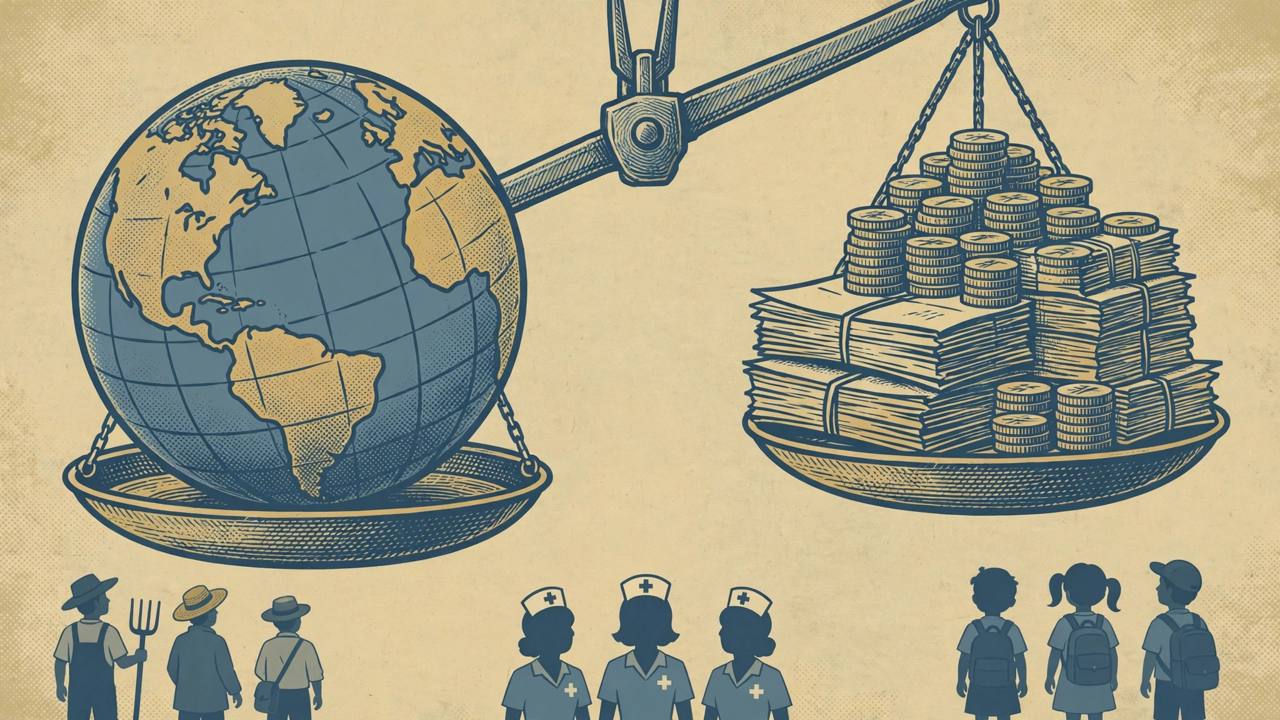
Developing countries now owe the rest of the world more than at any point in history. Their external debt rose 5.5 percent in 2025 to a record $9.4 trillion, the World Bank said on Thursday in its annual International Debt Report — the largest annual increase since 2021, and about four times the average pace of the previous three years, as governments returned to international bond markets in force.
Source: Reuters (World Bank International Debt Report)
$9.4 trillion — yaani $9,400 billion, or 9.4 lakh crore dollars in desi counting. The Bank said the rising cost of servicing that debt is preventing some governments from investing in the future — in schools, hospitals, roads and jobs — because so much of every budget now goes straight back out of the door to creditors.
The poorest pay the most — by far
The burden is rising fastest exactly where countries can least afford it. External debt in the poorest economies — those eligible for concessional lending from the World Bank's International Development Association (IDA) — grew 8.1 percent to $1.3 trillion. Those countries paid an average interest rate of 8.2 percent on new commitments from private creditors, the highest since 1989, and 9.4 percent on new bonds. Countries not eligible for IDA's cheap loans, by contrast, secured new bonds at an average of 5.5 percent, down from 5.8 percent in 2024.
Source: The Guardian (World Bank data)
The Bank named the prices the poorest borrowers are actually paying: Laos borrowed at 11.5 percent, the Republic of Congo at 13.88 percent and Kenya at 9.2 percent. The gap between what poor countries pay private lenders and what they pay official lenders widened to 5.5 percentage points in 2025, from 3.4 points in 2016.
Haishan Fu, the World Bank Group's chief statistician, put the squeeze in one line: access to international finance has improved, but the price of that finance has not — low- and middle-income countries are borrowing more, paying more and, in many cases, leaving less for long-term development.
More money leaves than arrives
Low- and middle-income countries paid a combined $1.4 trillion in principal and interest in 2025 — the fifth straight annual increase — including $363 billion paid to bondholders. Between 2022 and 2025, developing countries paid $436 billion more in debt service than they received in new financing: a net drain out of the world's poorer economies and into its lenders. Bond issuance by public entities climbed nearly 35 percent to $251 billion, the highest in five years, and preliminary data suggest borrowing has continued at a rapid pace in 2026 — at continued high interest rates.
The report lands as the war-driven shock to energy and food prices keeps budgets stretched across South Asia and Africa — the same economies whose workers in the Gulf send home the remittances that help service these debts. The UK government is preparing to champion a 'new drive on debt' during its presidency of the G20 next year, The Guardian reported — an early sign that the record numbers are starting to force a political response.
What is solid
- The World Bank's International Debt Report, released Thursday and reported by Reuters and The Guardian, puts developing-country external debt at a record $9.4 trillion in 2025, up 5.5 percent
- IDA-eligible (poorest) countries' external debt rose 8.1 percent to $1.3 trillion; their average rate on new private-creditor commitments was 8.2 percent and on new bonds 9.4 percent — the highest since 1989
- Low- and middle-income countries paid $1.4 trillion in principal and interest in 2025, the fifth consecutive annual increase
What is only claimed
- The figures describe 2025, the last full year of data — they are a report on last year's borrowing, not a measure of this week's markets
- Whether the UK's promised G20 'new drive on debt' will produce actual relief is a political pledge at this stage, not a programme
What happens next is a test of arithmetic as much as politics: at 8 to 14 percent interest, the poorest governments must grow faster than their debt just to stand still. The World Bank's warning is that, on 2025's numbers, many are not — and every year of delay adds another record to the pile.