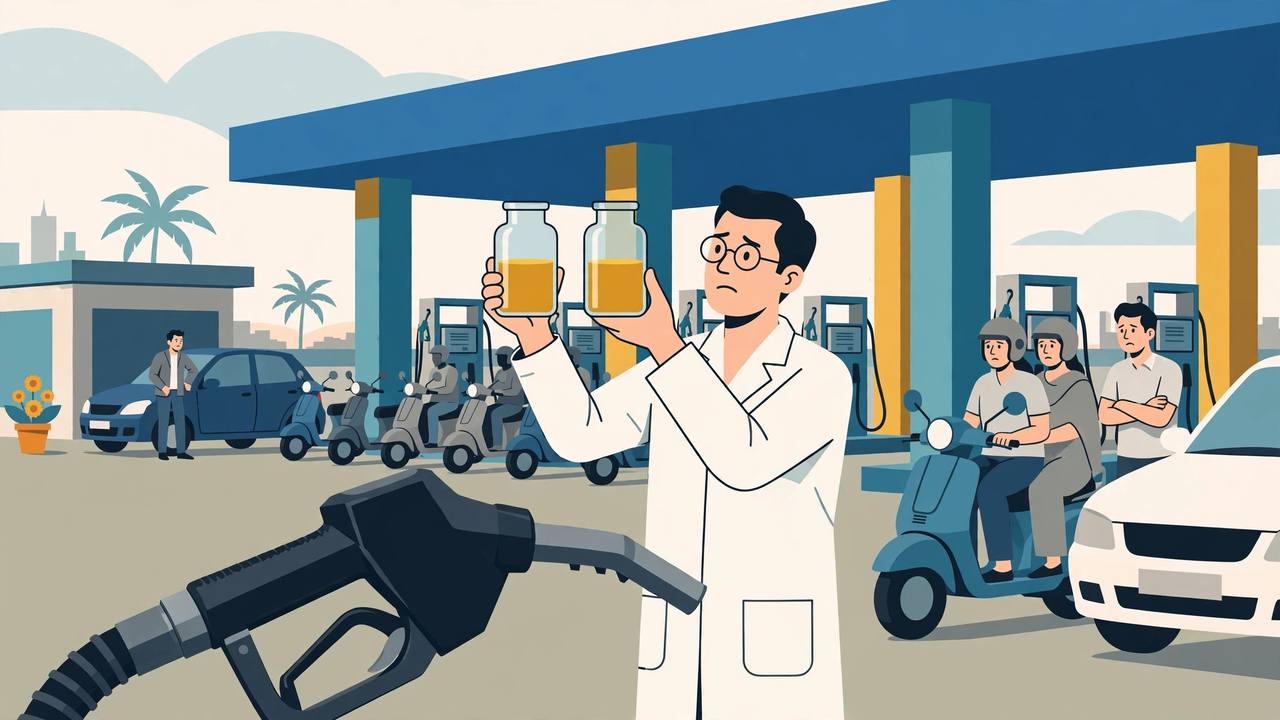
The Centre on Saturday, November 7, rejected claims of excessive ethanol blending in petrol at some retail outlets in Karnataka, questioning the sampling and testing methodology adopted by the state and saying all 56 samples tested in Karnataka under a nationwide quality-monitoring exercise complied with the prescribed E20 specifications.
Source: IANS
The Ministry of Petroleum and Natural Gas said the three public-sector oil marketing companies — Indian Oil Corporation Ltd (IOCL), Bharat Petroleum Corporation Ltd (BPCL) and Hindustan Petroleum Corporation Ltd (HPCL) — had clarified that the reported claims of 26–31 per cent ethanol blending were not supported by tests conducted under prescribed statutory and technical procedures. E20 petrol supplied by the three companies across the country, including Karnataka, conforms to IS 17021, the Bureau of Indian Standards specification for ethanol-blended motor gasoline, the ministry said in a statement.
Saturday's rejection is the Centre's response to the earlier development in this row: on Friday, November 6, the Karnataka government alleged that laboratory tests on petrol samples collected from seven districts had found ethanol above the 20 per cent limit in 11 of 14 detailed results, with one IOCL sample recording 31.2 per cent, and sought action against the oil companies and compensation for vehicle owners.
Leader of Opposition Rahul Gandhi on Saturday attacked the Centre over the same Karnataka test results. “E20 turned into 420 — stealing petrol from the public's cars,” Gandhi said in a post in Hindi on X, asking when action would be taken against companies supplying fuel beyond the prescribed 20 per cent limit. He said 11 of 14 samples contained more than 20 per cent ethanol — 31.2 per cent at IOCL and 30.5 per cent at HPCL — and that samples of public and private companies alike exceeded the limit. Those excess-ethanol figures are Karnataka's allegation, which the Centre and the oil companies dispute.
Source: PTI via Swadesi News
What the Centre's own tests found
As part of the OMC–Centre for High Technology Quality Coordination Cell exercise, 893 E20 samples collected from 27 states and Union Territories — 330 from IOCL, 280 from BPCL and 283 from HPCL — were tested for ethanol content under IS 17021 at refinery and oil-company quality-control laboratories, and all were found within the prescribed 19–21 per cent range, the ministry said. All 56 samples tested in Karnataka, covering different locations and all three companies, also complied, recording ethanol between 19 and 20 per cent with an average of 19.30 per cent.
The ministry said the Motor Spirit and High Speed Diesel (Regulation of Supply, Distribution and Prevention of Malpractices) Order, 2005, issued under the Essential Commodities Act, 1955, read with the Marketing Discipline Guidelines 2024, prescribes a defined procedure for sampling, retention, testing and communication of results, under which six one-litre samples are drawn — two for the dealer, two retained by the oil company or department and two sent to a designated laboratory. It said the October 2026 exercise behind Karnataka's claims reportedly drew samples without oil-company representatives, the companies have not received the retention samples, complete outlet-wise details or laboratory reports despite seeking them, and the findings relied on certificates from a third-party laboratory rather than one specified under the Control Order, without complete technical details — preventing independent verification and any retesting. It also flagged that samples reported to contain 26–31 per cent ethanol showed densities lower than those recorded in the companies' own E20 samples.
The ministry also questioned estimates of an annual consumer mileage loss of around Rs 62,000 crore and vehicle-repair costs of Rs 39,000 crore — about Rs 1.01 lakh crore together — saying they required careful examination against technical evidence and actual vehicle-performance data. Citing studies involving the Inter-Ministerial Committee, IOCL, the Automotive Research Association of India and the Society of Indian Automobile Manufacturers, it said vehicles calibrated for E20 may see a mileage reduction of around 1–2 per cent and some other vehicles about 3–6 per cent, and that applying a blanket 10 per cent mileage loss across the entire vehicle population was not scientifically established. More than 30 crore two-wheelers and four crore four-wheelers have been running on E20 for over three years, and no widespread incidence of vehicle breakdowns has been reported, it added.
Defending the blending programme, the ministry said that since Ethanol Supply Year 2014-15 it has resulted in foreign-exchange savings of over Rs 1.97 lakh crore, substitution of about 316 lakh metric tonnes of crude oil, a reduction of around 952 lakh metric tonnes of carbon-dioxide emissions and transfers of more than Rs 1.66 lakh crore to farmers. During Ethanol Supply Year 2025-26, ending October 31, 2026, public-sector oil companies procured 1,089 crore litres of ethanol and blended 1,134 crore litres against petrol sales of about 5,673 crore litres. The suggestion that the companies had a commercial incentive to blend beyond the prescribed target was misplaced, the ministry said, because additional ethanol procurement would increase their costs.
The oil companies have sought the retention samples, outlet-wise details and laboratory reports behind Karnataka's findings through the State Level Coordinator, and the Centre says fuel quality will be protected through transparent, technically sound and jointly verifiable testing. Karnataka's response to the Centre's statement is awaited.
Sources: IANS report on the Ministry of Petroleum and Natural Gas statement, November 7, 2026; PTI report on Rahul Gandhi's post on X, November 7, 2026.