Latest News — Punjab, India, USA and the World
Awaaz Punjab is an independent digital news platform publishing original, source-verified reporting in English, Punjabi and Hindi. Every story below is published with its sources named and dated, and every article is available in all three languages. Our newsroom covers Punjab first — its politics, districts and the road to the 2027 assembly election — along with India, the Punjabi diaspora in the USA and Canada, and world affairs that touch Punjab's people, from the Gulf to North America.
An explosion at the Habas iron and steel plant in Aliaga, Izmir province, at around noon on Monday killed at least six people, left eight missing and injured 13 in the latest official update, the Izmir governor's office said. Initial findings say a ceiling crane snapped and fell into an arc furnace during liquid steel casting; rescue teams were still trying to reach workers trapped under rubble.
Published 2026-11-09 · Awaaz Punjab
Indian Olympic Association president PT Usha failed to win one of the four women's Sportspersons of Outstanding Merit seats in Monday's virtual election, polling 40 votes as Anju Bobby George (53), Rani Rampal (50), Dola Banerjee (45) and Saina Nehwal (43) were elected — a result that leaves Usha needing a National Sports Federation nomination to the General Assembly if she is to contest the December 5 Executive Council elections at all, PTI reported.
Published 2026-11-09 · Awaaz Punjab
Sushmita Roy, wife of Sumit Roy, the executive assistant to Trinamool Congress general secretary and Diamond Harbour MP Abhishek Banerjee, on Monday petitioned a single-judge bench of the Calcutta High Court alleging that West Bengal Police are torturing her husband in custody to extract a confession. She has sought a CBI probe into the two cases against him, protection in custody and transfer of the investigating officers. The petition has been admitted and will be heard on Tuesday. The allegations are unproven and police had not publicly responded in the reporting so far.
Published 2026-11-09 · Awaaz Punjab
Amtrak has told WABC-TV it will phase in, from January 2027, a policy allowing passengers 18 and older to bring declared, unloaded firearms in double-locked, TSA-compliant carry-on cases on trains that have no checked baggage — including the Northeast Regional and Acela — travelling only between staffed stations, in a rollout that began on the Auto Train on September 1. The Transport Workers Union, which represents 360 Amtrak on-board workers, calls the plan “sheer lunacy,” says it would cover another 1,500 trains a day, and is asking the federal government to reverse it. Amtrak ties the change to Executive Order 14206 and has not yet published the full rules.
Published 2026-11-09 · Awaaz Punjab
The nationwide 'Viksit Bharat Yuva Samvad: Know Your Vote' campaign, run by the Ministry of Youth Affairs and Sports through MY Bharat, concluded with 536 dialogues reaching 100,493 young people, the ministry said — a drive Union Minister Mansukh Mandaviya highlighted again on Monday, calling young voters' enthusiasm extraordinary.
Published 2026-11-09 · Awaaz Punjab
Punjab Finance Minister Harpal Singh Cheema said on Monday that Punjab Police has brought back 17 gangsters from abroad in six months under the 'Gangsters te Vaar' campaign, and that police conducted 1,61,266 raids and arrested about 2,162 proclaimed offenders between January 20 and November 7. Punjab BJP president Kewal Singh Dhillon hit back the same day, saying extraditions are done by central agencies, the MEA, CBI and Interpol — and that killings continue unchecked inside Punjab.
Published 2026-11-09 · Awaaz Punjab
At the seventh India-EU Strategic Partnership Review Meeting in New Delhi on Monday, co-chaired by MEA Secretary (West) Sibi George and the EU's Matti Maasikas, the two sides reviewed work towards the timely signing and implementation of the free trade agreement, agreed to keep working on the Investment Protection Agreement and the Geographical Indications pact, and underlined connectivity through Global Gateway and the India-Middle East-Europe Economic Corridor (IMEC).
Published 2026-11-09 · Awaaz Punjab
Punjab Congress president Pargat Singh, visiting Phagwara's Vishwakarma Temple with Leader of Opposition Partap Singh Bajwa on Vishwakarma Day, pledged a separate and comprehensive industrial policy for Punjab if Congress forms the government after the 2027 Assembly elections, with a special focus on small and medium industries and jobs.
Published 2026-11-09 · Awaaz Punjab
Replacing the 2011 law, the Rekha Gupta government's new Act makes on-time service a statutory right in the capital: every covered service gets a deadline and a designated officer, applications move online with tracking — and rejecting an application without proper grounds can itself cost the officer up to Rs 5,000.
Published 2026-11-09 · Awaaz Punjab
India and Lebanon held their first Foreign Office Consultations in New Delhi on Monday, co-chaired by MEA Secretary Sripriya Ranganathan and Lebanon's Ambassador Abdel Sattar Issa, reviewing the full range of bilateral ties and naming trade and investment, digital public infrastructure and pharmaceuticals as priority areas, the MEA said.
Published 2026-11-09 · Awaaz Punjab
A late-night fire between Nallasopara and Virar stations, reportedly sparked by Diwali firecrackers, damaged Western Railway signalling equipment and slowed Mumbai-bound suburban and long-distance trains through the Monday morning peak, with delays of 15 to 40 minutes reported.
Published 2026-11-09 · Awaaz Punjab
India's Women's Selection Committee on Monday named squads for the December all-format tour of South Africa — one Test, three ODIs and three T20Is. Jemimah Rodrigues, out since July with a hamstring injury, returns in every format, Smriti Mandhana captains all three sides and will lead the Test team for the first time, and Amanjot Kaur is back for the T20Is only.
Published 2026-11-09 · Awaaz Punjab
Justices Pardiwala and Manmohan set aside the Patna High Court's cancellation of bail in a Rs 4,000 alleged-bribe case, restated that custody beyond 48 hours suspends a public servant by operation of law — and asked Bihar to explain how the accused was put back on the same post in the same hospital.
Published 2026-11-09 · Awaaz Punjab
A petition filed in the Supreme Court has sought time-bound directions to ensure hygienic drinking water, functional toilets, cleanliness, emergency medical facilities and accessibility at railway stations across India, citing an August CAG report that flagged E. coli in station water coolers. The plea is listed for hearing on November 16 before a bench headed by Chief Justice Surya Kant.
Published 2026-11-09 · Awaaz Punjab
Punjab's Anti-Gangster Task Force has secured the deportation of Gurwinder alias Afridi, a key member of the Doni Bal-Prabh Dassuwal gang, from Ethiopia after a 10-month international manhunt, DGP Gaurav Yadav announced. The operation, named Operation SHAHID, was run by the AGTF with the Counter Intelligence wing's fugitive-tracking cell OFTEC and central agencies, tracking the accused across Asia, South America and Africa. Police allege he was directing targeted killings and extortion-related firings in Punjab from abroad; a reward of Rs 5 lakh had been announced for information leading to his arrest.
Published 2026-11-07 · Awaaz Punjab
In a major new development in the Gokul Dairy board row — after the state cabinet gave voting rights to nominee directors and the ordinance was promulgated last week — the Bombay High Court's Aurangabad bench on Monday allowed Tuesday's chairman election to proceed, but ordered the four government-appointed expert directors' votes to be kept sealed until the court decides the ordinance's validity on November 25, even as thousands of dairy farmers marched through Kolhapur in protest.
Published 2026-11-09 · Awaaz Punjab
Prime Minister Narendra Modi will inaugurate the newly built COSMOS-Mysuru planetarium on November 13, Mysuru-Kodagu MP Yaduveer Krishnadatta Chamaraja Wadiyar announced on Monday — a Rs 115-crore Indian Institute of Astrophysics facility whose tilted 15-metre LED dome, with 8K resolution and no projector at all, is billed as a world first of its kind.
Published 2026-11-09 · Awaaz Punjab
The Union Ministry of Ports, Shipping and Waterways announced on Monday that Delhi's first recreational Yamuna river cruise will be inaugurated on Tuesday, November 10, with electric-powered vessels on the Sonia Vihar–Jagatpur stretch of National Waterway-110.
Published 2026-11-09 · Awaaz Punjab
Union Home Minister Amit Shah on Monday inaugurated and laid foundation stones for 30 development projects worth Rs 1,024 crore in his Gandhinagar Lok Sabha constituency, opened the four-km ISKCON-Sanand Elevated Corridor in Ahmedabad, and said projects worth Rs 25,000 crore have been completed in the constituency over seven years.
Published 2026-11-09 · Awaaz Punjab
Speaking in Nagpur on Monday, RSS chief Mohan Bhagwat recounted that when a ban on the Sangh was attempted in the Central Provinces Assembly in the 1930s, the only voice in its defence was a Muslim man named Ibrahim, who said he knew founder Dr Hedgewar personally and that the RSS could never be communal.
Published 2026-11-09 · Awaaz Punjab
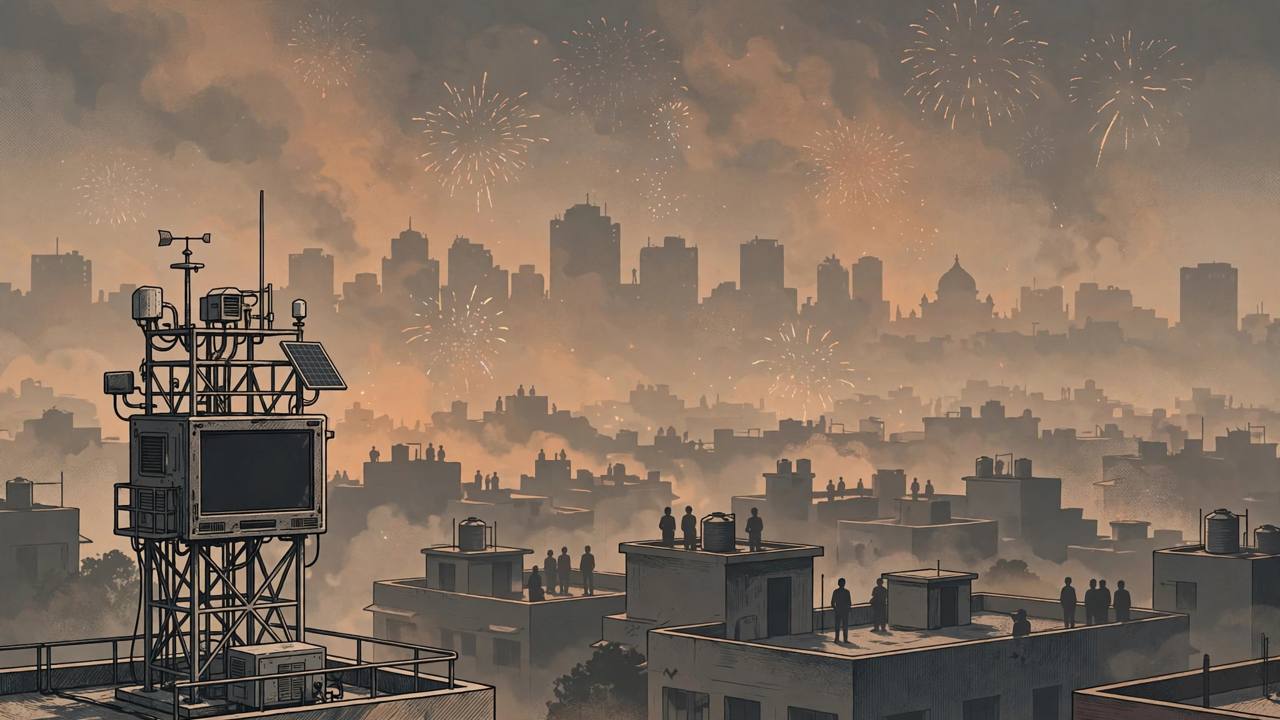
Kolkata's average AQI touched 437 at 2 am on Monday after widespread firecracker bursting during Kali Puja, data cited by the West Bengal Pollution Control Board showed, with Salt Lake's EE Block recording 662.
Published 2026-11-09 · Awaaz Punjab
President Droupadi Murmu will confer the Swachh Survekshan Awards 2025-26 at Vigyan Bhawan in New Delhi on November 11, the Housing and Urban Affairs Ministry announced on Monday — the 10th edition of the world's largest urban cleanliness survey, which assessed over 4,751 cities on 43 indicators with more than 3,000 trained assessors.
Published 2026-11-09 · Awaaz Punjab
A three-year-old girl, whose parents sell balloons at the roadside, was allegedly sexually assaulted by an unidentified person inside a dilapidated building in Mapusa, North Goa, on Sunday evening, police said. The child, first taken to Mapusa District Hospital and later shifted to Goa Medical College, is stable, Superintendent of Police (North) Rahul Gupta said, as police registered a case and launched a manhunt.
Published 2026-11-09 · Awaaz Punjab
The four-day exercise, running from November 8 to 11, brings the Indian Navy and the Royal Navy of Oman together to strengthen operational coordination and interoperability, the Indian Navy said on Monday.
Published 2026-11-09 · Awaaz Punjab
Published 2026-11-09 · Awaaz Punjab
Published 2026-11-09 · Awaaz Punjab
Published 2026-11-09 · Awaaz Punjab
Published 2026-11-09 · Awaaz Punjab
Published 2026-11-08 · Awaaz Punjab
Published 2026-11-08 · Awaaz Punjab
Published 2026-11-09 · Awaaz Punjab
Published 2026-11-09 · Awaaz Punjab
Published 2026-11-09 · Awaaz Punjab
Published 2026-11-09 · Awaaz Punjab
Published 2026-11-09 · Awaaz Punjab
Published 2026-11-09 · Awaaz Punjab
Published 2026-11-06 · Awaaz Punjab
Published 2026-11-09 · Awaaz Punjab
Published 2026-11-09 · Awaaz Punjab
Published 2026-11-09 · Awaaz Punjab
Published 2026-11-09 · Awaaz Punjab
Published 2026-11-09 · Awaaz Punjab
Published 2026-11-09 · Awaaz Punjab
Published 2026-11-09 · Awaaz Punjab
Published 2026-11-09 · Awaaz Punjab
Published 2026-11-09 · Awaaz Punjab
Published 2026-11-09 · Awaaz Punjab
Published 2026-11-09 · Awaaz Punjab
Published 2026-11-09 · Awaaz Punjab
Published 2026-10-22 · Awaaz Punjab
Published 2026-10-19 · Awaaz Punjab
Published 2026-10-18 · Awaaz Punjab
Published 2026-10-18 · Awaaz Punjab
Published 2026-10-18 · Awaaz Punjab
Published 2026-10-18 · Awaaz Punjab
More from Awaaz Punjab
Our Editorial Standards
How we work: every story is checked against at least two independent, reputable sources before publication; allegations are labelled as allegations; figures carry the name of the outlet or agency that reported them and the date; corrections are published openly. Read our full verification method on the How We Verify page, our data desks on the School, Podcast and SUNO audio pages, and our numbered original investigations in the Investigations section.
Awaaz Punjab is an independent, trilingual newsroom — for Punjab, by Punjabis. We do not sell aggregated news; we publish investigations that stand on sources, with the outlet and date attached to every claim. Our first beat is Punjab's drug crisis, our second is Punjab politics. From Amritsar to Toronto — wherever a Punjabi lives, Awaaz Punjab reaches.