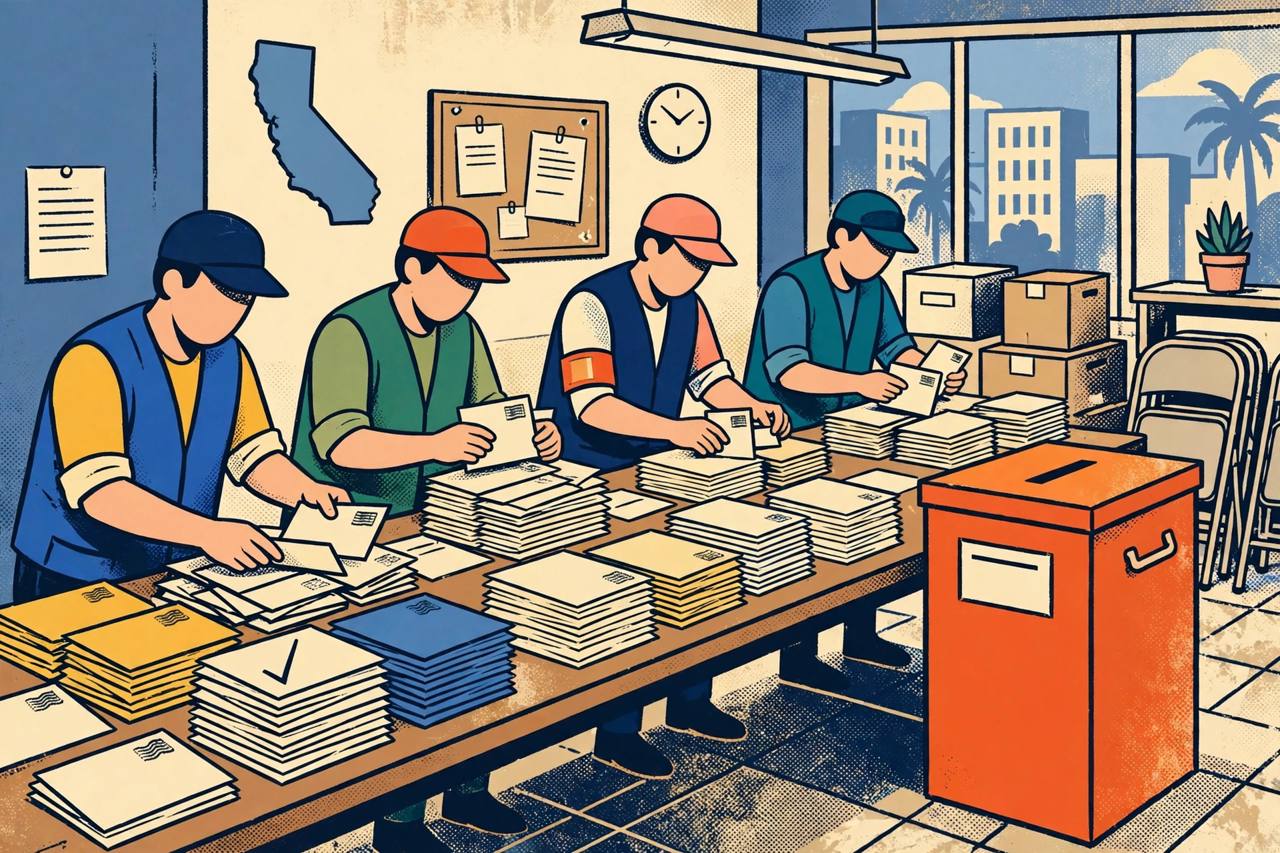
The Trump administration on Friday, November 6, voluntarily withdrew its lawsuit that tried to stop California from counting mail-in ballots from more than 20,000 registered voters whom federal officials alleged were likely non-US citizens, Reuters reported. The Justice Department filed a notice of voluntary dismissal in federal court in Los Angeles, formally ending one of the most closely watched election lawsuits of the 2026 midterms.
Source: Reuters
This is the final chapter of a fight this site has followed step by step: US District Judge David Carter first refused the government's emergency demand, the 9th US Circuit Court of Appeals rejected it as well, and on Monday, November 2 — the day before Election Day — the US Supreme Court also refused to block California from counting the ballots. Four days after that Supreme Court defeat, the department gave up the case altogether.
In its two-page filing, Assistant US Attorney Julie Hamill wrote that “the United States exhausted its appeals to obtain timely relief all the way to Supreme Court,” according to MyNewsLA's account of the filing. She added that by the time a previously scheduled hearing on November 13 would have taken place, “California will have already commingled the challenged ballots with lawful ones. There is then no way to get the challenged ballots segregated. As a result, the relief the United States sought and needed is no longer available,” rendering voluntary dismissal necessary.
Source: MyNewsLA
How the case unfolded
The federal government sued California on October 15, more than a week after mail ballots had been sent to all of the state's registered voters, demanding that election officials set aside the roughly 20,000 ballots from alleged non-citizens after the state refused to voluntarily sequester those votes, MyNewsLA reported. The Justice Department argued it needed quick action because the contested ballots could not be separated from all other votes once they were accepted, Reuters reported.
Judge Carter was openly sceptical from the start. He called the request a “monumental change” to election procedures when voting was already underway, Reuters reported, and in a forceful opinion he said the government's request “would wreak havoc and disrupt the election that is already underway, create a chilling effect on election workers and voters alike, and discount the votes of United States citizens,” according to MyNewsLA. Carter characterised the case as part of what he called a broad, ongoing pattern of attempted election interference.
The demand was then rejected again and again. The effort was rejected four times — twice by a 9th US Circuit Court of Appeals panel and by the Los Angeles federal judge — and finally the Supreme Court denied the appeal on Monday, on the eve of Election Day, in a one-line, unsigned order, MyNewsLA reported. Democracy Docket noted the Supreme Court application had been presented to Justice Elena Kagan, who handles emergency applications from California, and referred to the full court, which denied it.
Source: Democracy Docket
California officials had challenged the accuracy of the federal government's list throughout, warning that it included eligible voters and that complying with the demand could disenfranchise American citizens, Democracy Docket reported. In a separate federal lawsuit brought by the Coalition for Humane Immigrant Rights (CHIRLA) and an individual plaintiff, an expert analysis filed on October 31 put the government's list at 20,930 names and raised questions about false matches that included citizens.
Why the department said it had to quit
The department dismissed the case under a federal procedural rule that allows a plaintiff to voluntarily withdraw a lawsuit before the defendants file an answer or a motion for summary judgment, Democracy Docket reported. The case therefore ends without any final ruling on the merits — no court ever held that the 20,000 voters were, or were not, eligible. What the courts decided, at every level, was only that the ballots could not lawfully be pulled out of a count that was already underway.
The dismissal is not a complete retreat. Despite abandoning the lawsuit, the Justice Department signalled it is not necessarily giving up its broader efforts over suspected noncitizen voting. “The United States is evaluating how to best ensure that American votes are protected, including by preventing vote dilution by noncitizens,” government attorneys wrote in Friday's filing, according to Democracy Docket. The filing did not identify any specific new legal actions.
The November 13 hearing in Los Angeles federal court is now moot and the case is closed, so California's count continues uninterrupted. Judge Carter had noted election officials have until December 3 — the date by which results must be certified — and the dismissal removes the last federal court threat hanging over those ballots. Watch for any new Justice Department filings on voter-list maintenance in other states.
The California fight was part of a much wider campaign. The Justice Department sued at least 30 states that refused to turn over voter data, losing almost all of the cases, MyNewsLA reported, and the dismissal followed another setback on Thursday in Washington state, where a federal judge temporarily barred department officials from using coercive demands and threats of prosecution to pressure election officials into withholding ballots during the ongoing count, according to Democracy Docket.
For California's large immigrant and Punjabi-American communities, the practical meaning is direct: ballots that were cast lawfully in this election stay in the count, and a challenge built on a disputed federal list — a list the state said swept in eligible citizens — has ended without a single one of those votes being segregated. The dismissal came after midterm elections in which Democrats won by comfortable margins in all of California's statewide contests and most of its congressional races, Reuters reported.