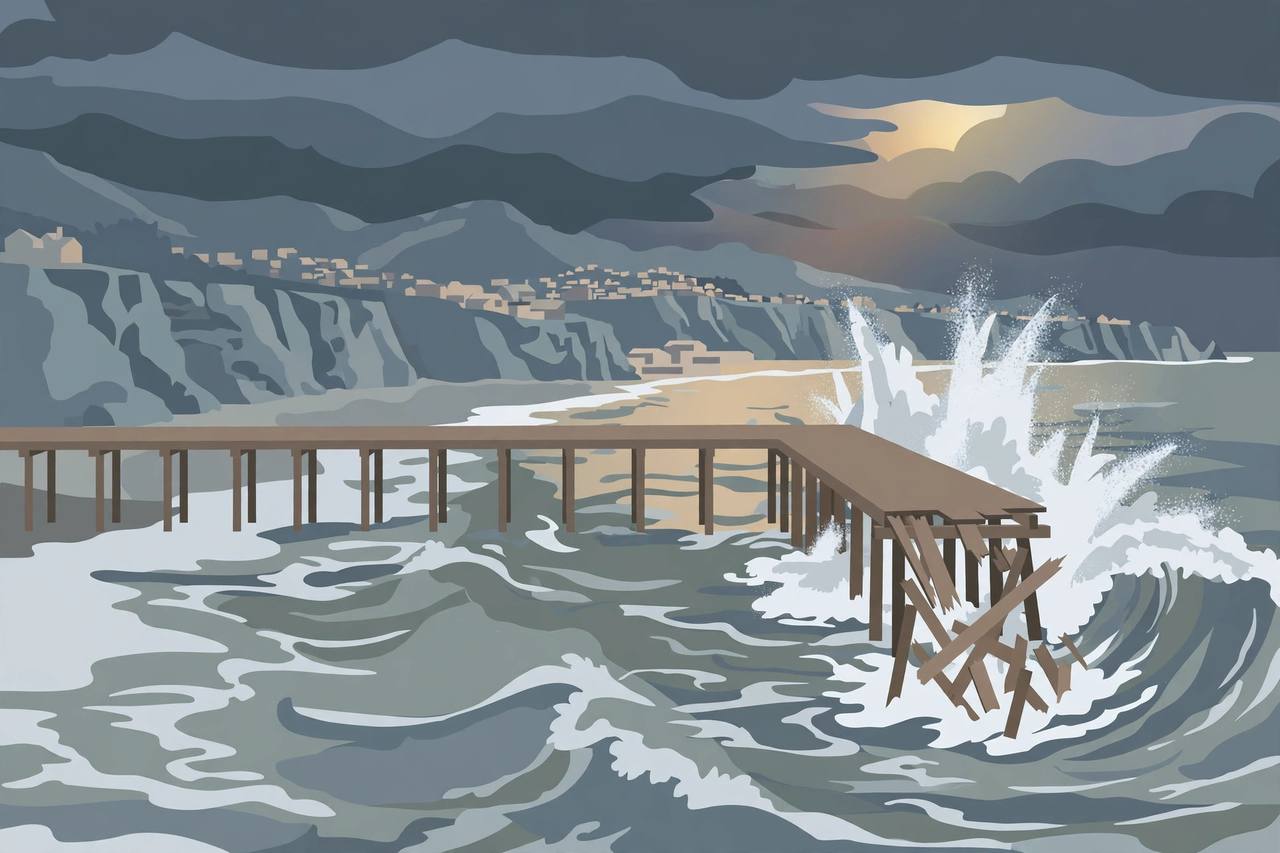
A massive wave tore away part of the Pacifica Municipal Pier in Northern California on Wednesday morning, November 25, as record king tides and huge surf battered the coast — and officials warned more beachfront homes are at risk of flooding. Video showed the L-shaped pier's outer end tipping backward and dropping into the Pacific Ocean. The pier had been closed to the public since June, so the collapse happened with no public access to the structure.
Source: Associated Press
The 1,140-foot (350-metre) pier, built in 1973, has been an iconic fishing spot for decades, drawing anglers and crabbers. Footage of the collapse filmed by weather observer Colin McCarthy was shared by the San Francisco Chronicle, and ABC7 confirmed the partial collapse. The Los Angeles Times reported the section gave way shortly after the predicted high-tide peak for the area, at about 10:30 a.m.
Source: Surfer
A pier already closed for cracks
Engineers found serious cracking near the pier's entrance in June, and the structure was closed. The adjacent Chit Chat Cafe was later demolished over safety concerns. City officials had spent months working to stabilise the site, so Wednesday's failure is a serious setback. The pier remains shut indefinitely, and with dangerous surf continuing, the full extent of the damage is still to be assessed.
Record tides meet 30-foot waves
King tides are the highest tides of the year, occurring when the sun, moon and Earth line up closely. This time they arrived with a powerful west-northwest swell and elevated ocean levels linked to warm El Niño waters. The National Weather Service warned of breaking waves of 20 to 30 feet (6 to 9 metres) — about two to three stories high — in the Bay Area.
Records fell up and down the coast. Preliminary data showed all-time high tides at La Jolla, where the water reached 8.11 feet, and Santa Barbara, at 8.1 feet, while San Pedro tied its previous record at 8.19 feet. San Francisco's water level rose above 8 feet on Tuesday, a November record, and Wednesday's tides were expected to set another.
Flooding from Stinson Beach to Santa Barbara
Beachfront homes in Pacifica began flooding this week, and on Wednesday seawater pushed over the seawall and flooded nearby neighbourhoods and roads. In the Sharp Park neighbourhood, streets flooded more than a block inland, and portions of the seawall collapsed. Water pushed over the parking lot at Pacifica State Beach and onto parts of Highway 1 before 9 a.m. North of San Francisco, Marin County issued an evacuation warning for beachfront properties in Stinson Beach, and warnings were also issued for parts of the Santa Barbara County coast and around Capitola and Aptos in Santa Cruz County. Beaches and wharves were closed.
Source: Associated Press
The National Weather Service warned that breaking waves of 20 to 30 feet could overpower swimmers and sweep people into the ocean: "Everyone should remain out of the water due to life-threatening surf conditions." A coastal flood warning ran through 4 p.m. Wednesday, with a high surf warning in place until midnight.
California's coast has been battered by the same king tides all week — San Francisco set a November water-level record on Tuesday. Read the earlier report
What happens next: with dangerous surf continuing, the full damage assessment is still pending, and the pier will stay shut indefinitely. The collapse lands in the middle of the Thanksgiving travel week, with coastal roads and beaches affected, and officials warn more beachfront homes remain at risk of flooding as the high surf and high tides continue.
The week has already been costly for the California coast. Huntington Beach reported 114 properties damaged by the king tides and ratified an emergency declaration. King tides return every year, but this week's event — supercharged by El Niño-warmed waters and a major swell — has shown how quickly they can turn from a high-water curiosity into destroyed infrastructure.