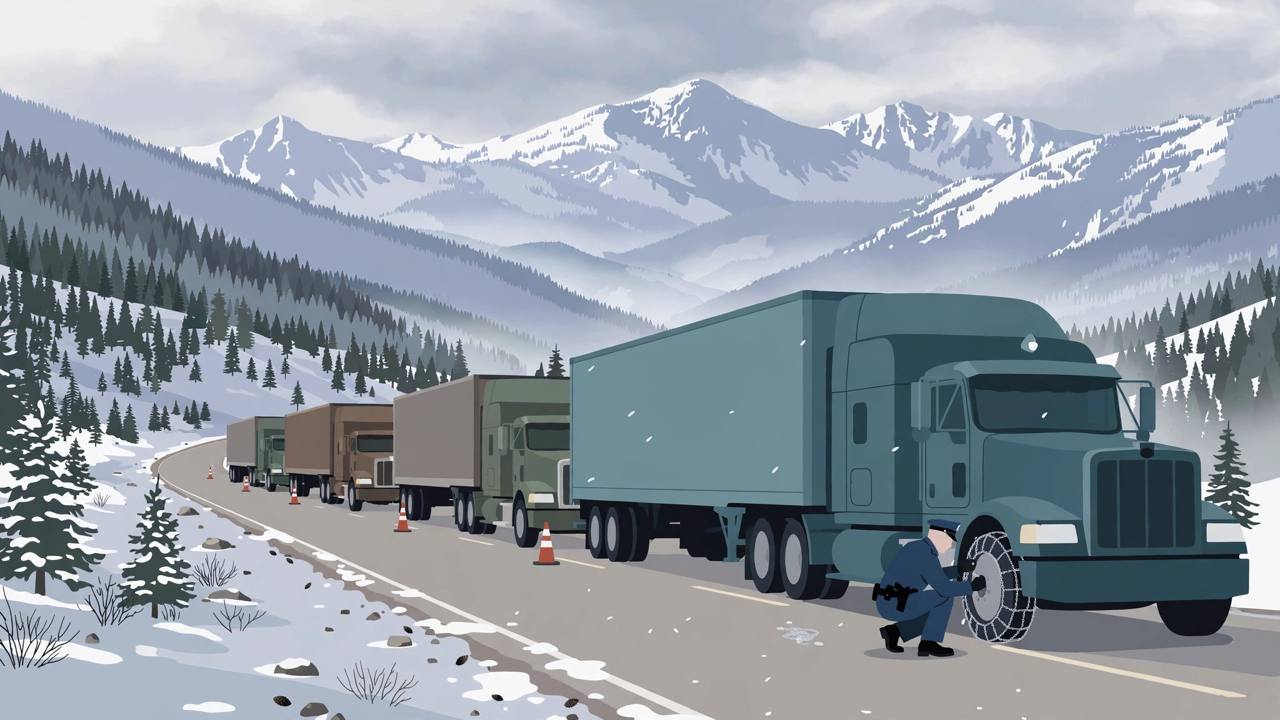
The Colorado State Patrol has released the results of two proactive chain-law enforcement operations on Interstate 70 near Dotsero in Eagle County, and the numbers show how seriously troopers are policing winter readiness this season: 703 commercial drivers were contacted, 262 citations were issued, and 119 professional drivers were stopped after failing to stop at the chain-check operation itself, according to the State Patrol's results reported by CDL Life on Friday, November 6.
Source: CDL Life, reporting Colorado State Patrol results
The two enforcement details ran on October 23 and October 28, 2026, on I-70 near Dotsero, the western gateway to Colorado's high-country corridor. Troopers set up the chain operation and checked whether passing commercial vehicles were carrying the tire chains or approved alternate traction devices that Colorado law requires them to have on board throughout the chain season, whether or not snow is falling.
Of the 262 citations, 63 were for chain violations — drivers who were not adhering to the state's must-carry law. The single largest enforcement action, however, was against drivers who did not stop: the State Patrol performed traffic stops on 119 professional drivers for failing to stop at the chain operation, issued them citations, and then checked the chains they were carrying. Overall, the Patrol recorded a 91 percent compliance rate with the must-carry rules across the two details.
The State Patrol said the point of running the checks in October, including in mild weather, is to get ahead of the first major storms. “Each year, CSP regularly implements chain checks at the ports of entry, active chain-up stations, and daily roadside contacts. However, the Patrol also conducts proactive enforcement operations during mild weather conditions, including proactive chain-carry checks, to send a clear message to commercial drivers to stay prepared for impending winter weather along the I-70 mountain corridor,” the agency said.
What Colorado's chain law requires
Every year from September 1 to May 31, commercial vehicle drivers must carry chains or approved alternate traction devices (ATDs) when travelling on the listed mountain roadways — in all weather, not only during storms. The law applies to vehicles with a combined weight of more than 16,000 pounds used in commerce, and to vehicles transporting at least 16 passengers including the driver, on public highways.
The covered roadways are: I-70 west of mile marker 259 at Morrison all the way to the Utah border; Colorado Highway 9 from mile marker 63 to 97, between Frisco and Fairplay; U.S. Route 40 from mile marker 256 at Empire to the Utah border; U.S. Route 50 from mile marker 225 at Salida to the Utah border; U.S. Route 160 from mile marker 304 at Walsenburg to the New Mexico border; U.S. Route 285 from mile marker 250 at Morrison to the New Mexico border; and the whole of U.S. Route 550.
The penalties are steep. According to the State Patrol, noncompliance with winter driving restrictions can bring a fine of up to $500 plus a $79 surcharge — and if a vehicle gets stuck and blocks any travelled portion of the roadway, the fine rises to $1,000 plus a $157 surcharge, on top of the delay and towing costs a blocked truck creates for its driver and carrier.
Why this corridor gets this much attention
I-70 west of Denver is one of the most demanding freight corridors in the United States, climbing through the Eisenhower–Johnson Memorial Tunnel and over Vail Pass at more than 11,000 feet. A single unprepared truck that loses traction in a storm can close the interstate for hours, and the State Patrol has spent several seasons escalating enforcement. Reporting on last season's effort, Truckers News recorded more than 2,700 citations against commercial vehicles for mandatory chain-law violations, including 2,218 at ports of entry and hundreds more at mobile checkpoints and against “port runners” who were followed and pulled over.
Source: Truckers News
For the many Punjabi and South Asian truckers who run cross-country loads through Colorado — a core part of this site's readership — the Dotsero results carry a practical message: the must-carry season is already two months old, troopers are checking even when the pavement is dry, and driving past a chain operation is itself a citable offence. Carrying serviceable chains or an approved traction device, and knowing how to fit them before the first storm, is far cheaper than a $500 citation or a $1,000 blocking fine.
What happens next
Another chain enforcement event is planned for Tuesday, November 10, near Dotsero on I-70, and the State Patrol's regular checks at ports of entry, chain-up stations and in daily roadside contacts continue through the season. The must-carry requirement itself runs until May 31, 2027, on all of the listed corridors. Drivers crossing Colorado this winter should check CDOT conditions before departure and make sure chains are on board before reaching the foothills west of Morrison.
Carry chains or an approved traction device from September 1 to May 31 on I-70 west of Morrison and the other listed routes; always stop at a chain-check operation when directed; fines run to $500 plus $79, or $1,000 plus $157 if you block the road.