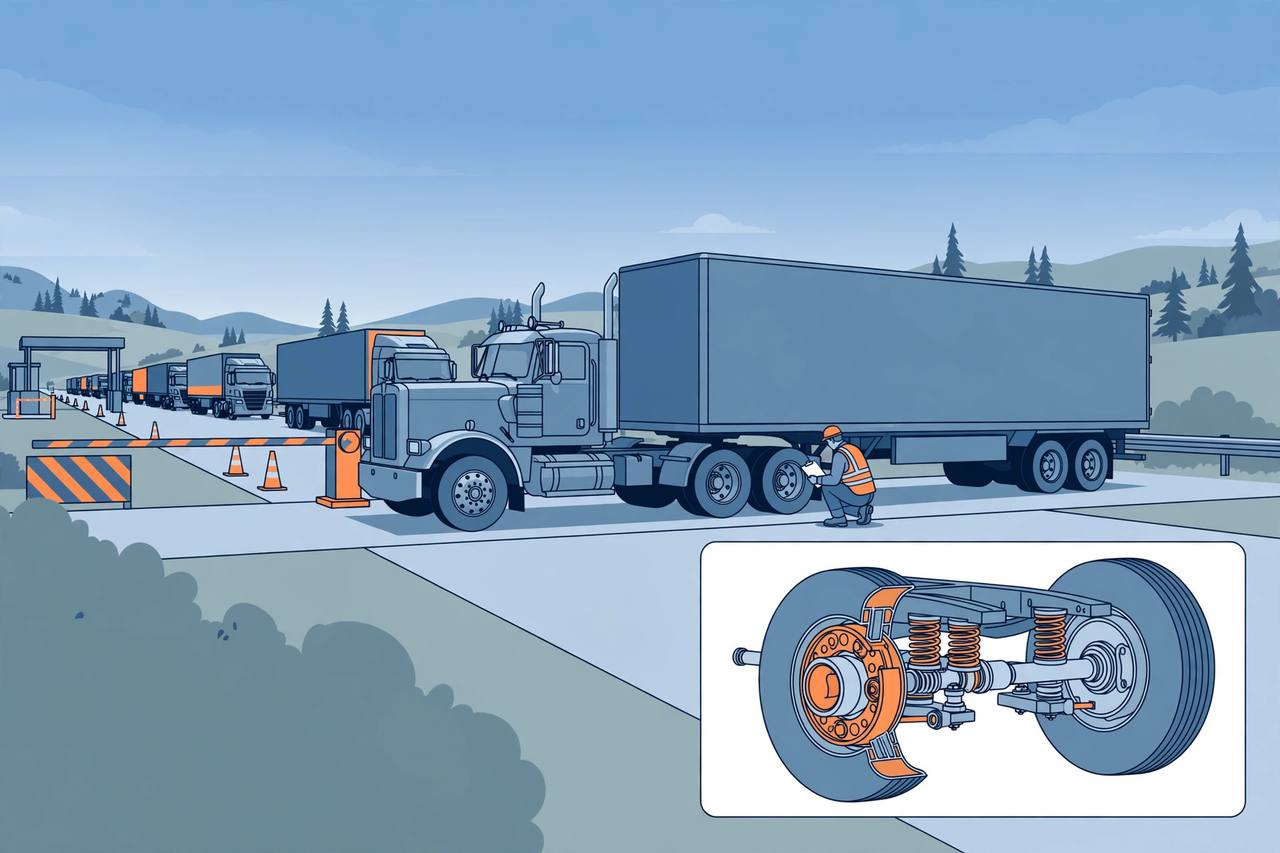
Inspectors across North America put 2,369 commercial vehicles out of service for brake violations during the Commercial Vehicle Safety Alliance's 2026 Brake Safety Week, the alliance announced on Friday, November 6, 2026. The week-long inspection and enforcement blitz ran from August 23 to August 29 in the United States, Canada and Mexico, and its results — released more than two months later — are the trucking industry's clearest annual snapshot of the state of truck brakes on the continent's highways.
Source: CDLLife, Nov. 6, 2026
The United States accounted for the overwhelming share of the work: 14,165 inspections, with 2,134 vehicles placed out of service, a 15.1% rate. Canada recorded 1,306 inspections and 232 vehicles out of service — at 17.8%, the highest rate of the three countries — while Mexico recorded 57 inspections and 3 vehicles out of service, a 5.3% rate. Fifty-one jurisdictions took part, and 91% of the checks (14,150) were full North American Standard Level I inspections, the 37-step procedure that examines both the driver's requirements and the vehicle's mechanical fitness.
Source: CDLLife / ATruckDrivers.com, Nov. 6, 2026
The single biggest failure: too many bad brakes on one truck
Almost half of all the shutdowns — 1,176 vehicles, 49.6% of those placed out of service — failed what inspectors call the 20% defective brake criterion: a vehicle is parked when 20% or more of its service brakes, or of the combination's service brakes, are in an out-of-service condition. In plain terms, these were not trucks with one marginal brake; they were trucks where a fifth or more of the braking system was already defective when the inspector looked.
Behind that came 600 out-of-service violations for brake hoses and tubes, 145 for air loss rate, 92 for steering-axle brake linings and 119 for other steering-axle conditions, plus 759 other brake out-of-service violations covering the tractor protection system, air tanks, parking, emergency and breakaway brakes, low-air warning devices, and hydraulic and electric brakes.
Source: CDLLife, Nov. 6, 2026
This year's focus: drums and rotors
Brake Safety Week 2026 put a special focus on drums and rotors. Inspectors recorded 141 drum and rotor violations and placed 64 vehicles out of service for them. On air disc brakes alone, inspectors found 97 violations — 32 broken rotors, 45 rusted rotors and 20 cases of metal-to-metal contact, where the friction material has worn away entirely and the brake is grinding steel on steel.
Source: ATruckDrivers.com, Nov. 6, 2026
A vehicle placed out of service cannot legally move until the brake defects are repaired. For the driver, that means the load stops where the inspection happened — lost hours or days, a repair bill before the truck rolls again, and a hit to the carrier's safety record. Inspectors check brakes at every level of inspection all year round; Brake Safety Week is a concentrated snapshot, not the only week brakes matter.
How 2026 compares
The 2026 figures are slightly worse than the year before. In Brake Safety Week 2025, inspectors checked 15,175 vehicles and put 2,296 out of service for brake violations, a 15.1% rate. On this year's separate unannounced Brake Safety Day, inspectors checked 4,021 trucks and parked 574, a 14.3% rate. Brake-related violations remain the largest single share of vehicle out-of-service violations found at roadside inspections in North America — which is why this one week of numbers draws industry-wide attention every year.
Source: OTR News (Over the Road News), Nov. 6, 2026
Why this matters to Punjabi and South Asian truckers
Punjabi and other South Asian drivers make up a large share of North America's long-haul trucking workforce, including on the cross-border Canada–US runs that pass through exactly the inspection systems these numbers describe. A brake out-of-service order is one of the most expensive surprises in the job: the truck cannot move until it is fixed, the delivery window is gone, and the violation follows the carrier's record. The cheapest defence is the unglamorous one the data points to — pre-trip checks that actually look at hoses and tubes for chafing and leaks, drum and rotor condition, air loss, and brake adjustment across every axle, not just the steering axle. The August blitz is over, but roadside inspectors apply the same out-of-service criteria every day.
What happens next is already on the calendar. The CVSA has set next year's Brake Safety Week for April 18–24, 2027 — a move from its usual late-August slot — with the alliance's biggest event, International Roadcheck, following on May 11–13, 2027. Drivers and carriers who treat the April week as the deadline for a full brake-system overhaul, rather than a surprise, will be reading next year's results instead of appearing in them.