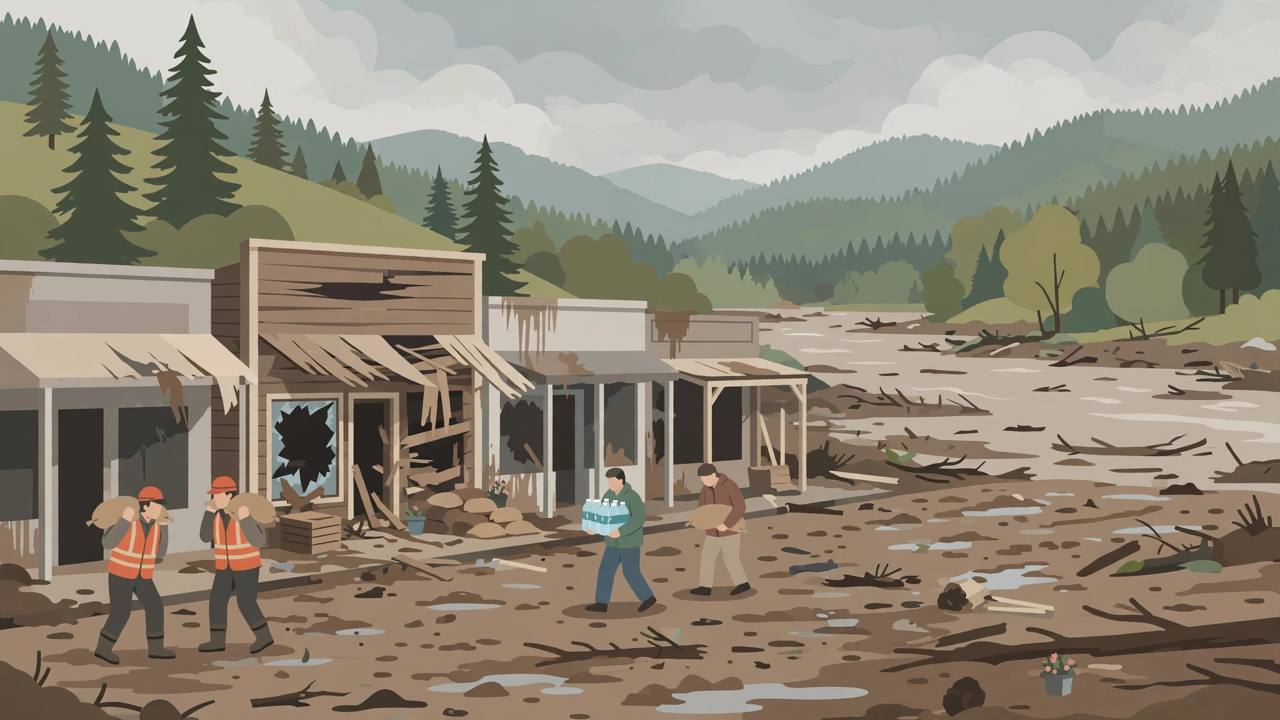
Search teams and cleanup crews were back across the flooded North Georgia mountains on Saturday, November 7, as officials confirmed the first death from Thursday's catastrophic flash floods and identified the victim as Julie Barrs, 56, of Ellijay. This report follows Awaaz Punjab's earlier coverage of the record Toccoa River flood that swamped McCaysville and of the curfew and drinking-water emergency that followed — the death is the first fatality confirmed from that flooding, after officials initially reported no deaths on Thursday.
Source: AccessNorthGA
Barrs died in Murray County after floodwaters swept her car away on Old CCC Camp Road, the Murray County Medical Examiner's Office said, as reported by Fox 5 Atlanta on November 6. According to the sheriff's incident report cited by the Atlanta Journal-Constitution, a caller reported water reaching her chest before she was swept away late on Wednesday night. Searchers found her car on Old CCC Camp Road at about 6 a.m. on Thursday, and her body was found later that day. Georgia Emergency Management Agency Director Josh Lamb confirmed the death, and one additional unexplained injury, at a Friday news conference.
Source: Orbis Weather (AJC, Fox 5 Atlanta, Atlanta News First)
A record river and a 1-in-1,000-year rain
The flood was driven by an overnight deluge late Wednesday into early Thursday, November 4-5. More than 11 inches (280 mm) of rain fell in 12 hours, and National Weather Service meteorologist Luke Culver told the AJC that more than 10 inches of it fell within six hours over the hardest-hit areas south of McCaysville near the Fannin-Gilmer county line and around Blue Ridge. The Tennessee Valley Authority measured 8 to 10 inches overnight between Blue Ridge and Ellijay. The NWS called the downpour over Blue Ridge a '1 in 1,000 year rainfall event' — a storm with about a 0.1% chance of occurring in any given year at a given place.
The Toccoa River rose about 14 feet in seven hours and crested at 18.05 feet at about 7 a.m. on Thursday, beating the previous record of 17.75 feet set in February 1990, according to NWS figures cited by the AJC. Water stood 6 to 7 feet deep in parts of downtown McCaysville on Thursday. Most of the water had receded by Friday, GEMA Director Josh Lamb said.
The rescue total has been finalised well above the first counts. Lamb said on Friday that crews made 100 water rescues in all — 97 in Fannin County and three in Gilmer County. The Fannin County Emergency Management Agency confirmed on Saturday that more than 80 people were rescued in its area alone, up from an initial count of 57 that kept rising as rescue teams submitted their reports. Across the state line in Copperhill, Tennessee, first responders rescued more than 60 people, WSB Radio reported.
'Everyone has lost everything': the cleanup in McCaysville
In McCaysville, the Fannin County town of about 1,000 people at the centre of the flooding, cleanup continued on Saturday with no quick end in sight. Police Chief and Public Safety Director Michael Earley told area media: 'Everyone has lost everything. Our grocery stores, our service stations, our police station, our post office, all affected.' Earley said crews would keep checking homes 'to make sure nobody was left behind,' and said his department had 'lost virtually everything' — its station had reopened only the week before, after repairs from August flooding. Mayor Terry Arp remained optimistic on Friday: 'We're gonna make it. It's going to take a while, but we will, slowly but surely.'
The flood knocked out McCaysville's drinking-water system and shut its municipal water treatment plant, and a boil-water advisory remained in place on Friday. Some houses were swept off their foundations, washed-out roads and culverts cut off several communities in Fannin and Gilmer counties, and Hugh Rogers, owner of McCaysville Drug & Gun, estimated $200,000 to $300,000 in lost inventory. No total damage estimate has been published.
Governor Brian Kemp's state of emergency covers Fannin, Gilmer, Murray and Union counties and runs through 11:59 p.m. on Thursday, November 12. Swift-water crews from Cherokee, Union and Murray counties, the Tri-State Mutual Aid Group and the Georgia Department of Natural Resources helped trapped residents, and the American Red Cross opened a shelter at the Fannin County Recreation Center, 520 Winding Drive, Blue Ridge. A 6 p.m. to 6 a.m. curfew covered a designated downtown area, a federal temporary flight restriction covers the disaster zone, Fannin County schools closed on Friday while Gilmer County students returned, and Gilmer County also declared a local emergency after flooding washed out roads and culverts.
The only death in this flood came after floodwater swept a car off a mountain road at night. Emergency officials repeat the same rule after every event of this kind: never drive or walk into floodwater — its depth cannot be judged at night, and moving water can carry a vehicle away. Stay off closed and washed-out roads, and in McCaysville keep boiling water until officials lift the advisory.
Background: the second major flood this year
McCaysville and its Tennessee twin town, Copperhill, sit either side of the state line on a river that is called the Toccoa in Georgia and the Ocoee once it crosses into Tennessee. This was the second major flood to hit the twin towns this year: flooding in August was classified by the NWS as a 500-year event, and McCaysville's police station had only just finished August repairs when this week's water came through it again. For drivers in the mountains — including the truckers and delivery drivers who work these two-lane corridors — washed-out roads and culverts remain the immediate disruption, with several communities still cut off on Saturday.
What happens next: searches were continuing across the damaged areas on Saturday as officials worked to confirm no one else was missing, damage assessments are expected to feed insurance and aid claims under the governor's disaster declaration, and the state of emergency stays in force until November 12 unless renewed. McCaysville has given no timeline for restoring its water treatment plant. 'Our hearts and prayers go out to all of those affected by this flood. We are here to help,' Lamb said on Friday. Earley put the town's position plainly: 'McCaysville may be down right now, but we are not defeated.'