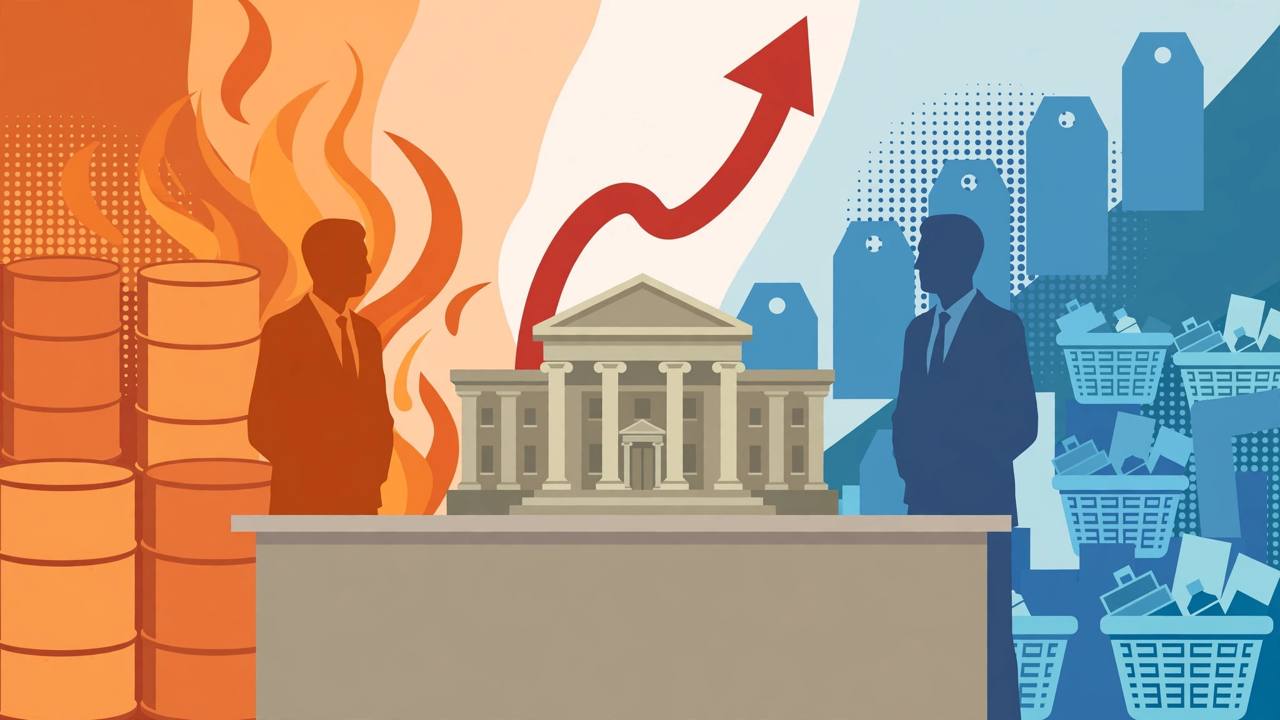
The United States government and its central bank argued in public on Friday about what is really driving American inflation — and whether interest rates need to go higher. Treasury Secretary Scott Bessent told CNBC on Friday, November 13, that the Federal Reserve should not raise rates over inflation he described as an "energy supply shock" tied to the Iran war. Minutes later on the same network, Chicago Fed President Austan Goolsbee contradicted him, saying price pressures have spread far beyond oil into services and medical care, and that the Fed is not on a path back to its 2 percent inflation target.
Source: Reuters
"I think the Fed should understand that this is an energy supply shock," Bessent said in the CNBC interview, arguing that the underlying US economy is very strong. His case, in short, is that a shock coming from energy markets is temporary by nature, and that raising borrowing costs to fight it would punish an otherwise healthy economy.
Goolsbee, appearing on CNBC's Squawk Box shortly afterwards, answered the same question differently. "I respect the secretary and I am trying to figure out the same thing he is trying to figure out, which is how persistent is this inflation? The tariff inflation and oil price shock were supposed to have gone away by now and it hasn't," he said, according to Reuters.
"Not just oil": services, health care and AI demand
"Services inflation, which is probably not coming from tariffs or oil, is one of the more troubling aspects of the inflation reports we have been getting," Goolsbee said. He pointed to price pressures in services and in medical care — categories that do not normally move with the price of crude — and to strong demand tied to the AI data-centre buildout, where construction costs, expensive computer chips and shortages of skilled workers are pushing prices up.
"We have had signs of trouble now for several months in a row if you look at how broad-based the inflation is," Goolsbee said. "In categories that are not driven by oil prices and not driven by tariffs, you are still seeing stalled progress and in some cases going the wrong way." His conclusion was blunt: "Are we on a path back to 2%? My feeling right now is we are not and we've got to deal with that." Earlier the same week he had called October's inflation report "borderline disturbing."
The data behind the argument landed through the week. The October Consumer Price Index, released November 10, rose 0.4 percent on the month against expectations of 0.3 percent, while core inflation rose 0.3 percent for a third straight month. The October Producer Price Index, published by the Bureau of Labor Statistics on November 13, rose 0.3 percent on the month and 6.5 percent from a year earlier — the highest annual reading since November 2022. Truck freight prices inside that report rose 3.9 percent on the month even as the diesel producer-price index fell 7.9 percent.
Where the Fed stands before December
The Federal Open Market Committee held the federal funds rate at 3.75 to 4.00 percent at its October 27–28 meeting, voting 10–2, with Governor Lisa Cook and Cleveland Fed President Beth Hammack dissenting in favour of a 25-basis-point increase. The range itself had been set by a 25-basis-point hike in September. Goolsbee, who votes on rates again in 2027, stopped short of committing to a December hike, but said the Fed "has definitely got work to do to continue to reestablish its credibility," and that incoming inflation data will decide how fast rates need to rise.
Other officials sounded the same alarm the same week. Fed Governor Christopher Waller said in a November 10 speech in London that a 50-basis-point hike should be considered in December. New York Fed President John Williams said on Thursday that "inflation is far too high" and that further tightening will be needed. Fed Vice Chair Philip Jefferson, speaking Friday at a University of California, San Diego economic roundtable, said the path of inflation — not jobs — will guide his vote: the PCE price index rose 3.6 percent in the year to September, core PCE rose 3.1 percent, unemployment stood at 4.1 percent in October, and GDP grew at a 3.4 percent pace in the third quarter.
Markets are treating at least a quarter-point December increase as close to settled, with a roughly 10 to 15 percent chance of a half-point move, depending on the day and the source. Stocks slipped in after-hours trading on Friday after Goolsbee's remarks: the SPDR S&P 500 ETF fell 0.63 percent, the Invesco QQQ Trust fell 0.83 percent and the SPDR Dow Jones Industrial Average ETF fell 0.37 percent.
The Fed's final meeting of the year is December 8–9. The next PCE inflation reading — the Fed's preferred gauge — is due November 25. November's CPI arrives December 10, one day AFTER the rate decision, so the committee will vote without it.
Why this matters beyond Wall Street: the December decision sets the direction of mortgage rates, auto loans and credit-card costs for households across the United States — and, for the Punjabi diaspora's many truck owners and small fleet operators, the cost of financing trucks and carrying fuel and repair bills. If inflation really is only an energy shock, higher rates squeeze those borrowers for no benefit; if Goolsbee is right and inflation has spread into services, waiting makes the eventual tightening harder. That is the argument the Treasury Secretary and a Fed president had, unusually, in front of television cameras instead of behind closed doors.
Goolsbee also pushed back on one common claim: "Wage growth is not a leading indicator of inflation. It's actually a lagging indicator of inflation," he said — meaning pay rises follow prices rather than cause them. For now, both sides say the next inflation reports will settle the argument; the November 25 PCE release is the first test.