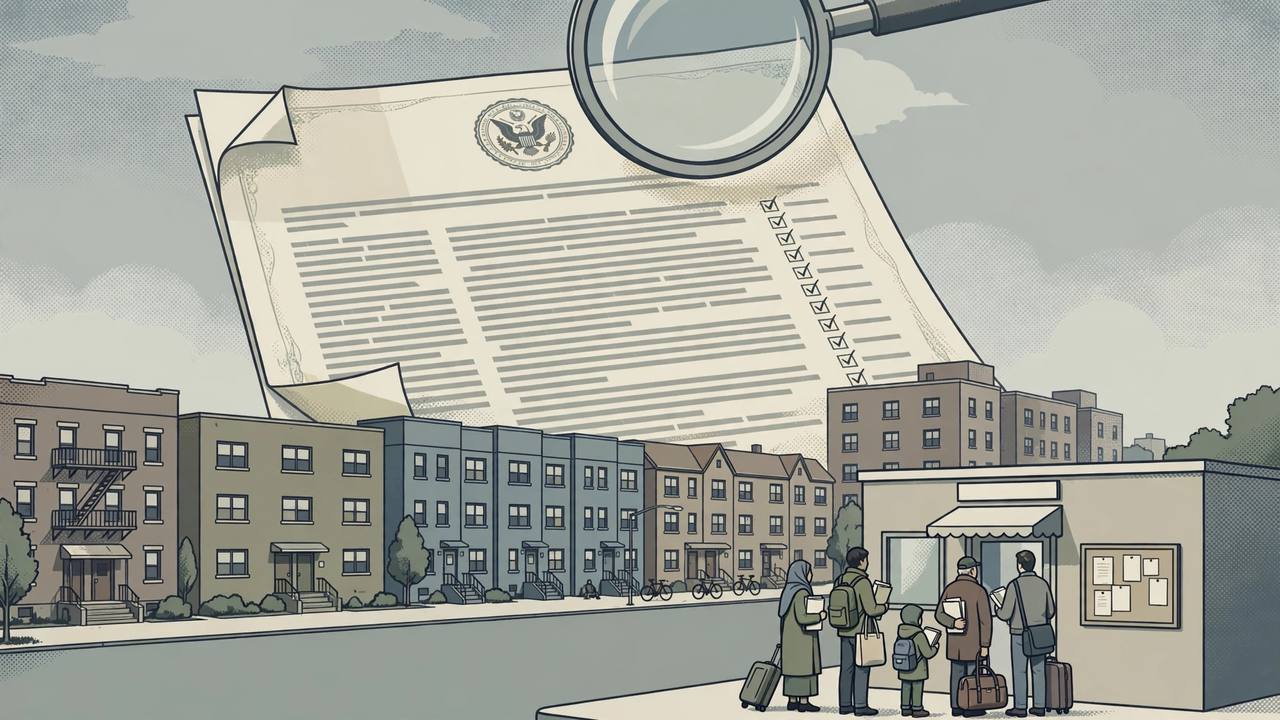
Every person living in federally assisted housing in the United States — every adult, every child and every senior, with no exception for age — will soon have to prove U.S. citizenship or an eligible immigration status, under a final rule the Department of Housing and Urban Development (HUD) published in the Federal Register on Thursday, November 12. The rule, announced by HUD Secretary Scott Turner on November 10, takes effect on December 14, 2026, and it ends the long-standing arrangement that has let so-called mixed-status families — households where some members are eligible for aid and others are not — keep a reduced, “prorated” rent subsidy indefinitely.
Source: HUD press release No. 26-091
The change is one of the most consequential housing moves of the Trump administration's immigration crackdown, because of who lives in mixed-status homes. The Center on Budget and Policy Priorities, a nonpartisan research group, estimated in December 2025 that nearly 80,000 people in about 20,000 mixed-status families could be affected, including nearly 37,000 U.S.-citizen children, NPR reported. Undocumented immigrants themselves do not receive federal rental aid; since the 1990s, however, Congress has allowed them to live with eligible family members while the household's subsidy is cut in proportion to the ineligible members. That is the arrangement now ending.
What the final rule actually changes
The rule — formally titled Verification of Eligible Status, published at 91 FR 72978 under docket FR-6524-F-02 — rests on Section 214 of the Housing and Community Development Act of 1980, which bars HUD assistance for people who are not citizens or in listed immigration categories such as lawful permanent residents, refugees and asylees. Under the final rule, there is no age exemption: children and people aged 62 or older must be verified too. Citizens must sign a declaration and disclose their Social Security number, and people claiming an eligible immigration status must submit evidence for verification.
Source: Federal Register final rule, 91 FR 72978
Two features of the old system disappear entirely. First, the “do not contend” option — under which a family member could decline to claim any status and simply be excluded from the subsidy calculation — is gone; HUD says Section 214 gives no family member the option to skip a status claim. Second, prorated assistance becomes only temporary: reduced help continues only while other members' status is pending final verification, rather than lasting indefinitely. Verification will run primarily through SAVE, the Department of Homeland Security's Systematic Alien Verification for Entitlements database, and families may get up to 60 days in total to produce documents, including an added 30-day extension HUD adopted after public comments.
The rule covers public housing, the Housing Choice Voucher program — widely known as Section 8 — project-based rental assistance, and some Section 236 units. It does not order eligible relatives to move out, and HUD notes they need not leave a unit just because a family member lacks status. In practice, critics say, a family whose subsidy ends must somehow cover the full rent itself or give up the home — the choice they argue the rule is designed to force.
The two sides: waitlists versus “self-evict”
Secretary Turner framed the rule as a fairness measure for Americans waiting for scarce housing help. “We're closing this decades-old loophole,” Turner said on the Fox Business Network. In HUD's announcement he added: “It's unacceptable that America's homeless veterans, disabled, elderly, and victims of domestic violence languish on waitlists while illegals and ineligibles scam our system. American taxpayers will no longer foot the bill.” HUD says a joint HUD-DHS audit of all assisted households identified nearly 200,000 tenants with incomplete or unknown eligibility verification, and that HUD-funded housing reaches only about a quarter of eligible households in need — a shortage that produces years-long waitlists in many cities.
Source: NPR via Montana Public Radio
Housing advocates answered that the rule uses housing policy as an immigration-enforcement tool. “It really looks more like they are trying to deploy HUD for immigration enforcement purposes,” said Marie Claire Tran-Leung of the National Housing Law Project, which opposes the rule. She criticised the reliance on the SAVE system, which the administration revamped to check state voter rolls — a change already facing a legal challenge after the system mistakenly flagged some eligible voters as potential noncitizens — and accused HUD of promoting fear: the administration is focused, she said, “not necessarily on the rights of mixed-status families, but on trying to get them to self-evict.” Advocates also note, as HUD itself acknowledges in the rule, that removing mixed-status families can cost the government more per household, because those families receive a smaller, prorated subsidy than a fully eligible household that replaces them.
HUD's own regulatory analysis puts hard numbers on the transition. The department counts 19,810 mixed families eligible for a temporary deferral of termination, projects that about 990 households — roughly 5 percent — would contest and face formal eviction, and estimates that $167 million to $218 million a year in assistance would move from mixed families to fully eligible households. HUD calls that a transfer, not a saving, and puts the real costs at $17 million to $33 million, mostly one-time administrative work. The analysis also found 19,660 citizens or eligible noncitizens in these programs who have no proof of status on file — people legally entitled to help whose paperwork failures could put their homes at risk if documents are not gathered in time.
A fight that began in 2019 — and what happens next
This is the second attempt to make the change. A similar proposal in 2019 never advanced past the proposal stage and was withdrawn on April 2, 2021. HUD revived it as a proposed rule on February 20, 2026, drawing 16,238 public comments, with groups such as the National Low Income Housing Coalition urging withdrawal; HUD made modest changes in response, chiefly the added 30-day extension and Privacy Act language in the consent form. Because this version is a final rule, reversing it would require a new rulemaking or a court order. A lawsuit under the Administrative Procedure Act is considered likely, and the central legal question will be whether Section 214's text compels ending proration, as HUD argues, or merely permits the current system, as commenters argued — a question judges will answer without deferring to the agency, since the Supreme Court ended Chevron deference in 2024.
The rule takes effect December 14, 2026. Housing agencies and owners must notify affected tenants within 30 days after that date, by January 13, 2027. Families in public housing or using Section 8 vouchers who include members with different immigration statuses — including many immigrant and diaspora households, among them elderly parents living with citizen children — should gather citizenship and immigration documents now and respond to any verification notice within the deadlines, which can total up to 60 days.
The rule sits inside a wider administration pattern of tying federal benefits to immigration status, built on President Trump's executive order titled “Ending Taxpayer Subsidization of Open Borders.” Under Secretary Turner, HUD has signed a data-sharing memorandum with DHS to identify ineligible tenants, revised FHA residency requirements so FHA-backed loans go only to citizens — after which FHA loans for non-permanent residents fell to nearly zero — and demanded that public housing authorities validate the citizenship status of all tenants or risk losing funding. HUD expects the first year of the new rule to bring the most terminations and evictions, while any court challenge works its way through the federal courts.