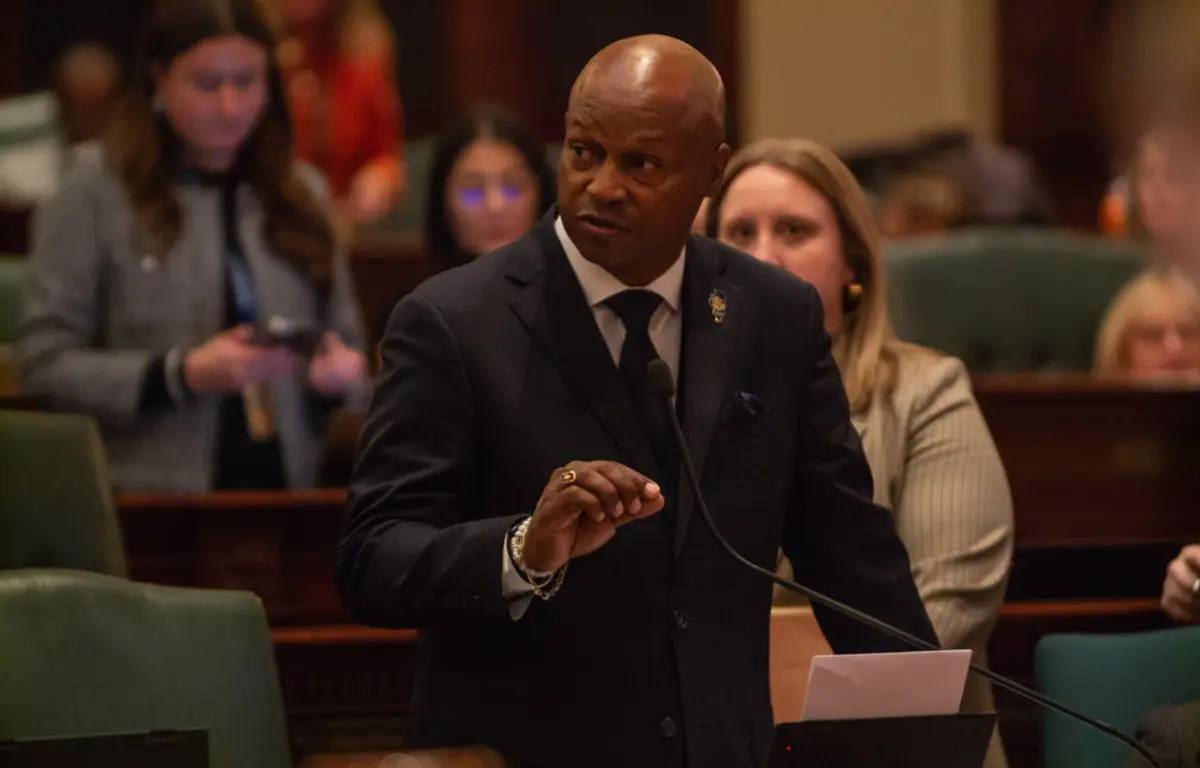
SPRINGFIELD, Illinois — Emanuel “Chris” Welch will not seek another term as Speaker of the Illinois House of Representatives, ending a six-year run in the most powerful seat in the state legislature just days after his party won its largest majority in more than four decades. Welch announced the decision in a statement on Thursday afternoon, November 5, after 26 incumbent and incoming House Democrats publicly said the supermajority caucus “needs new leadership” and that they would not support him for another term.
“I am proud of this work, but I serve at the pleasure of the caucus, and I want our caucus to lead in unity and take on the mandate we received from voters this past election confidently,” Welch said in the statement. He said he will step aside and continue as a regular member of the caucus so a new speaker can take his place, adding that he has always told members “our time in this space is finite.”
Source: Capitol News Illinois
The math that ended it
House Democrats are expected to hold 84 or 85 seats in the next General Assembly after a strong showing in Tuesday's elections. That size made the revolt decisive rather than symbolic: even if nobody else joined them, the 26 holdouts are enough to deny Welch the 60 votes needed to keep the gavel, as long as they stick together and he receives no Republican support. “I don't see a path to 60,” Rep. Mary Beth Canty of Arlington Heights, one of the signatories, told Capitol News Illinois. Multiple sources told the news service that opposition inside the caucus runs beyond the 26 who signed.
The signatories — 19 women and seven men, according to WAND's reporting of the letter — cut across every regional, racial and ideological subcaucus, are nearly three-quarters women and are majority suburban. Most strikingly, four members of Welch's own handpicked leadership team signed: Reps. Eva-Dina Delgado of Chicago, Lisa Hernandez of Cicero, Bob Morgan of Deerfield and Katie Stuart of Edwardsville. Hernandez also chairs the Democratic Party of Illinois. Rep. Jessica Dixon Heitman of Plainfield, who succeeded former Rep. Harry Benton, signed as well. “We represent a broad spectrum of our caucus, and each have come to this decision for our own reasons,” the group wrote late Wednesday. “We look forward to a robust race for a new Speaker of the House.”
The Benton scandal at the centre of the revolt
Welch's decision follows months of criticism over his handling of sexual harassment allegations against former Rep. Harry Benton, a Democrat from Plainfield, as well as broader complaints about his leadership style across three terms presiding over the House. A legislative inspector general report published in July revealed that Welch's office knew about an allegation made by a former district staffer against Benton as early as April 2023, but did not address it with Benton until July of that year. The staffer did not file a complaint with the inspector general, and Welch continued to back Benton; the House Democratic campaign arm Welch controls ultimately spent $1.4 million supporting Benton's 2024 re-election bid.
Only in February, after two additional allegations — by a female lobbyist and a female House district director — were deemed founded by the inspector general, did Welch remove Benton from the House Democratic caucus and strip his committee assignments. Benton later resigned his seat in July. A Chicago Tribune story this summer also detailed Welch's own interactions with the staffer who made the first allegation, including reacting to her Instagram photos and inviting her to a bar through an encrypted messaging app; Welch told Capitol News Illinois earlier this year he was “embarrassed” by the interactions and apologized. The allegations against Benton and the details of Welch's interactions are reported accounts that Welch and Benton have addressed only in part; Benton has not been charged in connection with the allegations described in the inspector general process.
Welch responded this summer by forming a Democrat-only working group on how the General Assembly handles sexual harassment and workplace culture — but announced it without publicly naming its members, and a list was later leaked by an ally of the speaker. Three members on that list withdrew: Reps. Kelly Cassidy of Chicago, Gregg Johnson of East Moline and Tracy Katz Muhl of Northbrook. All three signed the statement opposing another Welch term. “They weren't honest with me,” Johnson told Capitol News Illinois. “They just weren't.” Members have also criticized Welch for supporting Rep. Murri Briel of Ottawa, who has been accused of inappropriate behaviour by multiple former staffers, including her former chief of staff, who said Briel sexually harassed her. Briel denies the claims.
Other fractures: money, discipline and the 60-vote rule
The leadership fight was not only about the Benton case. In September, Welch pulled his caucus out of the Democratic Party of Illinois' coordinated campaign in a dispute over financial contributions — a split that cut his members off from the state party's steep postage discount on campaign mailings, even though his own leadership-team member Hernandez chairs the party. He stripped Rep. Fred Crespo of Hoffman Estates of his committee chairmanships and expelled him from the caucus for working on a budget plan independent of leadership; Crespo signed the letter. Members, and at times Gov. JB Pritzker's team, have also expressed frustration with Welch's unofficial rule that a bill needs 60 Democrats behind it before it is called for a House vote — a practice blamed for stalling Chicago Bears stadium legislation and for temporarily blocking Pritzker's push to regulate intoxicating hemp products. “The whole (Democratic) Caucus has been a circus,” Rep. Larry Walsh Jr. of Elwood told the Farmers Weekly Review. “There is no organization, no consistency.”
A historic speakership, ending early
Welch was elected speaker in January 2021, becoming the first Black speaker in Illinois history, after former Speaker Michael Madigan stepped aside when 19 House Democrats announced they would no longer support him amid a sexual harassment scandal in the House and a widening federal investigation. Madigan, the longest-serving state House speaker in American history, was later incarcerated over the bribery scheme at the centre of that investigation. Welch himself had to answer questions in 2021 about past treatment of women, including domestic violence allegations and sexual harassment claims from his time as a school board member in Proviso Township, before skeptical Democrats were satisfied and elected him. Those were allegations, which he addressed at the time; they are part of the record members weighed again this week.
The timing makes the fall sharper: Democrats are set to gain six to seven seats and hold the largest House majority either party has ever had under the 118-member, single-member district system created in 1983 — a result built partly on a legislative map Welch helped push through in his first year and on money he raised for the caucus. “We set out to protect our incumbents, expand our majority, and make sure members had the resources necessary to compete and win,” Welch said in an election-night release. “Tonight, we delivered on that promise.” Two of the members elected with the help of Welch-controlled campaign money, Dixon Heitman and Rep.-elect Maria Peterson of North Barrington, signed the letter asking him to go.
What happens next
The formal vote for speaker does not happen until the new General Assembly is inaugurated on January 13, 2027, but the real contest will move much faster. Legislative caucuses traditionally hold their internal leadership elections when they return to Springfield for the veto session, scheduled for November 17–19 and December 1–3, giving the caucus more than two months to settle on a successor. Four of the signatories — Canty, Cassidy, Katz Muhl and Walsh — issued a joint statement welcoming Welch's decision and insisting the process to choose the next speaker be “deliberate and intentional,” without “a finger on the scale from the current Speaker's operation.” Canty, who chairs the House Democratic Women's Caucus, said “it is time for us to look to women to lead us.” Rep. Robyn Gabel's name has been floated as a potential successor, though Gabel told The Center Square before Welch's announcement she was not sure she is interested in the job. No candidate has formally declared.
For readers in the Chicago area — home to one of the largest Punjabi communities in the Midwest and to thousands of Punjabi truckers who run the I-55, I-80 and I-94 freight corridors through Illinois — the choice of speaker is not an inside-baseball story. The speaker controls which bills reach the House floor, from the state budget and road funding to hemp regulation and stadium financing, and the next speaker will inherit a record supermajority and a caucus that has just shown it will remove a leader who loses its confidence.