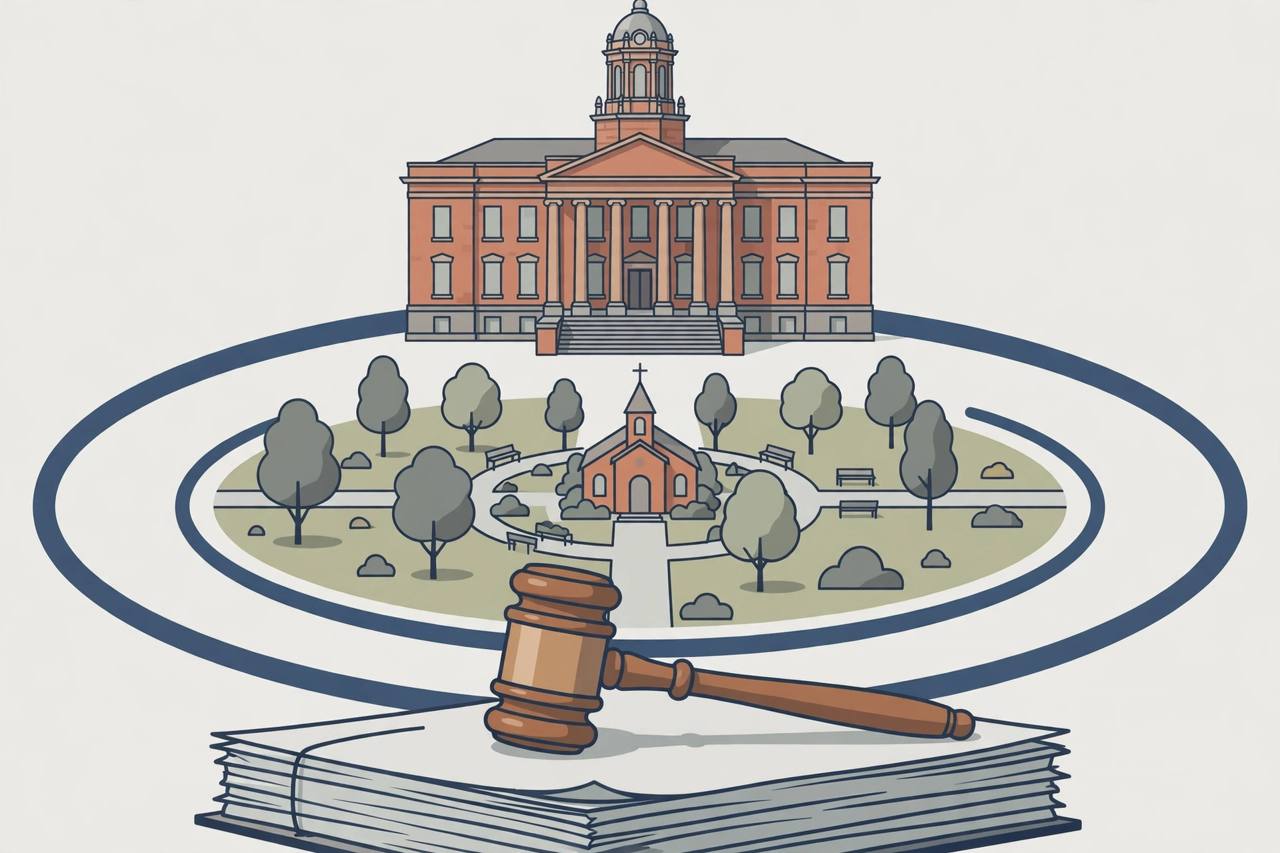
A federal judge in Maryland sided with Montgomery County on Monday, November 9, dismissing with prejudice the U.S. Justice Department's lawsuit against the county's law banning firearms within 100 yards of certain places, including houses of worship, and denying the department's request for a preliminary injunction that would have blocked enforcement of the law. U.S. District Judge Theodore Chuang issued the ruling in a 33-page opinion, Bethesda Today reported Monday.
Source: Bethesda Today (Bethesda Magazine), Nov. 9, 2026
Dismissal “with prejudice” is the strongest form of the outcome for the county: the Justice Department's case is permanently closed in the district court and cannot be refiled there. Judge Chuang's opinion, in United States v. Montgomery County, Maryland, No. 8:26-cv-03025-TDC, found that the department had failed to allege the law-enforcement “pattern or practice” of constitutional violations that the statute it sued under requires — and the opinion expressly did not decide whether the county's ordinance itself violates the Second Amendment, according to a detailed summary of the opinion's opening and closing pages published the same day.
What the county law does
Montgomery County's law — enacted as Expedited Bill 23-26 — bars carrying firearms in or within 100 yards of “places of public assembly,” a category that includes houses of worship, along with other gathering places. The ban carries narrow exceptions, including for law enforcement and licensed security guards. One hundred yards is roughly the length of a football field, so in the county's dense suburban neighbourhoods — Silver Spring, Bethesda, Rockville and Gaithersburg among them — the buffer zones around churches, synagogues, mosques, temples, schools, parks and libraries overlap across whole blocks, which is exactly the breadth the Justice Department attacked.
The legal theory the court rejected
The Justice Department sued on August 3, arguing the county law is “breathtaking in scope” and likely unconstitutional. For its authority to sue a local government at all, the department relied on a provision of the Violent Crime Control and Law Enforcement Act of 1994 — codified at 34 U.S.C. § 12601 — which authorizes the attorney general to sue a law-enforcement agency that “engages in a pattern or practice of conduct” depriving people of constitutional rights. Congress passed that statute in response to the Los Angeles police beating of Rodney King; it was written for patterns of police misconduct, and Chuang's opinion held that the department's complaint did not allege such a pattern.
“Under our system of government, the federal government should not have unfettered authority to intrude on the actions of state and local governments,” Chuang wrote. “Congress, not the Executive Branch, should decide when such intrusions are warranted by the need to protect individual rights.” At an October 1 hearing at the federal courthouse in Greenbelt, the judge had already signalled his concern: a ruling for the department, he said, could mean the federal government could sue “any local government for almost any law.”
Arguing for the county at that hearing, attorney Jeffrey Schwaber said “no policy is enough” on its own to let the Justice Department sue under the statute. Even if county officers had made arrests under the law, Schwaber argued, the department would still have to prove those arrests formed a “pattern or practice” of violating rights — for example, arrests carried out with excessive force or enforced only against certain groups. The county also put a practical fact on the record: a spokesperson for the Montgomery County State's Attorney's Office, Lauren DeMarco, previously told Bethesda Today that no one in the county had been arrested or charged under the law, and the office did not intend to prosecute gun violations under it while the constitutional challenges were pending.
Judge Chuang dismissed the Justice Department's suit on the “pattern or practice” pleading ground. He did not rule that the county's 100-yard ban is constitutional under the Second Amendment — that question is not answered by this opinion and remains live in a separate case brought by a Silver Spring synagogue and its rabbi.
The county's response, and Washington's silence
Montgomery County Executive Marc Elrich, a Democrat, welcomed the ruling in a statement Monday afternoon. “I am pleased that this legal challenge has been resolved in the County's favor,” Elrich said, calling the decision “an important affirmation of the County's responsibility to protect public safety, uphold the law, and exercise its authority to safeguard the communities we serve,” and adding: “We will continue to stand by our responsibility to keep Montgomery County safe and to ensure that our public spaces remain places where residents can gather with confidence.” The Justice Department did not respond to Bethesda Today's request for comment on Monday.
Background: the synagogue case running beside this one
The county's law still faces a separate federal challenge filed by the Silver Spring Jewish Center and a rabbi from the congregation — a case that tests the same 100-yard rule from the other side, on Second Amendment and religious-freedom grounds. In that case, U.S. District Judge Deborah Chasanow ruled that congregation members may carry firearms inside their synagogue, but on October 27 she refused to extend that protection to the walk to synagogue — the path Rabbi Menashe Shapiro takes on the Sabbath passes within 100 yards of nine other places of public assembly, and congregants who observe Shabbat cannot use the law's vehicle exemption because they walk. Litigation in that case is ongoing, so the legal fight over the 100-yard zones is narrowed by Monday's ruling, not ended by it.
For readers in Maryland's large immigrant communities — Montgomery County is one of the most diverse counties in the United States, and its houses of worship include gurdwaras, temples and mosques alongside churches and synagogues — Monday's ruling has a practical meaning either way the remaining case goes: the county's 100-yard rule stays in force for now, the federal government's attempt to strike it down in one stroke has been closed with prejudice, and the only challenges left are the slower, case-by-case kind, brought by the people and congregations the rule directly touches.
What happens next: because the dismissal is with prejudice, the Justice Department cannot simply refile the same lawsuit in the district court; its remaining route would be an appeal to the U.S. Court of Appeals for the Fourth Circuit, and the department had announced no such step as of Monday evening. The Silver Spring Jewish Center case continues in the same district court, and it is that case — not this one — that will decide whether the 100-yard ban itself survives the Second Amendment.