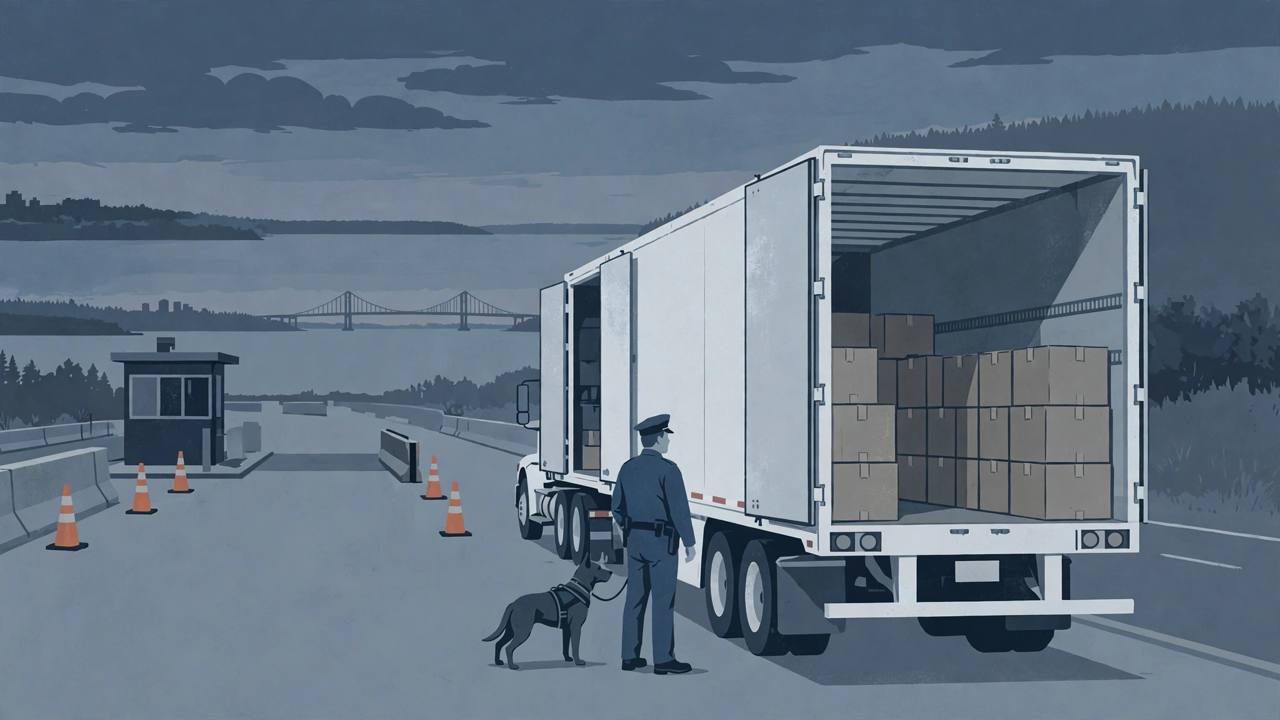
A Canada-bound semi that left Laredo, Texas, never reached the border. Michigan State Police troopers who stopped the truck in St. Clair County found 205 pounds of cocaine — an estimated $2 million worth — hidden inside the trailer, and the 27-year-old driver is now in federal custody, according to MLive's reporting on the stop and the federal case.
Source: MLive (Michigan), reporting on the Michigan State Police stop and the federal case
The truck was hauling a semi-trailer from Laredo to Canada and carried Ontario licence plates, MLive reported. The stop turned on a small detail: a trooper noticed that the serial number on the lock securing the trailer's cargo did not match the number listed on the vehicle's shipping manifest.
Source: MLive (Michigan), reporting on the Michigan State Police stop and the federal case
A lock that did not match the paperwork
Because the lock and the manifest disagreed, the Department of Homeland Security was called to the scene, along with a K-9 unit, according to the reports. After the dog alerted to something inside the trailer, agents opened the doors and found four garbage bags containing bricks of a white powdery substance wrapped in cellophane and vacuum-sealed. The substance was tested and confirmed to be cocaine, the reports said.
Source: WGRD 97.9 (Townsquare Media), reporting MLive's account
Authorities seized the full 205 pounds before the load could be transported across the Canadian border, according to MLive. St. Clair County is Michigan's border county on the St. Clair River, where the Blue Water Bridge at Port Huron carries one of the busiest truck crossings between the United States and Ontario — the last stretch of road a Canada-bound load travels before it leaves the country.
Source: MLive (Michigan), reporting on the Michigan State Police stop and the federal case
The seal trail: intact in Texas, missing in Indiana, yellow in Battle Creek
The driver told investigators he knew nothing about the drugs, MLive reported. But investigators reviewing the truck's shipping records found a timeline that did not line up with an untouched trailer. The trailer's bolt seal was recorded as intact during an inspection in Campbell, Texas, on October 29. When the trailer was checked again the following day in Terre Haute, Indiana, the seal was missing, according to the reports.
Source: WGRD 97.9 (Townsquare Media), reporting MLive's account
A review of the driver's cellphone records then produced another piece of that trail, investigators said: a photo taken in Battle Creek, Michigan, showing a yellow seal on the trailer rather than the original white one. While agents were examining the phone, a message arrived on Signal, the encrypted messaging app, according to the reports. Investigators have not publicly said who sent that message or what it contained, and the arrival of a message on an encrypted app is not itself evidence of a crime — it is one detail in a file that prosecutors will have to prove in court.
Source: WGRD 97.9 (Townsquare Media), reporting MLive's account
The case was built out of paperwork every long-haul driver handles: a manifest, a lock serial number and a bolt seal. A seal that is intact at one inspection and missing at the next is exactly the gap investigators look for, and a seal whose colour changed along the route became a central fact in the file. Drivers who pick up sealed loads protect themselves by photographing the seal at pickup, checking it at every stop, and reporting any mismatch before moving — the same records that convicted no one yet in this case are the records that can clear a driver who never touched the load.
The charge, and what the law does with five kilograms
The driver, who was not named in the reports, was arrested and charged with possession of more than five kilograms of cocaine with intent to distribute, MLive reported. He will remain in custody as he awaits trial in federal court. The five-kilogram line matters: in federal law it is the top quantity tier for cocaine trafficking, and a conviction at that tier carries a mandatory minimum prison term measured in years, not months — which is why cases built on a roadside stop in a border county are prosecuted federally rather than in a county court.
Source: MLive (Michigan), reporting on the Michigan State Police stop and the federal case
Why this corridor keeps producing these cases
The Laredo-to-Canada run is one of the longest regular freight corridors in North America, and it passes through the working lives of thousands of Punjabi and South Asian truckers who drive legal loads between Texas, the Midwest and Ontario every week. Enforcement agencies on both sides of the border say smuggling organisations prize exactly that traffic: a legitimate sealed load, on a legitimate manifest, is the best cover a hidden load can have. Commercial vehicle inspections — weigh stations, rest-area checks and manifest reviews by units such as the Michigan State Police Commercial Vehicle Enforcement Division — are the net that cover is meant to slip through, and this week the net caught one at the last county before the bridge.
Source: WGRD 97.9 (Townsquare Media), reporting MLive's account
What happens next
The driver remains in custody pending his federal case, where prosecutors will have to prove he possessed the cocaine with intent to distribute it — and where the defence will be able to test the claim that he did not know what was in the four bags. Investigators have not announced any further arrests, named the carrier, or said who loaded the trailer or swapped its seal between Campbell, Texas, and Terre Haute, Indiana. Those unanswered questions — who put the bags in, and who was waiting for them in Canada — are where the wider investigation points from here.
Source: MLive (Michigan), reporting on the Michigan State Police stop and the federal case